
Conversational Thai for Beginners: 40 Essential Phrases
Affiliate disclosure: This article contains affiliate links. We may earn a small commission at no extra cost to you. As an Amazon Associate, we earn from qualifying purchases.

About the reviewer

Phuut Editorial Team
Thai Language Learning
The editorial team behind Phuut, a Thai-learning app for English-speaking learners. Includes Bangkok-based staff who share real-world Thai usage and study techniques.
Follow Phuut on X →You’re standing at a Bangkok street stall at 10pm. The vendor looks up. The pad kra pao smells exactly right. You open your mouth — and every phrase you half-remember from the internet comes out garbled or wrong because no resource told you the tones.
This article covers conversational Thai for beginners in the way that actually helps: 40 phrases across four real-world scenes, each with Thai script, Paiboon romanization, and a tone label. Not just what to write — what to say.
In this article:
- Thai greetings and the polite particle that changes everything
- Thai script vs. romanization — what you actually need
- Street food Thai — 12 phrases to order, pay, and compliment the cook
- Market bargaining and shopping — 10 phrases including the one that gets you a discount
- Taxis and transport — 8 phrases that protect you from tourist pricing
- How to actually practice these phrases (not just read them)
Start Here — Thai Greetings and the Polite Particle That Changes Everything
The greeting สวัสดีครับ/ค่ะ (sà-wàt-dii khráp/khâ) is not just one phrase. It’s a framework. Once you understand what makes it work, you can apply its structure to almost any sentence you produce in Thai.
Here’s why this matters more than adding vocabulary.
Thai conversation depends heavily on two structural elements: the greeting head (สวัสดี) and the polite tail particle (ครับ (khráp) for men, ค่ะ (khâ) for women). Foreigners who skip the particle sound abrupt — not rude necessarily, but flat in a way that closes doors. Foreigners who use both are received with patience and goodwill almost universally, even if the rest of the sentence is broken.
This isn’t a grammar observation. It’s a social one. The particle isn’t decoration; it signals your awareness that Thai conversation has rules of courtesy, and that you’re attempting to follow them.
Watch the particle do its work across five different situations — the same ครับ/ค่ะ tail converts each one into an appropriately polite form:
- Greeting: สวัสดีครับ (sà-wàt-dii khráp) — the complete hello
- Thank you: ขอบคุณครับ (khòp-khun khráp) — a thank you that lands warm
- Price question: เท่าไหร่ครับ (thâo-rài khráp) — a price question, not a demand
- Apology: โทษทีครับ (thôot-thii khráp) — excuse me, with genuine courtesy
- Goodbye: ลาก่อนครับ (laa-gòon khráp) — a farewell that leaves a good impression
Five different functions. One particle. You don’t need separate vocabulary for each — you need ครับ or ค่ะ and the word at the front. That’s the structural efficiency of Thai politeness, and it’s why learning the particle before anything else is the highest-ROI move in beginner Thai.
Once you have the greeting + polite particle pair, you have the social scaffolding to attempt any phrase in this article and have it land the way you intended.
Greetings phrase table (10 phrases)
| Thai | Paiboon | Tone contour | Meaning | Note |
|---|---|---|---|---|
| สวัสดีครับ | sà-wàt-dii khráp | LOW-DROP-FLAT / HIGH | Hello (male) | Any time of day; formal or casual (ครับ is phonemically high tone; de-stressed in natural speech) |
| สวัสดีค่ะ | sà-wàt-dii khâ | LOW-DROP-FLAT / DROP | Hello (female) | Statement form; use khá (rising) when asking |
| ขอบคุณครับ/ค่ะ | khòp-khun khráp/khâ | DROP-FLAT | Thank you | Works for any favor, any context |
| ไม่เป็นไรครับ/ค่ะ | mâi-pen-rai khráp/khâ | DROP-FLAT-FLAT | No problem / you’re welcome | Also: don’t worry about it |
| ยินดีที่ได้รู้จักครับ/ค่ะ | yin-dii-thîi-dâi-rúu-jàk khráp/khâ | FLAT-FLAT-DROP-DROP-RISE-DROP | Nice to meet you | First introductions |
| สบายดีไหมครับ/ค่ะ | sà-baai-dii mái khráp/khâ | LOW-FLAT-FLAT RISE | How are you? | Casual check-in with someone you know |
| สบายดีครับ/ค่ะ | sà-baai-dii khráp/khâ | LOW-FLAT-FLAT | Fine, thanks | Standard response |
| แล้วเจอกัน | láew-jooe-gan | RISE-FLAT-FLAT | See you later | Informal parting |
| ลาก่อนครับ/ค่ะ | laa-gòon khráp/khâ | FLAT-LOW | Goodbye (formal) | More formal than แล้วเจอกัน |
| โทษทีครับ/ค่ะ | thôot-thii khráp/khâ | DROP-FLAT | Excuse me / sorry | Bumping into someone; mild apology |
Thai Script vs. Romanization — What You Actually Need to Hold a Conversation
You can begin speaking Thai today without reading a single character of Thai script. But there’s one thing worth understanding about the romanization debate before you commit to a learning method — it’ll save you months of frustration.
Most beginner resources use inconsistent romanization. The same greeting gets spelled “sawadee” on one site, “sawasdee” on another, and “sà-wàt-dii” on a third. Three spellings, one greeting, and none of them tell you whether the first syllable falls or rises.
This is why Paiboon romanization exists, and why this article uses it throughout. Paiboon marks each syllable’s tone with a diacritic. You can read a Paiboon-romanized word and know exactly how to say it — not just roughly, but precisely enough to be understood.
Here’s the same greeting written four ways:
| System | Spelling | Does it tell you the tone? |
|---|---|---|
| Tourist romanization (variant 1) | sawadee | No |
| Tourist romanization (variant 2) | sawasdee | No |
| Tourist romanization (variant 3) | sa-wat-dee | No |
| Paiboon | sà-wàt-dii | Yes — LOW-DROP-FLAT |
Only Paiboon tells you the first syllable drops and the last one is flat. The tourist spellings are guesses at pronunciation that leave out the most important information.
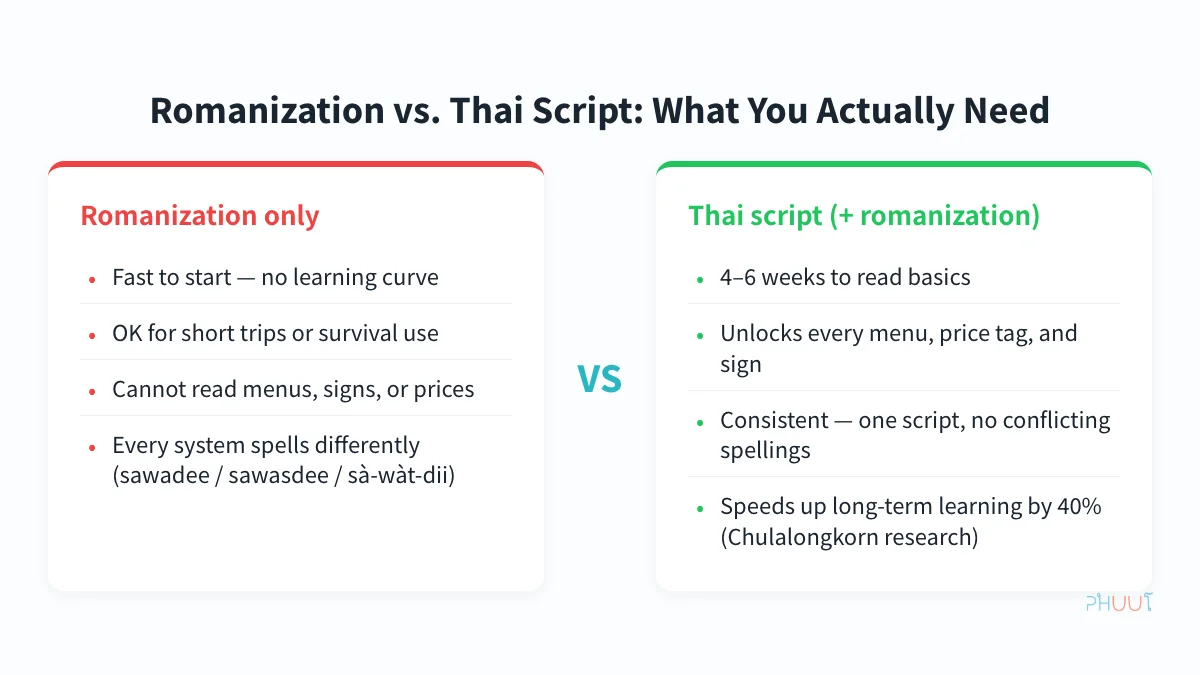
The practical path: use Paiboon now for learning to speak. Add Thai script over the following 4–6 weeks. Learners who engage with the script early in their studies progress faster in the long run — reading the script gives you access to menus, price tags, signs, and any written Thai, which is how you get independent from the romanization crutch.
Street Food Thai — 12 Phrases to Order, Pay, and Say It Tastes Great
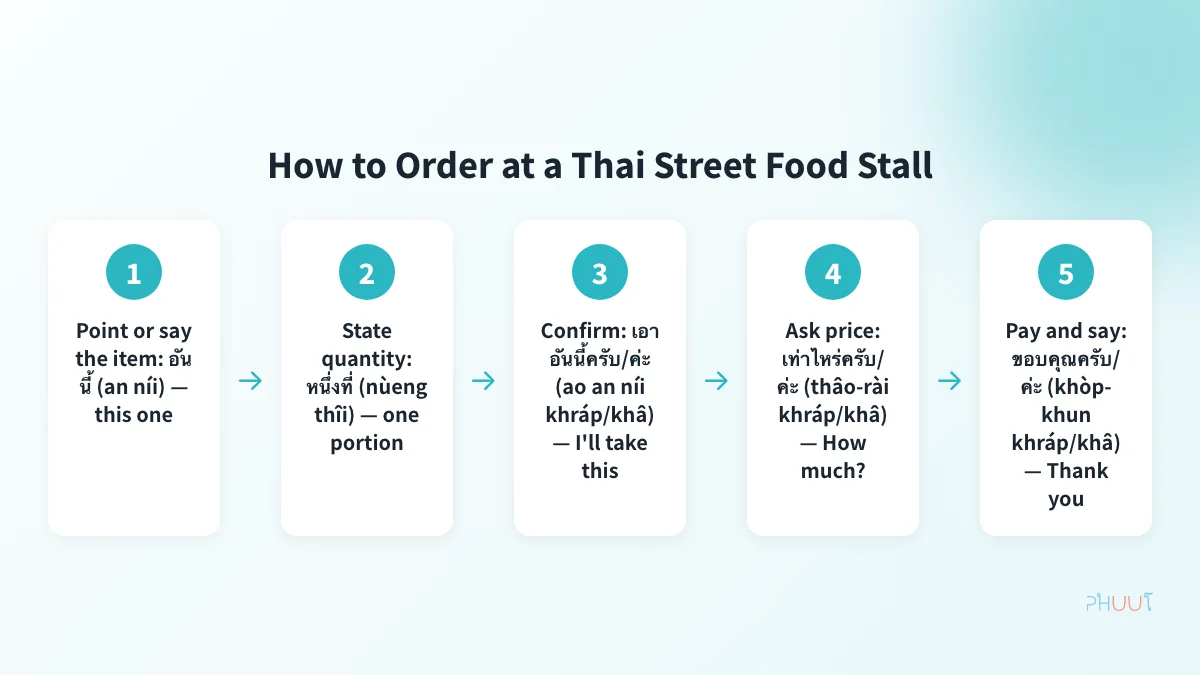
Street food interactions follow a predictable five-beat script: arrive, look, point, confirm price, pay. Knowing 12 phrases covers the entire loop, every time.
This is the highest-frequency beginner conversation scenario in Thailand. Vendors at street stalls deal with foreigners constantly — they’re patient, they’re good at reading intent, and a smile plus the right particle goes a long way. It’s the ideal place to build spoken confidence because the stakes are low (worst case: you get something slightly different from what you wanted) and the repetition is high.
Here’s how a complete ordering interaction runs:
A word on tones and minimal pairs: อร่อย (a-ròoi) means “delicious.” If you say it with a flat, unexpressive tone — like reading an English word with no inflection — it can blur into something the vendor doesn’t quite register as the compliment you intended. This isn’t catastrophic. But it is the difference between a smile and a polite nod. Tones at a street stall matter, not because you’ll be misunderstood every time, but because getting them right is what makes the interaction feel like a conversation rather than a transaction.
Street food phrase table (12 phrases)
| Thai | Paiboon | Tone contour | Meaning | Usage note |
|---|---|---|---|---|
| อันนี้ครับ/ค่ะ | an-níi khráp/khâ | FLAT-HIGH | This one | Point at item while saying |
| หนึ่งที่ครับ/ค่ะ | nùeng-thîi khráp/khâ | LOW-DROP | One portion | Add สอง (sǒong) for two, สาม (sǎam) for three |
| เอาอันนี้ครับ/ค่ะ | ao-an-níi khráp/khâ | FLAT-FLAT-HIGH | I’ll take this one | Confirms your choice |
| เท่าไหร่ครับ/ค่ะ | thâo-rài khráp/khâ | DROP-LOW | How much? | Universal price question |
| ไม่เผ็ดครับ/ค่ะ | mâi-phèt khráp/khâ | DROP-LOW | Not spicy | Critical for many Western palates |
| เผ็ดนิดหน่อย | phèt-nít-nòoi | LOW-HIGH-LOW | A little spicy | Mild-spice request |
| เผ็ดมากครับ/ค่ะ | phèt-mâak khráp/khâ | LOW-DROP | Very spicy | For heat-seekers |
| อร่อยมากครับ/ค่ะ | a-ròoi-mâak khráp/khâ | FLAT-DROP-DROP | Very delicious | Compliment the vendor — always lands well ⚠ tone-sensitive: wrong pitch blurs the compliment |
| ขอน้ำเปล่าด้วย | khǒo-nám-plào-dûuay | RISE-FLAT-LOW-DROP | Water too, please | Add ครับ/ค่ะ to complete |
| ใส่ถุงด้วยครับ/ค่ะ | sài-thǔng-dûuay khráp/khâ | LOW-RISE-DROP | In a bag please | Takeaway order |
| รับบัตรเครดิตไหม | ráp-bàt-khree-dìt-mái | HIGH-LOW-FLAT-LOW-RISE | Do you accept credit cards? | Most stalls are cash only — useful to check |
| ขอใบเสร็จด้วยครับ/ค่ะ | khǒo-bai-sèt-dûuay khráp/khâ | RISE-FLAT-LOW-DROP | Receipt please | Guesthouses and shops; stalls rarely have these |
Twelve phrases, committed to memory, make every street food interaction in Thailand a language practice session instead of a pointing-and-guessing exercise.
Market Bargaining and Shopping — 10 Phrases Including the One That Gets You a Discount
Thai markets — from Chatuchak in Bangkok to any provincial night market — run on a two-phase interaction: establish the price, then negotiate from it. Each phase has a standard phrase. Know both and the vendor treats you as a participant, not a tourist target.
The phrase that opens negotiations is ลดได้ไหมครับ/ค่ะ (lót-dâi-mái khráp/khâ — “Can you reduce the price?”). It’s high-ROI for two reasons. First, it actually works — market stall vendors often come down 10–20% from the opening price. Second, it signals cultural awareness. Asking politely in Thai with a smile tells the vendor you know how the interaction is supposed to go. Even when they say no, the goodwill stays.
One boundary: fixed-price shops (7-Eleven, department stores, pharmacies) are not bargaining contexts. Using ลดได้ไหม at a 7-Eleven will get a confused stare. This phrase is for open markets and independent stalls only.
Here’s how a full bargaining exchange runs:
- You: ราคาเท่าไหร่ครับ/ค่ะ (raa-khaa-thâo-rài khráp/khâ) — “How much is it?”
- Vendor: gives a price
- You: ลดได้ไหมครับ/ค่ะ (lót-dâi-mái khráp/khâ) — “Can you reduce the price?” [smile]
- Vendor either comes down, or holds firm
- If they come down and you agree: เอาราคานี้ได้เลย (ao-raa-khaa-níi-dâi-looei) — “I’ll take it at this price”
The smile is not optional. In Thai market culture, negotiation is a social exchange, not a confrontation. Cheerful and lighthearted closes deals. Aggressive doesn’t.
Market and shopping phrase table (10 phrases)
| Thai | Paiboon | Tone contour | Meaning | Usage note |
|---|---|---|---|---|
| ราคาเท่าไหร่ครับ/ค่ะ | raa-khaa-thâo-rài khráp/khâ | FLAT-FLAT-DROP-LOW | How much is it? | More formal than เท่าไหร่ alone |
| ลดได้ไหมครับ/ค่ะ | lót-dâi-mái khráp/khâ | HIGH-DROP-RISE | Can you reduce the price? | The bargaining opener; smile mandatory |
| ลดให้หน่อยได้ไหม | lót-hâi-nòoi-dâi-mái | HIGH-LOW-LOW-DROP-RISE | Can you reduce it a little? | Softer ask; good if the first offer was only slightly high |
| แพงไปครับ/ค่ะ | phaeng-pai khráp/khâ | FLAT-FLAT | That’s too expensive | Polite decline / counter-signal |
| เอาราคานี้ได้เลย | ao-raa-khaa-níi-dâi-looei | FLAT-FLAT-FLAT-HIGH-DROP-FLAT | I’ll take it at this price | Closes the deal after agreeing |
| ขอดูหน่อยได้ไหม | khǒo-duu-nòoi-dâi-mái | RISE-FLAT-LOW-DROP-RISE | May I look at it? | Before handling merchandise |
| มีสีอื่นไหม | mii-sǐi-ùuen-mái | FLAT-RISE-LOW-RISE | Do you have another color? | Clothing, accessories |
| มีไซส์ใหญ่กว่านี้ไหม | mii-sái-yài-gwàa-níi-mái | FLAT-HIGH-LOW-LOW-HIGH-RISE | Do you have a larger size? | Clothing; swap ใหญ่ (yài, large) for เล็ก (lék, small) |
| ห่อของขวัญให้หน่อยได้ไหม | hòo-khǒong-khwǎn-hâi-nòoi-dâi-mái | LOW-RISE-RISE-LOW-LOW-DROP-RISE | Could you gift-wrap it? | Souvenir shops |
| ขอใบเสร็จด้วยครับ/ค่ะ | khǒo-bai-sèt-dûuay khráp/khâ | RISE-FLAT-LOW-DROP | Receipt please | Larger purchases |
Ten phrases cover the full shopping arc from browsing to buying.
Taxis, Grab, and Transport — 8 Phrases That Protect You From Tourist Pricing
Bangkok taxi Thai has one critical phrase beyond stating your destination: เปิดมิเตอร์ด้วยครับ/ค่ะ (pòoet-mí-tôoe-dûuay khráp/khâ — “Turn on the meter please”). Knowing it costs nothing. Not knowing it routinely costs 3–5x the metered fare.
Here’s how the dynamic works. When you flag down a taxi in Bangkok, the driver sometimes quotes a flat rate before turning on the meter. Flat rates are almost always higher than what the meter would show for the same trip. A polite request to turn on the meter is completely standard — experienced passengers say it, drivers expect it, and compliance is the norm. You’re not being confrontational. You’re being a savvy passenger.
For Grab (the dominant ride-hailing app in Thailand), the fare is set by the app before you confirm the ride, so this phrase doesn’t apply. But Grab isn’t always available — at airports, during surge periods, or outside Bangkok, street-hailed taxis are common. That’s when the meter phrase earns its place.
Full taxi interaction sequence:
- Flag down taxi → ไปที่…ได้ไหมครับ/ค่ะ (Can you go to [destination]?)
- Driver agrees → เปิดมิเตอร์ด้วยครับ/ค่ะ (Turn on the meter, please) — say this before moving
- En route → ตรงไปครับ/ค่ะ (Straight ahead) / เลี้ยวซ้าย/ขวาครับ/ค่ะ (Turn left / right)
- Arrival → จอดตรงนี้ครับ/ค่ะ (Stop here please)
- Payment → เท่าไหร่ครับ/ค่ะ (How much?) / มีทอนไหมครับ/ค่ะ (Do you have change?)
Taxi and transport phrase table (8 phrases)
| Thai | Paiboon | Tone contour | Meaning | Usage note |
|---|---|---|---|---|
| ไปที่…ได้ไหมครับ/ค่ะ | pai-thîi-…-dâi-mái khráp/khâ | FLAT-DROP-[dest]-DROP-RISE | Can you go to [place]? | Say destination between thîi and dâi |
| เปิดมิเตอร์ด้วยครับ/ค่ะ | pòoet-mí-tôoe-dûuay khráp/khâ | LOW-HIGH-FLAT-DROP | Turn on the meter please | Critical — say this before moving |
| ตรงไปครับ/ค่ะ | trong-pai khráp/khâ | FLAT-FLAT | Straight ahead | Directions en route |
| เลี้ยวซ้าย/ขวาครับ/ค่ะ | líiaw-sáai/khwǎa khráp/khâ | HIGH-LOW/RISE | Turn left / right | Point while saying |
| จอดตรงนี้ครับ/ค่ะ | jòot-trong-níi khráp/khâ | LOW-FLAT-HIGH | Stop here please | Pull over signal |
| เท่าไหร่ครับ/ค่ะ | thâo-rài khráp/khâ | DROP-LOW | How much? | Fare confirmation at destination |
| มีทอนไหมครับ/ค่ะ | mii-thoon-mái khráp/khâ | FLAT-FLAT-RISE | Do you have change? | For large-bill payments |
| ขอบคุณมากครับ/ค่ะ | khòp-khun-mâak khráp/khâ | DROP-FLAT-DROP | Thank you very much | Closing the ride on a high note |
Eight phrases handle the full transport arc across taxis, tuk-tuks, and songthaews (shared trucks).
How to Actually Practice These Phrases (Not Just Read Them)
A phrase table tells you what to say. A practice loop tells you whether you’re saying it correctly — and builds the muscle memory to produce it under pressure.
The standard failure pattern for phrase-list learners is predictable: read 40 phrases, feel confident, arrive in Thailand, and freeze the moment a real person responds faster than expected or says something unexpected. This happens because reading a phrase and producing it in a live exchange are two different cognitive tasks. Passive exposure creates recognition. Only active output practice makes phrases come out of your mouth when you need them.
Here’s a three-step practice protocol for each phrase group in this article:
- Read the phrase aloud three times from the table, matching the tone label to your pitch. Don’t just subvocalize — produce it out loud. Your mouth needs to practice the shape of the sounds, not just your brain.
- Open Phuut AI Talk mode, select the matching scene (street food, market, or transport), and use the exact phrases from this article in a simulated exchange. You produce the Thai; the AI responds as a vendor, taxi driver, or market seller.
- After the exchange, replay your recording and compare your pitch to the native audio. You’re not listening for perfection — you’re looking for whether the pitch moves in the right direction.
The AI conversation loop is what converts a phrase list into conversational reflexes. Phrases become automatic when they’ve been produced in a live exchange — even a simulated one — not just read on a page.
What Phuut’s AI Talk mode does in practice:
- Generates scenario-based conversations, not just vocabulary prompts — you respond to real dialogue cues
- Gives immediate feedback on whether your utterance was understood in context
- Scene modules map directly to the four phrase groups in this article: greetings, street food, shopping, transport
- Casual and formal conversation topics available, with adjustable difficulty
Finish the Tourist level in Phuut (A1) and you can order at a Bangkok street stall. The phrases in this article map directly onto what that level covers.
If you want to practice these 40 phrases in a real-conversation context before your first street stall interaction, Phuut’s AI Talk mode is built for exactly this. Free to start.

Learn Thai that actually leaves your mouth
Free on iOS
Memorizing phrase lists doesn't help when you freeze at a food stall. Phuut runs lessons through real scenes — ordering, taxis, shopping — so the words come out when you need them.
- Scene-based lessons: street food, shopping, taxis, sightseeing
- AI role-play so you stop sounding like a phrasebook
- Native audio + Paiboon transliteration locks pronunciation in
- 5-minute sessions — preview just the scene you need today
Ready to go deeper?
- Thai Language Tones: What Every Beginner Gets Wrong — understanding tones is what makes the phrases above actually land
- How to Count in Thai — complete the market and price context; numbers come up in every transaction
- Duolingo Doesn’t Have Thai — Here’s What to Use Instead — if you’re ready to commit to structured learning
- How to Start Reading Thai Script — the next step after you’re comfortable with Paiboon romanization
Learn Thai that actually leaves your mouth
Free on iOS
Memorizing phrase lists doesn't help when you freeze at a food stall. Phuut runs lessons through real scenes — ordering, taxis, shopping — so the words come out when you need them.
- Scene-based lessons: street food, shopping, taxis, sightseeing
- AI role-play so you stop sounding like a phrasebook
- Native audio + Paiboon transliteration locks pronunciation in
- 5-minute sessions — preview just the scene you need today