
Thai Aspirated Consonants: Why English Speakers Mishear Them
Affiliate disclosure: This article contains affiliate links. We may earn a small commission at no extra cost to you. As an Amazon Associate, we earn from qualifying purchases.
About the reviewer

Ramy Hirano
Phuut Founder
Founder of Phuut. Has observed how Japanese and English speakers stumble on Thai and built learning products around those patterns.
Follow Phuut on X →The first time I really noticed Thai aspirated consonants was at a noodle stall in Sathorn. I asked for ปลา (fish) and got back a polite, confused stare - because what I actually said was closer to ผลา, with a puff of air that turned the word into nonsense. The vendor pointed at a few things, I nodded, and we got there. But that moment crystallised something: English speakers don’t fail at Thai aspirated consonants because the sounds are exotic. We fail because we can’t stop our mouths from adding a puff of air we don’t even know we’re adding.
This article explains the three-way Thai stop system, the romanization trap that hides it from beginners, and a short set of drills you can run today to separate the two sounds in your own mouth.
In this article
- Why Thai aspirated consonants feel invisible to English speakers
- The romanization trap that trips up every beginner
- A three-step drill to separate aspirated from unaspirated
- How Phuut handles aspiration in the A1 curriculum
Why Thai Aspirated Consonants Feel Invisible to English Speakers
Aspiration is just a puff of air after a consonant. Hold your hand a couple of inches from your mouth and say “pot.” You’ll feel a small burst of air on your palm right after the /p/. That burst is aspiration. Linguists write it with a little superscript h: /pʰ/.
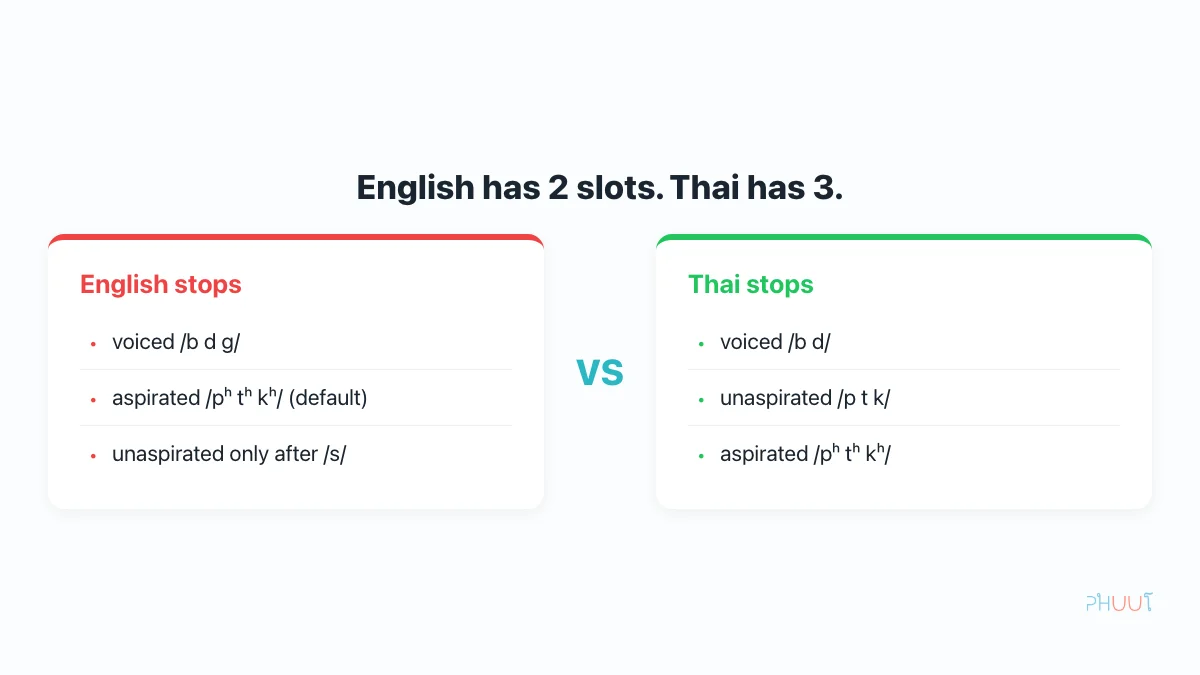
Now here’s the part that takes most English-speaking learners months to internalise. Thai has three slots where English has two.
- English lines up stops as voiced (/b d g/) versus aspirated voiceless (/pʰ tʰ kʰ/). Word-initially, those are your only choices. “Pat” starts with /pʰ/. “Bat” starts with /b/. There is no third option.
- Thai has voiced /b d/ (บ ด), unaspirated voiceless /p t k/ (ป ต ก), and aspirated voiceless /pʰ tʰ kʰ/ (พ ท ค or ข). That middle slot is a full phoneme - it changes the word. (Thai has no native voiced velar /g/, only unaspirated /k/ and aspirated /kʰ/, so the asymmetry runs both ways.)
The English ear hears ป (unaspirated /p/) and pattern-matches it onto the closest English thing: either /b/ (because there’s no puff) or /pʰ/ (because it’s not voiced). Both mappings are wrong, but they feel right, which is the harder kind of wrong to fix.
You already produce both sounds - just not where Thai needs them
Here’s the encouraging part. Your mouth already knows how to make the unaspirated /p t k/. English produces them every day. They just live in a specific phonetic prison: they only appear after /s/.
| English word | Initial sound | Aspiration |
|---|---|---|
| pot | /pʰ/ | aspirated (clear puff) |
| spot | /p/ | unaspirated (no puff) |
| top | /tʰ/ | aspirated |
| stop | /t/ | unaspirated |
| kin | /kʰ/ | aspirated |
| skin | /k/ | unaspirated |
Test it on yourself right now. Say “pot,” then “spot,” with your palm two inches from your mouth. The /p/ in “pot” punches your hand. The /p/ in “spot” barely touches it. Same letter on the page, two completely different sounds in your mouth - and your brain has been treating them as the same sound your entire life because in English, the difference never changes a word’s meaning.
Thai is the opposite. The difference between /p/ and /pʰ/ at the start of a word changes ปา (paa, “to throw”) into พา (phaa, “to lead/take”). Same vowel, same length, two different verbs. So this is not a hearing problem and it is not a mouth-mechanics problem. It is a placement problem: English locks the unaspirated stops behind an obligatory /s/, and Thai needs you to drop the /s/ and use the bare sound on its own.
That reframe is what makes the drills in H2-3 work. You are not learning a new sound; you are smuggling an existing one out of its English context. And if you’re new to Thai pitch shapes more broadly, our piece on Thai tones is the sibling article - aspiration and tones interact through Thai’s consonant classes, which is why getting aspiration right also makes tones easier to predict.
The Romanization Trap That Trips Up Every Beginner
If the three-slot system is the structural problem, romanization is the cosmetic one - and it might do more day-to-day damage than the structural one, because it hits every learner who ever picked up a guidebook.
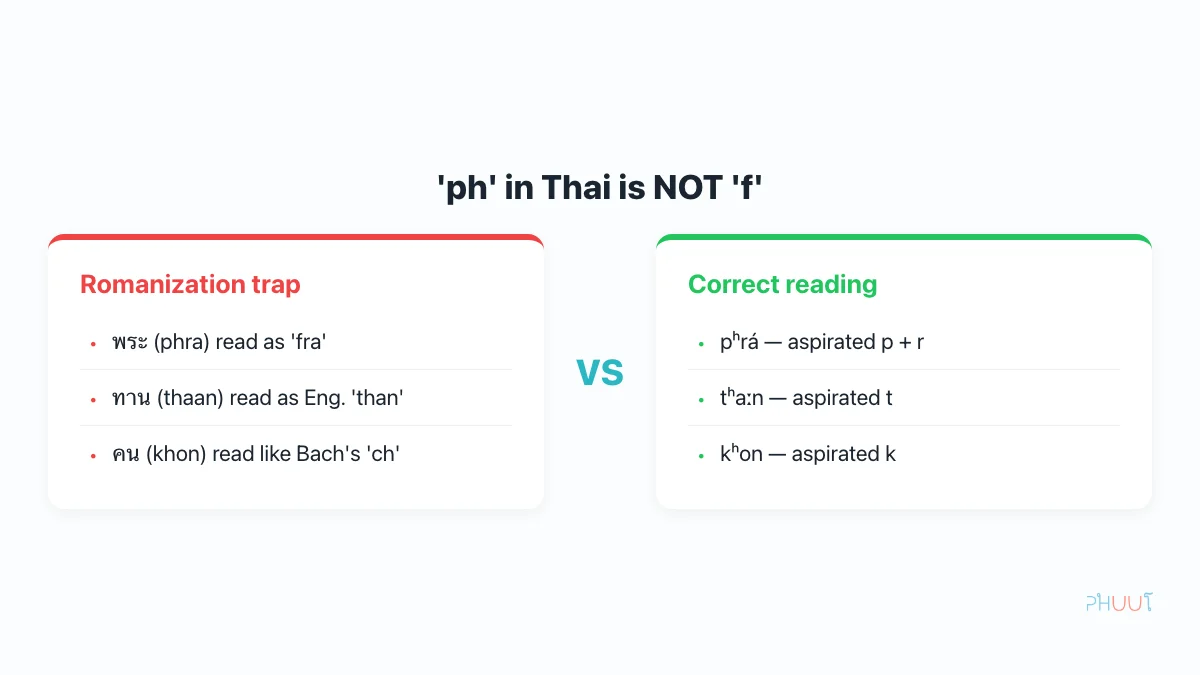
Royal Thai General System (RTGS) - the official romanization you’ll see on street signs, passports, and most English-language Thai textbooks - uses “h” after a stop to mean aspirated. So:
- “ph” = aspirated /pʰ/ - like the /p/ in English “pot.” It is not the English digraph “ph” as in “phone.”
- “th” = aspirated /tʰ/ - like the /t/ in English “top.” It is not English “th” as in “thin” or “this.”
- “kh” = aspirated /kʰ/ - like the /k/ in English “kin.” It is not the throaty “ch” in Bach.
That single convention burns more new learners than almost anything else I’ve watched trip up beginners learning Thai. The temple complex name พระ - written “phra” in romanization - gets read as /fra/ by almost every first-time visitor. It’s actually closer to /pʰrá/: an aspirated /p/, a flicked /r/, and a high tone. ทาน (“to eat,” formal) is “thaan” in RTGS, which English speakers naturally read as the word “than.” It’s actually /tʰaːn/ - an aspirated /t/, a long /aː/, a final /n/. And คน (“person”) shows up as “khon,” which trips up readers who know enough German to want to make it Bach-throaty. It’s just an aspirated /k/ plus /on/: /kʰon/.
The pairs you need to keep straight
Here are the production pairs that most directly affect A1 vocabulary. Each row is a real minimal pair - same vowel, same length, different first consonant. The romanization column shows what you’ll see in textbooks; the IPA column shows what your mouth should actually do.
| Thai | Romanization | IPA | Meaning |
|---|---|---|---|
| ปา | paa | /paː/ | to throw |
| พา | phaa | /pʰaː/ | to lead, to take |
| ตา | taa | /taː/ | eye / maternal grandfather |
| ทา | thaa | /tʰaː/ | to spread, to apply |
| กา | kaa | /kaː/ | crow / kettle |
| คา | khaa | /kʰaː/ | to be stuck |
These are not academic curiosities. They show up in tourist-level vocabulary all the time. ปลา (plaa, “fish”) versus ผ้า (phâa, “cloth”). ตี (tii, “to hit”) versus ที่ (thîi, “at/place”). กา (kaa, “crow/kettle”) versus ข่า (khàa, “galangal” - the root in tom kha kai). Order ข่าวมันไก่ at a food court when you meant ข้าวมันไก่ and you’ve asked for “news with chicken” instead of “chicken rice.” The vendor will figure it out. The point isn’t humiliation; the point is that aspiration is doing real lexical work from the first day of A1.
A quick framing that helps
The mental fix I’ve watched work for new learners is this: every time you see “ph,” “th,” or “kh” in a romanized Thai word, mentally read the “h” as a little puff symbol, not as a letter. It’s a diacritic in disguise. The romanizer was trying to tell you “puff of air goes here” and was hoping you’d take their word for it. Once that re-reading is in place, “phra” stops triggering the English /f/ reflex and starts looking like what it is: an aspirated /p/ plus the rest of the syllable.
A Three-Step Drill to Separate Aspirated from Unaspirated
Here’s how to pronounce Thai aspirated consonants reliably, using three drills you can run today. You cannot improve a sound you cannot diagnose. That’s the same principle behind the recording technique in the Thai tones article: if no signal comes back to tell you whether the attempt landed, you’re just repeating noise into a void and reinforcing whatever you happen to be producing - correct or not.
The three drills below give you that signal. Drill 1 gives you a way to produce the unaspirated sound on demand by borrowing it from English. Drill 2 gives you a tactile check you can run on any attempt, anywhere, in under two seconds. Drill 3 packages both into a 60-second daily rep that stays short enough to actually do.
Drill 1 - The “spot trick”
This is the signature drill of this article and it solves the placement problem from H2-1 in one move.
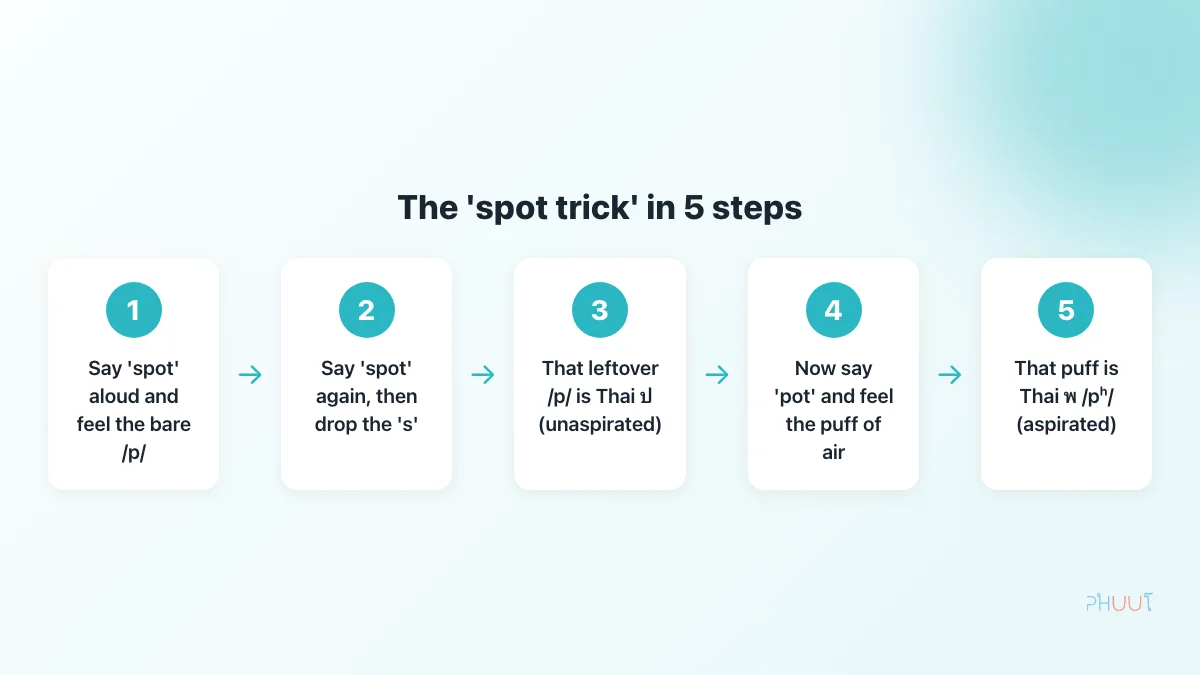
- Say the English word “spot” out loud at a normal pace. Hand at your mouth. Feel that the /p/ in there has no puff.
- Say it again, but stretch the /s/: “sssss-pot.” Same /p/, still no puff. Hold that mouth shape clearly in your head.
- Now mouth the same word but skip the /s/ entirely. Don’t start the word at all until you’re ready to begin your voice right at the /p/.
- The /p/ you just produced - bare, no puff, no /s/ in front of it - is the Thai ป (unaspirated /p/). Hold that shape and add a vowel: paa (ปา).
- Repeat the same logic for /t/ (start from “stop,” strip the /s/, you’re left with Thai ต) and for /k/ (start from “skin,” strip the /s/, you’re left with Thai ก).
When your first attempts come out sounding like /b/ instead of /p/ - that is, voiced rather than just unaspirated - that’s normal and tells you something useful. English speakers reach for /b/ as their “no puff” stop because that’s the only voiceless-puff-free slot English keeps word-initially. Don’t fight it; just keep the airflow check running (Drill 2 below) and the shape will sort itself out within a few sessions.
Drill 2 - The hand test (tactile feedback loop)
Hold your hand two to three inches in front of your lips. Make any of the contrast pairs above - ปา then พา, ตา then ทา, กา then คา.
- Aspirated (พา / ทา / คา) should land a clear, distinct puff on your palm.
- Unaspirated (ปา / ตา / กา) should barely register at all.
If both feel about the same, you’re aspirating both - which is the default English failure mode. When you can’t get any puff on your hand for the aspirated version, you’re under-aspirating the high-class consonants, which can drift you into the unaspirated/voiced row instead.
The reason this drill is powerful is that it’s a feedback loop you can run silently and anywhere. Waiting for the bus. Mid-conversation, between sentences. During an app drill while the audio is still playing. You don’t need a recording, you don’t need a tutor, you don’t even need to be alone. The signal is on your own palm, in real time.
Drill 3 - 60-second minimal-pair shadowing
This is the daily rep that locks both above into a habit.
- Pick one minimal pair. ปา / พา is the canonical one and the easiest to feel.
- Find a clean native recording of both words (a dictionary app, the Phuut pronunciation game, or any YouTube clip).
- For 60 seconds: native audio → mimic out loud → hand check → native audio → mimic → hand check. Alternate the pair.
- Stop at 60 seconds. Don’t go to two minutes. Short, focused, daily - same principle as the recording loop in the tones article. Your brain consolidates these on the rest, not on the rep.
Daily 60-second sessions outperform 15-minute weekly sessions for this kind of motor pattern. The math isn’t dramatic - it’s just that aspiration is a sub-second mouth movement, and you only get a handful of useful reps before fatigue blurs the signal anyway.
Key takeaways
- Thai aspiration is phonemic - it changes the word, not just the accent
- The English allophone you already produce (the /p/ in “spot”) is your starting point for Thai unaspirated /p/
- Royal Thai romanization “ph,” “th,” “kh” are not English /f/, /θ/, /h/ - they are aspirated stops
- Use the hand-to-mouth airflow test as a quick self-check during practice
- Pair this with the Thai tones article - aspiration and tones interact through consonant classes
How Phuut Handles Aspiration in the A1 Curriculum
Phuut’s A1 (Tourist) level introduces ป and พ in adjacent units, on purpose. The contrast lands while the first one is still fresh, which is when your ear is most sensitive to the difference. Same pattern for ต / ท and ก / ค. The point is to give your mouth the comparison early, before either consonant has time to calcify as “just a p.”
Pronunciation game mode evaluates your spoken attempts and returns an immediate result on each one. That’s the acoustic side of the feedback loop this article keeps pointing at: instead of recording yourself and replaying it, the system tells you in real time whether the attempt landed. Combine that with the hand test (Drill 2 above) and you have a two-channel check - tactile and acoustic - on the same drill.
Thai script mode drills the visual difference between ป and พ, ต and ท, ก and ค as letter shapes. This matters more than it sounds. Once you can read the script, the consonant class - and therefore the aspiration status, and therefore the tone - is encoded right there in the symbol. Learners who stay in romanization keep hitting the “is this ป or พ?” wall every time they read a new word; learners who learn the script stop hitting it.
Spaced repetition reviews bring the minimal-pair distinction back at the intervals when you’re most likely to lose it. ปา / พา, ตา / ทา, กา / คา cycle through the review queue alongside everyday vocabulary, so the contrast stays alive without you having to schedule “aspiration practice.”
A short focused daily session is the right shape for this kind of drill. If you find it hard to settle into one, the kind of focus music from Brain.fm pairs well with the 60-second-shadowing routine above - short, repeatable, low-friction.
The app is free to start. If you want a closed acoustic loop on your own aspirated/unaspirated attempts, the pronunciation game mode is where to begin.

Stop guessing — hear if your tone is right
Free on iOS & Android
Even if you can recognize tones, producing them accurately is a different skill. Phuut gives you AI feedback so you can self-correct.
- Speak into the app, AI flags exactly which tone is off
- Sequenced from mid → falling → rising → high/low
- Paiboon transliteration shows nuance kana/romanization miss
- 5 minutes a day; most learners flip in about 3 weeks
Frequently Asked Questions
Is “ph” in Thai romanization pronounced like “f” in “phone”?
No. Royal Thai romanization uses “ph” to mean an aspirated /p/ (a /p/ followed by a puff of air), not the English /f/ sound. So พระ is /pʰrá/, not /fra/. The same convention applies to “th” (aspirated /t/, not the English “th” in “thin”) and “kh” (aspirated /k/, not the “ch” in “Bach”). Mentally read the “h” as a puff symbol, not as a letter.
Why do my Thai friends laugh when I say ปา (throw)?
Most likely you’re aspirating it as English would - pronouncing it more like พา (lead/take), which is a different verb. English speakers default to aspirated /pʰ/ word-initially because that’s the only pattern English allows at the start of a word. Drilling the “spot trick” (Drill 1 above) separates the two sounds in your mouth, and the hand test gives you immediate feedback on which one you actually produced.
Does aspiration affect Thai tones?
Indirectly, yes - and importantly. Thai consonants belong to three classes (low, mid, high), and a consonant’s class, together with the syllable shape and any tone marks, determines which tone the syllable carries. Aspirated and unaspirated consonants at the same place of articulation often fall into different classes (for example, ป is mid class, พ is low class), which means getting the aspiration right narrows the possible tones for an unfamiliar word. That’s why our Thai tones piece and this one belong together.
Can I learn Thai aspiration without learning Thai script first?
Yes, partially. You can drill the sounds and minimal pairs using romanization plus audio. But the link between consonant shape, aspiration, and tone is hard to internalise from romanization alone - RTGS hides too much. Once you start reading the script, the whole system clicks into place much faster, because the consonant you see on the page already tells you the aspiration status and constrains the tone. Script study and aspiration drills reinforce each other.
Get the cheat sheet
If a printable reference would help, grab our one-page Thai aspirated vs unaspirated minimal-pairs PDF - same tables as above, formatted to fit on a single sheet.
If you want pronunciation feedback on your own aspirated/unaspirated attempts, try Phuut free on iOS. The pronunciation game mode is the part to try first.
By Phuut Editorial Team | Reviewed by Ramy Hirano | Last updated May 2026 | 11 min read
Stop guessing — hear if your tone is right
Free on iOS & Android
Even if you can recognize tones, producing them accurately is a different skill. Phuut gives you AI feedback so you can self-correct.
- Speak into the app, AI flags exactly which tone is off
- Sequenced from mid → falling → rising → high/low
- Paiboon transliteration shows nuance kana/romanization miss
- 5 minutes a day; most learners flip in about 3 weeks