
Learn Thai Without Romanization: The Script-First Path
Affiliate disclosure: This article contains affiliate links. We may earn a small commission at no extra cost to you. As an Amazon Associate, we earn from qualifying purchases.
About the reviewer

Ramy Hirano
Phuut Founder
Founder of Phuut. Has observed how Japanese and English speakers stumble on Thai and built learning products around those patterns.
Follow Phuut on X →You’ve been studying Thai for two months. You can hold a basic conversation, order food, ask for directions. Your Paiboon phrasebook has served you well. Then you step onto the Bangkok Skytrain at Siam station and look up at the overhead map. The sign says สยาม. Your phrasebook says “Siam.” They are not the same system. You cannot connect what you hear to what you see. You cannot read a single station name. This is the first symptom of a structural problem - not a gap in your vocabulary, but a ceiling built into the tool you’re using. This article explains what that ceiling is, names it precisely, and gives you the concrete 4-week plan to break through it. If you want to learn Thai without romanization, here is where you start.
- The Romanization Ceiling - Why Staying in Transliteration Costs You Later
- The Two-Speed Reading Trap and Why It Keeps Learners Stuck
- The 4-Week Script Graduation Roadmap
- How to Make the Script Stick - Tracing, Game Modes, and the Daily 10-Minute Drill
The Romanization Ceiling - Why Staying in Transliteration Costs You Later
Romanization is not wrong for the first few days. It’s structurally incomplete. And that incompleteness creates a permanent ceiling as you advance - one that tightens the longer you stay in it.
Here’s the precise reason.
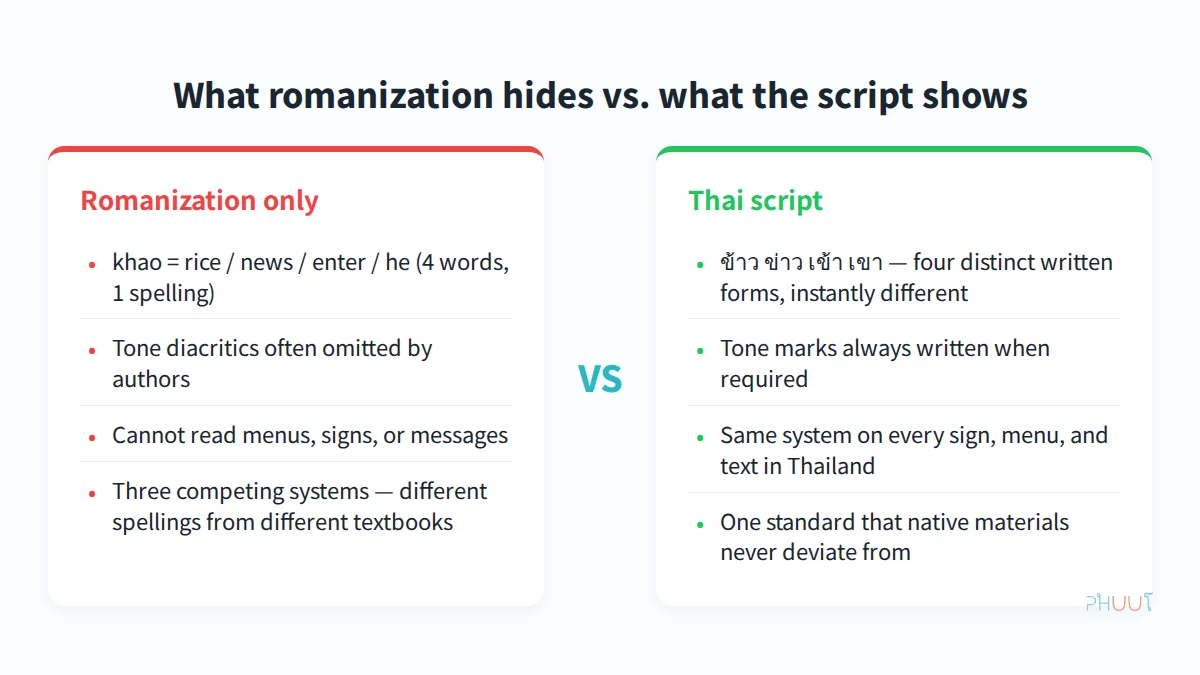
Thai has 5 tones. Every Thai syllable has a tone that is fully predictable from three factors written in the script: the consonant class of the initial consonant (mid, high, or low), the syllable type (live or dead), and the presence or absence of a tone mark. None of these three factors are encoded consistently in any romanization system. RTGS - the Thai government’s official romanization - was designed for geographic signage, not language learning. It encodes zero tonal information by design. Paiboon is more learner-friendly: it adds diacritics (à â á ǎ a) to indicate the five tones. But those diacritics are author-optional. Most phrasebooks omit them. Different textbooks use different conventions. And even when Paiboon’s tone marks are present, they give you the tone output without showing you the mechanism that produces it.
The practical consequence: a learner who has been studying with Paiboon for two months and mispronounces ข้าว (rice) as a mid tone instead of a falling tone has no written reference to consult. If the Paiboon is correct in their materials, it shows “kâao” - which gives an approximation. But the script gives an exact specification: high-class consonant ข, combined with ้ (mai tho), produces falling tone. No ambiguity. No textbook variation. No missing diacritic. The ceiling is not about reading difficulty - it’s about whether you have a system that lets you self-correct.
Take the word สวัสดี (hello). In RTGS it’s “sawatdi” - three syllables, zero tonal information. In Paiboon it’s “sà-wàt-dee” - three syllables, three tone marks, if the author included them. In the Thai script, the tone of each syllable is fully specified by the consonant class + syllable type of each character. Same word, three spellings in romanization, one consistent written form in the script.
Look at the rightmost column - “Tone in script.” That is what romanization drops. The falling tone on ข้าว is not a fact you memorize; it’s a derivation from the character’s properties. Romanization gives you neither the derivation nor a reliable signal that you should be looking for one.
The romanization ceiling is fixable. But there’s a specific psychological obstacle that most learners hit when they try to fix it - and it’s the reason the fix doesn’t take the first time. Understanding it before you start is the difference between switching once and having to switch twice.
The Two-Speed Reading Trap and Why It Keeps Learners Stuck
The hardest part of dropping romanization is not learning the characters. You can learn the 9 mid-class consonants in a week. The hard part is something that happens after you’ve learned them - and it’s psychological.
You already know that สวัสดี means hello. You’ve said it a hundred times. When you first see it in Thai script, reading it is slow - you’re sounding out ส, then ว, then อ, then ส, then ด, then ี. But “sawatdee” is right there in your memory from months of Paiboon. The romanization reads itself in your head automatically. The script requires effort.
This is the trap. You keep romanization as the fast lane for familiar words and use the script only for new words you’ve never seen before in any system. The problem: the script never becomes automatic, because instant recognition requires consistent, exclusive use. Reading without thinking is not built by using a system “when convenient.” It’s built by using a system until it becomes the only option.
The trap is unique to transitioning learners - people who already have a romanization vocabulary. Absolute beginners who start from scratch with the script never develop this gap because they build both systems simultaneously and the romanization never gets ahead. But if you’ve spent two months with Paiboon, your romanization reading is fluent and automatic, and your script reading is effortful and new. Closing that gap requires a specific commitment: script-only during practice sessions, for 2-3 weeks, even when the romanization would be faster.
The positive frame for making this commitment: the script is not just a different notation for the same information. It’s a more complete notation. Every time you read a Thai character, you get the sound, the consonant class, and the tone derivation - three pieces of information that romanization provides inconsistently or not at all. The discomfort of the two-speed transition is temporary. The capability you’re gaining is permanent.
Three months is roughly the point where the table above becomes visible in your own learning. Script-first learners are reading signs, menus, and messages. Romanization-reliant learners are still dependent on romanized materials that don’t exist in the real world. The divergence starts in the first month, when one path builds the tools for self-correction and the other doesn’t.
The transition has a specific sequence - and it’s faster than most learners expect.
The 4-Week Script Graduation Roadmap
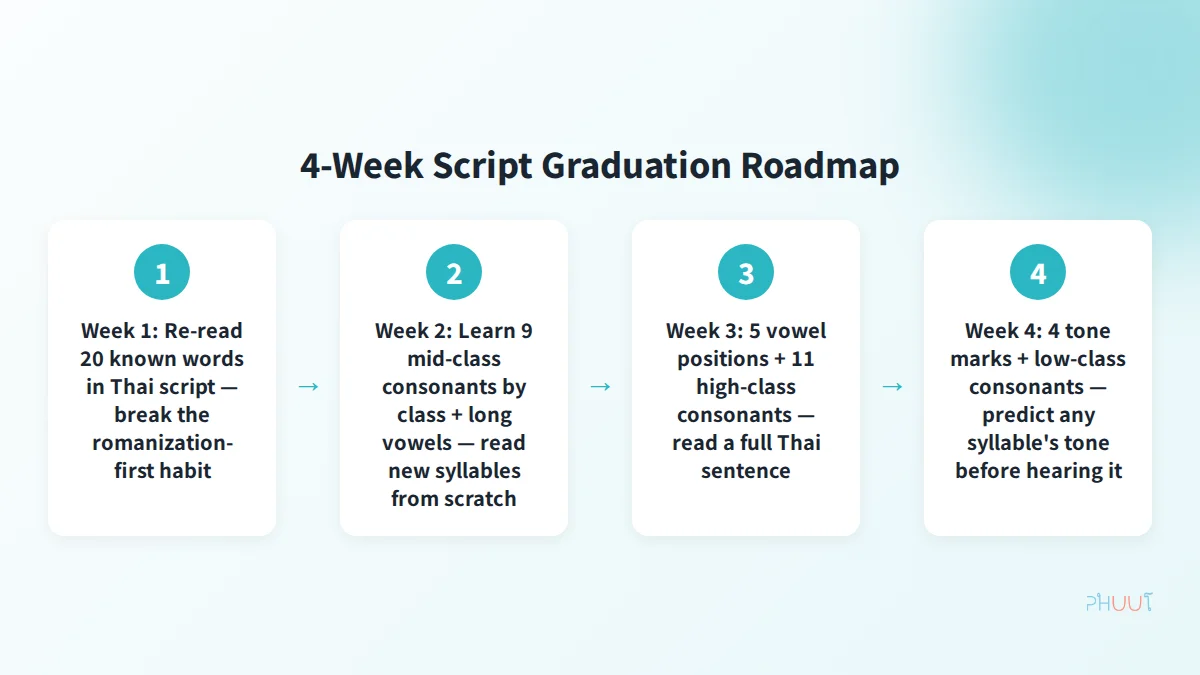
The transition from romanization to script is a 4-week project, not a multi-year undertaking.
This matters because of how the transition is usually framed: “learn Thai script” sounds like starting over. It isn’t. You have vocabulary. You know what words mean and roughly how they sound. What you’re doing over these four weeks is connecting that existing knowledge to its correct written form - and building the tone-derivation tools that romanization couldn’t give you.
Week 1: Re-reading what you already know
Week 1 is the critical differentiation from the absolute-beginner script sequence. You’re not starting from zero.
Take สวัสดี (sawasdee, hello), ขอบคุณ (khob khun, thank you), ดี (dee, good), and ไป (pai, to go). You know these words. Find them in Thai script - in a dictionary, on Google Images, in Phuut’s Script Mode. Trace each character in stroke order. Then read the word from the script, not from memory. Sound out each character.
The goal is not to learn new vocabulary. It’s to break the romanization-first reading habit for vocabulary you already have. When you read สวัสดี and decode the four characters rather than reading “sawatdee” from memory, you’ve taken the first step out of the two-speed trap.
If you’re an absolute beginner with no vocabulary yet, the Thai script from scratch guide gives the complete sequence from Day 1 - it’s designed for zero prior knowledge, where this roadmap assumes you’re already conversational in romanization.
Week 2: The 9 mid-class consonants
The 9 mid-class consonants are: ก จ ด ต บ ป อ ฎ ฏ.
Learn what “mid-class” means for tone: a mid-class initial consonant in a live syllable with no tone mark produces a mid tone. This is the first tone rule you’ll derive from the script - not guess from romanization, but derive from the character you can see. The tone is not memorized; it falls out of the class identity.
Combine these consonants with long vowels า ี ู เ◌ to read new syllables you’ve never seen in any system: กา, ตี, บู, เดอ. These aren’t words from your phrasebook - they’re new material you’re reading for the first time, in script only. That’s the milestone: first script-only reading of unfamiliar material.
Week 3: Vowel positions and high-class consonants
Don’t try to memorize all 32 vowel marks individually. Learn the 5 positional patterns first - before consonant, after consonant, above consonant, below consonant, surrounding consonant. Once you know where to look, each new mark becomes a variant of a known position rather than an isolated symbol. The Thai vowels article covers all 32 marks and the 5-position framework in full detail when you’re ready to go deeper.
Add the 11 high-class consonants: ข ฃ ฉ ฐ ถ ผ ฝ ศ ษ ส ห. With mid and high class now covered and 5 vowel positions understood, you can start reading many common written items - food menu items, straightforward shop signs, simple messages. Read a complete sentence from a Thai children’s book or a food menu without any romanization support. That’s the Week 3 milestone.
Week 4: Tone marks and the end of the ceiling
The 4 tone marks are: ไม้เอก ( ่), ไม้โท ( ้), ไม้ตรี ( ๊), and ไม้จัตวา ( ๋). Each mark modifies the default tone of a syllable, and the modification depends on the consonant class of the initial consonant. Mid-class + mai ek = low tone. High-class + mai ek = low tone. Low-class + mai ek = falling tone. The same mark, three different outcomes - all predictable, all visible in the script.
Low-class consonants are the remaining ~24 consonants that are neither mid nor high class. Learn them by elimination: anything that isn’t in the 9-mid or 11-high group is low. You’ve already learned 20 of the 44 consonants; the remaining 24 have a single category identity.
The Week 4 milestone: read a mid-class syllable with a tone mark and predict the tone before hearing it. That’s the moment the romanization ceiling is gone - you’ve built the derivation mechanism that romanization structurally cannot provide.
For the complete 3-step class-before-mark reading workflow and the full tone-mark grid, the Thai tone marks explained article is the natural next step after completing this roadmap - it’s the deep-dive on the 4-mark system that Week 4 introduces. And for the complete consonant class system and tone derivation table across all three classes, the Thai consonant classes article covers the full framework.

Once your script reading is fast enough to keep up with a spoken conversation, a single lesson with a native Thai tutor to verify your tone production out loud - particularly on the consonant classes you’ve been drilling - is the highest-leverage use of a human teacher. italki connects you with native Thai tutors for on-demand pronunciation sessions, precisely when your script knowledge is solid enough that a tutor can hear the specific errors rather than just correcting everything at once.
How to Make the Script Stick - Tracing, Game Modes, and the Daily 10-Minute Drill
Learning to recognize characters and making them automatic are two different skills.
You can look at ก and know it’s an unaspirated /k/. But when you see ก inside กรุงเทพ, surrounded by vowel marks and adjacent characters, the recognition can still break down. Visual memory of isolated characters doesn’t automatically transfer to recognition in context. Motor memory does.
When you trace a character - following the correct stroke order with a pen or finger - you’re building a motor representation of its shape alongside the visual one. These two memory systems are stored separately, and they reinforce each other in recall. In our internal usage data, learners who commit to script-only practice sessions within their first month consistently overtake romanization-reliant learners in reading speed by week six - a gap that keeps widening after that. When you’re scanning a real street sign under time pressure, the motor memory holds up where isolated visual memory sometimes doesn’t.
There’s a second benefit specific to Thai: stroke order reveals character structure. Many Thai consonants share sub-components. The circular element in ก, ข, ค, and ง is the same stroke sequence. Once you’ve traced ก through its stroke order, you’ve pre-encoded part of ข, ค, and ง. New characters become extensions of known patterns rather than arbitrary new shapes.
Ten minutes. Five characters. Three air traces each. That’s the session. The goal is not to become a Thai calligrapher - it’s to build the motor layer that makes recognition automatic under real-world conditions.
Phuut’s Thai Script Mode implements exactly this approach. The handwriting tracing feature provides stroke-by-stroke entry with immediate feedback - not just whether the final shape is right, but whether the stroke sequence is correct. All 3,850 vocabulary items are presented in Thai script with no romanization alongside them, which removes the romanization fast lane during practice. After tracing, those vocabulary items move into game-based review across 8 game modes, including Boss Battle weekly review, under mild time pressure - the condition that most closely replicates real-world reading. The A1-B2 curriculum sequences vocabulary by consonant class, so the characters you’re learning in the tracing drill show up immediately in vocabulary practice. The two roadmaps - script and vocabulary - reinforce each other rather than running in parallel.
If you want stroke-order tracing with automatic feedback built in, try Phuut’s Thai Script Mode free on iOS.

Don't just read Thai — write it
Free on iOS & Android
Many learners can recognize Thai script but freeze when asked to write. Phuut's handwriting tab lets you trace letters directly on screen.
- Trace all 44 consonants and vowel marks on screen
- Stroke-order guidance with instant red-line feedback
- Paired Paiboon transliteration links sound to script
- 5 minutes a day builds writing muscle that boosts reading too
The next time you stand at Siam station and look up at that overhead map, สยาม won’t be a mystery you skip past. You’ll read the characters, derive the tone, and move on - the same way you read street signs at home without thinking. That’s what the four weeks buy you: not just a reading skill, but the mechanism to keep self-correcting every word you encounter after that.
Frequently Asked Questions
Get the free Script Graduation Cheat Sheet: 9 mid-class consonants + 5 vowel-mark positions + the 4-week roadmap summary, printable PDF. Everything you need to start Week 1 today.
Don't just read Thai — write it
Free on iOS & Android
Many learners can recognize Thai script but freeze when asked to write. Phuut's handwriting tab lets you trace letters directly on screen.
- Trace all 44 consonants and vowel marks on screen
- Stroke-order guidance with instant red-line feedback
- Paired Paiboon transliteration links sound to script
- 5 minutes a day builds writing muscle that boosts reading too