
How to Practice Thai Tones at Home (5 Methods That Work)
Affiliate disclosure: This article contains affiliate links. We may earn a small commission at no extra cost to you. As an Amazon Associate, we earn from qualifying purchases.
About the reviewer

Taishi Hirano
Phuut Founder | Bangkok-based
Bangkok-based for 7 years. Founder of Phuut. Has observed how Japanese and English speakers stumble on Thai and built learning products around those patterns.
Follow Phuut on X →The first time I ordered ข้าว (rice) at a Bangkok street stall after weeks of daily tone practice, the vendor handed me something white and pointed at the sauces. I’d produced the rising tone instead of the falling. I’d been practicing the wrong feedback loop — repeating tones with no signal telling me whether I was correct — and the errors had compounded silently for weeks.
If that failure mode sounds familiar, this article is for you. The problem isn’t that you’re practicing the wrong sounds. It’s that your practice loop has no feedback signal. You repeat a tone, nothing tells you whether you were correct, and errors quietly compound. This article covers five practical methods for practicing Thai tones at home without a tutor — ranked by how much diagnostic feedback each one gives you. It also explains the cognitive reason why daily practice often stalls, so you know exactly what to fix.
In this article:
- Why Thai tones are hard to practice at home
- The feedback gap — why most home practice doesn’t register errors
- 5 methods for practicing Thai tones at home
- How Phuut is designed for home tone practice
- FAQ
- Start With the Feedback Loop, Not More Listening
Why Thai Tones Are Hard to Practice at Home (It’s Not What You Think)
Most learners who struggle with Thai tones assume they have a hearing problem. They can’t tell the tones apart, or they’re not musical enough, or their ear hasn’t developed yet. This assumption leads to one response: more listening. More tone charts. More audio loops. More passive repetition.
That response doesn’t fix the problem, because the problem isn’t in the ear. It’s in the motor system under cognitive load.
The Automated Pitch Habit English Wired Into You
English speakers use pitch constantly — but for a completely different purpose than Thai does. In English, rising pitch at the end of a sentence signals a question. Falling pitch signals a statement. A high, sustained pitch signals emphasis or strong emotion. These patterns are automated. You don’t choose them consciously any more than you choose where to place your tongue for the letter “t.” They run without attention.
Thai uses those same pitch shapes — rising, falling, high, mid, low — but as properties of individual words, not signals of speaker attitude. The rising pitch that English assigns to questions, Thai assigns to words like หมา (dog). The falling pitch that English assigns to declarative statements, Thai assigns to words like ข้าว (rice). When you speak Thai, you must override your English pitch habits on every syllable, every word, every phrase — simultaneously.
The override works in isolation. When you’re alone, calm, focused on a single word, your deliberate attention can produce the correct tone. But Thai conversation isn’t a single word at a time. It is vocabulary retrieval, grammar construction, turn-taking, and social reading happening simultaneously. When your attention is split that many ways, the automated English pitch habit reasserts itself. Your production reverts. The tone you drilled correctly alone breaks down in real use.
That breakdown isn’t a failure of effort or aptitude. Most home practice methods share a structural flaw: they never train the tone under the conditions where it has to work.
The “Understood” Gap
Learners who’ve practiced Thai tones in isolation for weeks or months but still get blank stares in actual conversations share a consistent failure pattern: the tone is correct when produced slowly, in a quiet room, with full conscious attention. The same tone disappears when the learner is also managing an unfamiliar word, a noisy environment, mild social anxiety, and real-time listening.
The gap isn’t in the tone itself. The gap is in whether the tone has become automatic enough to survive the distraction load of real speech. A tone you have to think about producing will always lose to vocabulary retrieval and social awareness when those compete for the same limited attention.
The goal of home practice, properly understood, is not to produce tones correctly in a quiet room. It is to produce tones correctly when your conscious attention is fully occupied elsewhere. That requires a different kind of practice than listening to a chart.
The Stakes: What Gets Lost When Tones Go Wrong
Before getting into methods, it’s worth anchoring the cost. Thai tone errors don’t just produce slight mispronunciations — they produce completely different words.
For understanding all 5 Thai tones in detail, see our foundational guide. Here is the quick-reference version:
And here is a set of high-stakes minimal pairs — same syllable, different tones, completely different meanings — that illustrate exactly where errors cost you:
Ordering rice (ข้าว, falling) when you produce the rising tone gets you “white” (ขาว). Saying “come here” (มา, mid) when you produce the rising tone says “dog” (หมา). Saying “near” (ใกล้, falling) when you produce mid tone says “far” (ไกล). These aren’t minor accent differences. They are different words.
The goal of home practice is to make these tonal contrasts automatic enough that you produce them correctly while simultaneously thinking about everything else a conversation requires.
The Feedback Gap — Why Most Home Practice Doesn’t Register Errors
Understanding why home practice stalls requires looking at what a productive correction cycle actually looks like — and comparing it to what most self-study routines actually deliver.
How Children Acquire Tones (And Why Adults Can’t Copy It Directly)
Thai children don’t study tones. They acquire them through thousands of micro-correction cycles embedded in normal conversation. A child mispronounces มา (mid, come) as หมา (rising, dog). A parent immediately models the correct word back — not as a lesson, but as a natural conversational response. The child hears the corrected tone, registers the difference, and gets another attempt.
The key feature of this loop is its immediacy: attempt → signal → re-attempt, within seconds. The correction arrives before the incorrect version has time to consolidate. It is the tight cycle of feedback — not the volume of exposure — that creates the habit.
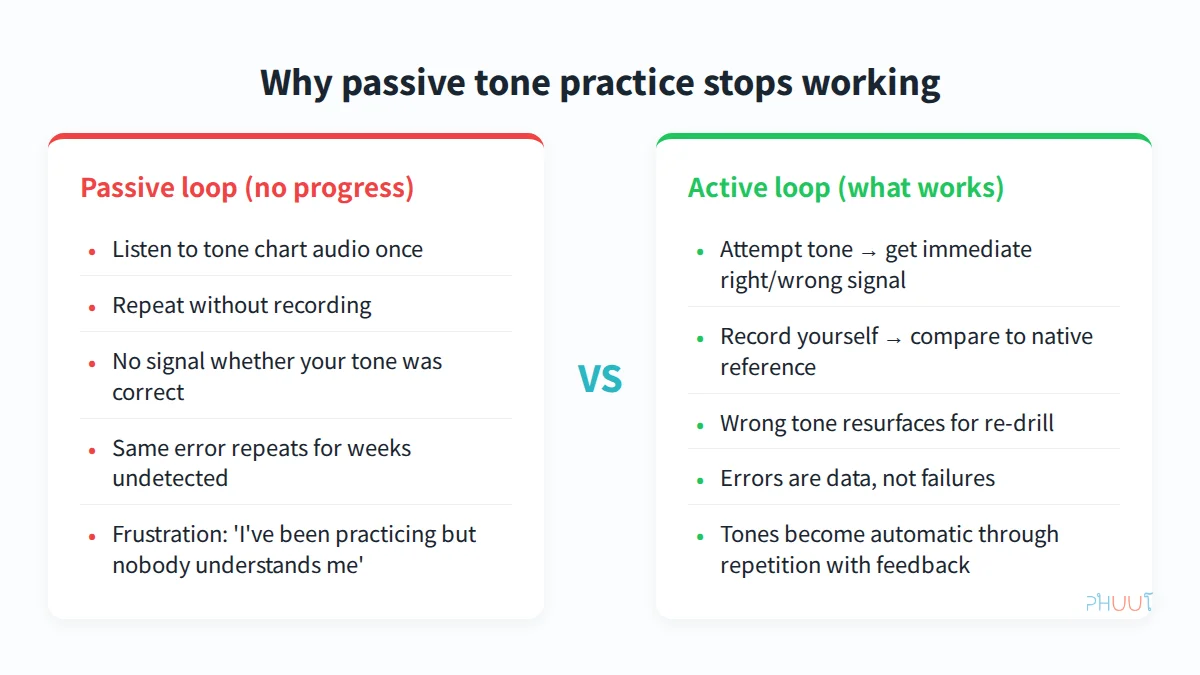
Adult home learners have no equivalent. The typical home practice loop is: listen to a tone chart → repeat → move on. There is no signal at any point telling the learner whether the production was correct. The error can persist for weeks or months, reinforced by repetition, entirely undetected.
Why Your Ear Misses Your Own Errors
Here’s why you can’t easily catch your own tone errors in real-time production: listening and producing are separate attentional processes that compete for bandwidth.
When you speak, your attention is occupied by the motor task of speaking. When you listen to your own recorded voice, that motor demand is gone — your full attention is available for auditory discrimination. Recordings catch errors that real-time production hides. Your ear in playback mode is more accurate than your ear during live speech, because it isn’t also running your mouth.
Self-recording works for exactly this reason. It doesn’t require special equipment or a tutor. A phone voice memo and a native audio reference give you access to a more accurate version of your own ear.
How to Self-Record Effectively
Effective self-recording is not just hitting record and playing it back. The approach matters:
- Choose one minimal pair (e.g., มา / หมา — mid/rising).
- Record yourself producing both words, one at a time, with a brief pause between.
- Play back your recording immediately — do not wait.
- Play the native audio reference for the same words immediately after.
- Don’t just note “it sounded wrong.” Note exactly what went wrong: “I produced mid when the target was rising — my pitch didn’t curve up at the end.”
- Record again. Compare again.
Specificity matters. “It sounded wrong” gives you nothing to fix. “My rising tone started too high instead of dipping first” gives you an exact target for the next attempt.
The limitation of self-recording is that it is manual, slow, and bounded by your ear’s ability to detect subtle tonal errors. It will catch obvious errors reliably. For very subtle production differences — a high tone that drifts toward falling, a mid tone that slips slightly low — it will miss things that an external measurement system would catch. That’s where AI pronunciation scoring (Method 5) becomes the upgrade path.
5 Methods for Practicing Thai Tones at Home (Ranked by Feedback Quality)
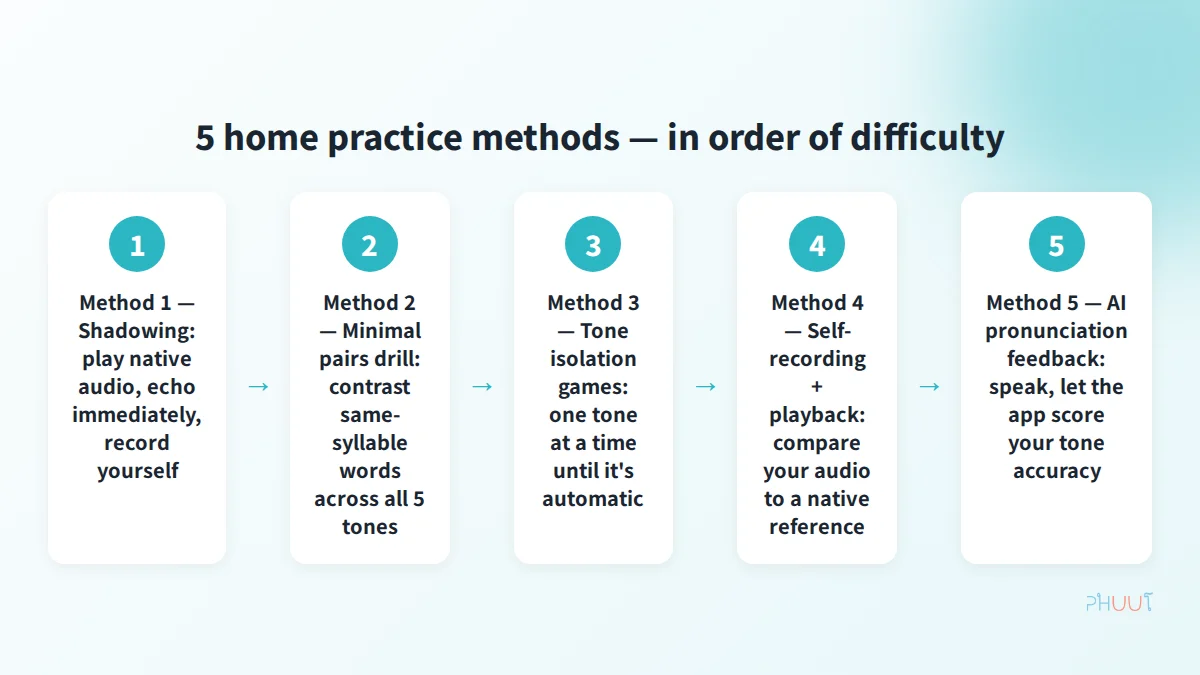
These five methods are not a list of equal options. They are a ranked toolkit, ordered from lowest to highest feedback quality. A learner with no smartphone can start at Method 1 and get genuine improvement. A learner who wants the shortest path to accurate production should prioritize Method 5. The right starting point depends on your equipment, your current level, and how much time you have per session.
Here is the overview before the detail:
Method 1 — Shadowing (No-Tech, Lowest Feedback)
How to do it: Find native Thai audio with clear, natural speech. Play a short segment — 5 to 15 seconds. Echo every word in real time, matching the pitch, rhythm, and speed as closely as possible. Do not read along from text. Your goal is to track the audio like a shadow, with almost no delay between hearing and producing.
Best audio sources for Thai shadowing: Thai news segments (Channel 7, Channel 3) offer clear, formal speech. Thai educational YouTube channels aimed at children carry natural speech at slightly reduced pace. Slow-Thai podcast content structures sentences for comprehension, which suits early-stage shadowing. Verify that your chosen source is still active before committing to a session series.
What shadowing trains: It puts tones into connected speech. It builds the rhythm habit. It exposes you to natural tone transitions between words — something isolated syllable drills cannot provide.
What it doesn’t do: It gives no external signal about whether your production was correct. You are relying entirely on your own ear, which — as noted above — is less accurate during live production than during playback. Shadowing is a strong complement to other methods, not a replacement for feedback-based drilling.
Method 2 — Minimal Pairs Drill (Low-Tech, Self-Perceived Feedback)
How to drill without an app: Print the minimal pairs table below. Cover the “Meaning” and “Pair contrast” columns, leaving only the Thai script visible. For each row, produce the tone for that word aloud. Uncover the meaning to check which word you were targeting. If you produced the wrong tone, produce both words in the pair back-to-back before moving on.
For the drill table, use the minimal pairs list in the reference section above or the full table included earlier in this article.
Sequenced approach: Do not drill all pairs simultaneously on day one. Start with mid vs. falling (มา/ม้า, ข้าว/ขาว). Add rising (มา/หมา) once mid and falling feel reliable. This sequenced approach directly mirrors how a structured curriculum introduces tonal vocabulary and significantly reduces cognitive overload compared to attempting all five tones from the start.
Limitation: Without audio comparison, you are checking your production against your memory of the tone, not against a reference signal. Your memory of a tone you have heard many times is reasonably accurate. Your memory of a tone you just learned last week is not. The lower your level, the more important it is to have audio playing during the drill, not just relying on recall.
Method 3 — Tone Isolation Games (App-Based, Right/Wrong Signal)
Any listening quiz or game that presents a Thai tone and requires you to identify or select it gives you something neither shadowing nor minimal pairs drilling provides on their own: a definitive right/wrong signal per attempt.
Listening-based tone games train discrimination: your ability to hear tonal differences, to map an incoming pitch shape to one of the five categories, and to do this reliably across speakers and phonetic environments. Home practice develops this skill slowly with passive methods and faster with interactive feedback.
For game-based tone practice in depth — including an analysis of which game mechanics actually produce tone habits versus which only feel productive — see our dedicated guide on this topic. The short version: games with immediate right/wrong signals per attempt improve discrimination. Games with production components improve production.
The limitation of listening-only games: They train recognition, not production. You can become very accurate at identifying tones you hear without improving your ability to produce them accurately. Recognition and production are related skills but not the same skill. A learner who is excellent at hearing tones and poor at producing them typically needs more production practice, not more listening practice.
Method 4 — Self-Recording + Playback (Manual Feedback, Higher Accuracy)
Method 4 structures the self-recording technique from the Feedback Gap section into a deliberate practice session.
Equipment: Phone voice memo app + any native Thai audio for comparison (a YouTube video, a podcast clip, the audio from a Thai learning app).
Session structure:
- Choose one minimal pair.
- Record yourself producing both words in sequence.
- Play your recording.
- Play the native reference audio for the same words.
- Write down exactly what went wrong (not just “wrong” — which pitch moved in the wrong direction, and when).
- Record the pair again with the correction in mind.
- Repeat until you can’t detect a difference between your recording and the native reference.
Time per session: 15–20 minutes. Don’t try to cover every tone in one session. One or two minimal pairs, done carefully, produces more improvement than a rushed run through all five tones.
Limitation: Manual, slow, and bounded by your ear’s accuracy. Catches obvious errors reliably. Misses subtle tonal drift. The upgrade path is Method 5.
Method 5 — AI Pronunciation Scoring (Highest Feedback, Fastest Correction Loop)
The highest-quality feedback available for home tone practice is external, automatic, and independent of your own ear. An AI pronunciation system receives your spoken input and returns an accuracy signal — correct or incorrect — so you can re-drill without relying solely on your own ear to catch the error.
This closes the feedback loop that self-recording can only approximate. You don’t need to rely on your ear’s accuracy during playback. The signal is external. The correction cycle — speak → receive signal → speak again — runs at the same speed as a good minimal pairs drill session, without the limitation of manual comparison.
For the best apps for Thai pronunciation feedback including a head-to-head comparison of available options, see our comparison guide. The key feature to look for isn’t just “pronunciation practice” — it’s whether the app gives you an actionable signal per attempt, or only a general score at the end.
The Recommended Acquisition Sequence
Regardless of which methods you use, the order in which you introduce the five tones matters.
The conventional order (mid/low/falling/high/rising) presents the most commonly confused pair — mid and low — at the very start, before the learner has a stable tonal baseline. The sequenced approach above uses mid tone as a foundation before introducing contrast, then introduces falling (the most acoustically distinct tone) as the first contrast, then rising as a U-shape contrast, then high and low as a final subtle pair once the learner’s ear is calibrated.
Trying to drill all five tones simultaneously is one of the most common reasons daily tone practice stalls without producing results. The cognitive load of discriminating five pitch shapes at once exceeds what working memory can manage when the learner is also dealing with unfamiliar vocabulary and script.
A 7-Day Home Practice Routine
How Phuut Is Designed for Home Tone Practice
The feedback-loop problem this article describes is exactly the problem Phuut was built to address. Here’s what that looks like in practice — not a feature list, but an explanation of why the product is structured the way it is.
Pronunciation game mode: The learner speaks a Thai word. The AI evaluates the tone produced and returns an accuracy signal — correct or incorrect — so wrong tones get fed back into the practice queue for re-drilling. This is Method 5 from the framework above, integrated into a structured curriculum. The correction loop runs automatically without the learner needing to design their own session.
Sequenced vocabulary introduction: The A1 curriculum introduces tonal vocabulary progressively rather than presenting all five tones simultaneously from the start. The rising tone is introduced once earlier tones are stable. The learner is never asked to juggle all five tones simultaneously at A1 level — the same framework as the acquisition sequence described in this article, applied at the curriculum level.
Boss Battle (weekly review): At the end of each week, all vocabulary from that week’s sessions appears in a cumulative, scored review. A mild time component adds pressure. The Boss Battle creates the closest home approximation of the cognitive load under which tone errors actually occur. It trains the tone to survive distraction — which is exactly what real conversation requires.
Spaced repetition across sessions: Words mispronounced in the pronunciation game resurface in later sessions according to a spaced-repetition schedule. Errors don’t just get corrected once — they are re-drilled until production is consistently accurate. The feedback loop is not single-session; it is cross-session.
8 game modes: The same tonal word appears in different game formats across a session — listening identification, pronunciation production, flashcard, Boss Battle. Multi-context exposure reinforces the tonal association through multiple cognitive channels, which accelerates the automatization that real conversation demands.
Phuut is currently available on iOS only. Android is in development.
For understanding the 5 Thai tones before beginning production practice, see our foundational guide — it covers the full tonal system, including tone mark rules and the acoustic shapes of each tone.

Start With the Feedback Loop, Not More Listening
The reason Thai tones don’t transfer from home practice to real conversation is clear: practice loops that generate no feedback signal allow errors to compound undetected. The English pitch habit — fully automated, running below conscious attention — reasserts itself the moment conversational load rises. More listening can’t override that automation. Active production practice with diagnostic feedback can.
The five methods in this article are ranked by how much feedback they provide. You don’t need to use all five. Shadowing and a minimal pairs list cost nothing and require no technology. Self-recording costs one phone and a native audio clip. AI-scored production practice is the highest-feedback option available for solo home practice.
Pick the highest-feedback method you have access to. Run it in 10-minute daily sessions, in the sequenced tone order, and note exactly what went wrong after each session. By week four, most learners have mid, falling, and rising tones stable enough that simple transactions — ordering food, asking directions — stop requiring repeats. That’s when the sequencing shifts: high and low tones enter the rotation, and real conversation stops feeling like a guessing game.

Master Thai tones with real audio
Free on iOS
Staring at tone charts doesn't work. With Phuut you record yourself, get instant feedback, and hear how close you actually are.
- AI conversation drills you on all 5 tones in context
- Native audio paired with Paiboon transliteration
- Voice recording with automatic accuracy feedback
- Practice minimal pairs like ข้าว vs ข่าว every day