
Thai Tone Game Practice: Which Apps Actually Deliver (2026)
Affiliate disclosure: This article contains affiliate links. We may earn a small commission at no extra cost to you. As an Amazon Associate, we earn from qualifying purchases.
About the reviewer

Taishi Hirano
Phuut Founder
Founder of Phuut. Has observed how Japanese and English speakers stumble on Thai and built learning products around those patterns.
Follow Phuut on X →I once ordered ข้าว (rice) at a Bangkok street stall and watched the vendor’s face go blank. I’d said the word - I’d practiced it. But the tone came out flat instead of falling, which pushed the syllable toward ขาว (white). A moment of silence, a head tilt, then she figured it out from context. Game-based Thai tone practice exists precisely to prevent that loop from repeating. This article explains what a thai tones game actually does differently from passive study, why you need both listening and production games, and which tools hold up when you run them against an honest checklist.
In this article:
- Why passive tone study stops working - and what “the loop” actually is
- Listening games vs. production games - why you need both
- How to evaluate a Thai tone game: a 4-point checklist
- How Phuut builds game-based tone practice into its curriculum
- FAQ
Why a Thai Tones Game Works Where a Tone Chart Doesn’t
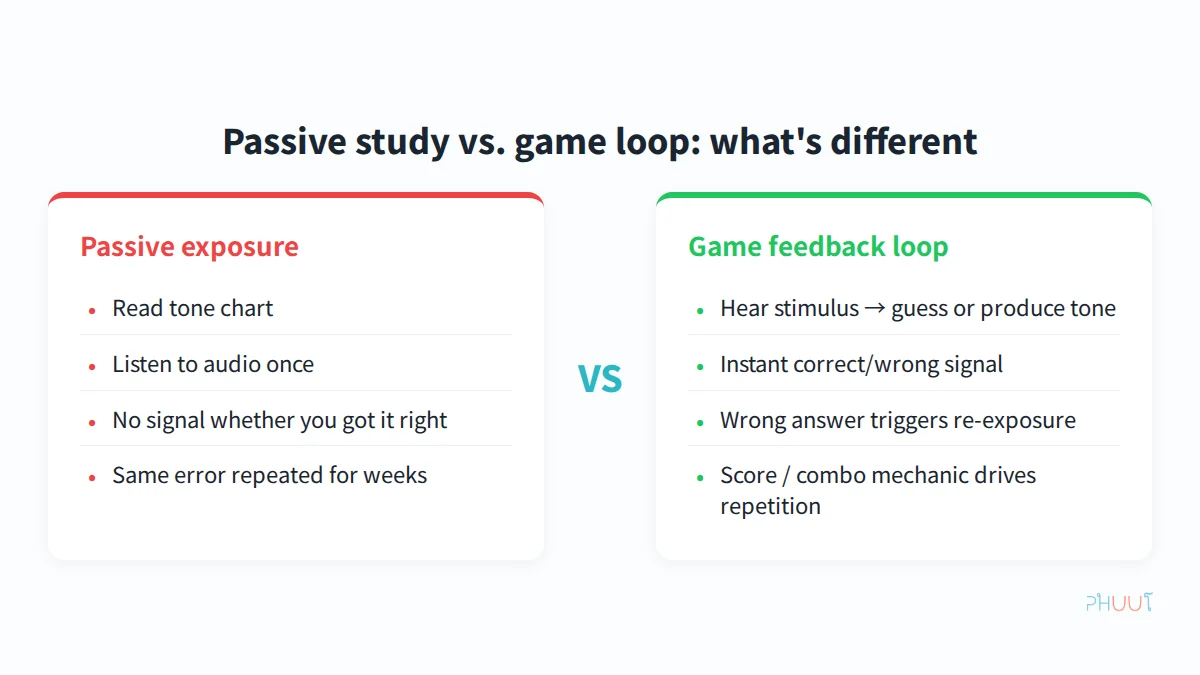
Every Thai beginner goes through the same phase. You find a tone chart - five rows, each with a pitch shape diagram and a romanization - and you study it. Then you find an audio sample, you listen three or four times, you repeat aloud. You move on to vocabulary. Later you come back and listen again. This feels like studying. It produces very little usable tone ability.
The failure isn’t about effort. It’s about what’s missing: a signal.
When you produce a tone - any tone - nothing tells you whether you were right. You can produce the falling tone too shallow - landing somewhere between mid and falling - and repeat that version for three weeks. Nothing flags the error. What you’re reinforcing is a flawed motor pattern. Passive exposure without feedback doesn’t correct mistakes; it embeds them.
Compare this to how a Thai child acquires tones. A three-year-old who mispronounces ข้าว gets corrected on the spot - by a parent, a sibling, anyone nearby who heard it. The correction is immediate and specific. The child doesn’t have a chance to reinforce the wrong version, because the wrong version gets interrupted before it sticks. Tone acquisition in native speakers feels effortless from the outside because the feedback loop operates at very high frequency and very low latency.
This is the correction cycle an adult self-learner never gets from a chart and an audio sample.
The loop, defined simply:
Stimulus → Attempt → Immediate signal (right/wrong) → Re-exposure on error
That four-step structure is what converts passive exposure into active calibration. The “stimulus” can be a heard tone you must identify or a word you must speak. The “attempt” is your guess or your spoken output. The “signal” is the instant correct/wrong feedback before your brain moves on. The “re-exposure” is the same item appearing again when you got it wrong, before the session ends.
Game mechanics replicate all four of these steps automatically. Score, combo, session timer, error queue - these are all mechanisms that force the loop to close rather than letting errors silently pass.
Before looking at specific tools, it helps to see exactly what’s at stake if the loop doesn’t close. The table below is the reason this matters at A1 level - not advanced Thai, not polished conversation, just the first words you need when you arrive.
The มา / หมา / ม้า cluster is the cleanest example. Three syllables, identical romanization, completely different meanings. A tone game exposes you to that cluster repeatedly until your ear (and your mouth) sorts them out. A tone chart shows you the cluster once. If you want a full technical explanation of how the 5 tones are classified before you start drilling them, the full Thai tones guide covers that foundation here.
Listening Games vs. Production Games - Why You Need Both
Not all tone games train the same skill. This distinction matters more than any other when you’re choosing a tool.
Listening games present you with a word or syllable and ask you to identify its tone. You hear มา, you tap “mid.” You hear ม้า, you tap “falling.” If you’re wrong, you see the correct answer and the word reappears later. These games train auditory discrimination - your ability to hear the difference between tones. That’s a real and necessary skill. Learners who use listening games consistently stop confusing tones in natural speech. They can follow a Thai speaker without losing the meaning in the tonal noise.
Production games work differently. You see a word or hear a prompt, you speak it aloud, and the app evaluates your output. It doesn’t just check whether you pressed the right button - it processes your actual voice and returns a judgment: right tone, wrong tone, and in the better implementations, which tone you produced instead of the target. Production games target your spoken output - your mouth, your breath control, the actual pitch your voice produces.
Here’s the gap that listening-only practice leaves open: recognition does not equal production.
A musician who has perfect pitch recognition can hear exactly which note was played. That doesn’t mean they can sing it on demand. Your ear recognizing a tone and your mouth producing it are two separate physical skills, and practicing one doesn’t automatically train the other. The same split applies to tones. A learner who has spent two months on listening-only tone games might have excellent auditory discrimination - and still produce the falling tone incorrectly under the pressure of a real conversation, because their mouth has never received feedback on the output it generates.
This is why studying with Thai Tone Trainer or the Thai Tone iOS app - both solid listening-recognition tools - will take you only halfway. Your ears improve. Your production doesn’t, because no system has ever told your voice whether it was right.
What this means for your app choice is simple: if the app only has listening games, it trains half the skill. If it has both listening and production games with real feedback on your spoken output, it trains the full loop. A complete tone practice habit includes both.
How to Evaluate a Thai Tone Game: A 4-Point Checklist
Not every “tone game” delivers what the name implies. Run any app you’re considering through these four questions.
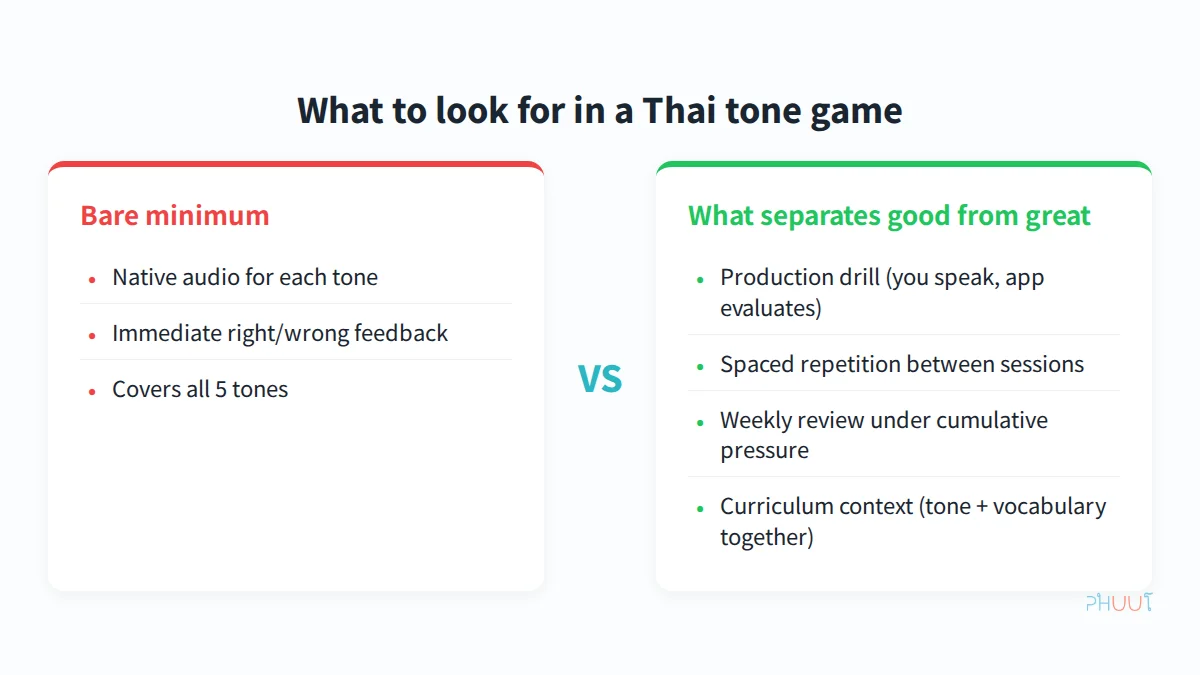
1. Does it use native audio for all 5 tones?
Your ear calibrates to whatever reference it gets. If the audio is synthesized text-to-speech, your calibration point is off before you start. A tone game should feature a native Thai speaker producing each target tone clearly. This isn’t a premium feature - it’s the baseline. Without it, you’re training your ear to a degraded model.
2. Does it give immediate feedback on errors?
When you answer incorrectly, does the correct answer appear instantly? Or do you have to tap to reveal it, or wait for the session to end? The delay between error and correction matters for memory encoding. The shorter the gap, the stronger the connection between “what I produced” and “what was correct.” Games that bury the correction inside a post-session summary lose most of the benefit.
3. Does it re-expose you to errors within the same session?
This is the difference between a quiz and a learning tool. A quiz shows you what you got wrong at the end. A learning tool shows you the wrong item again later in the same session, before you close the app. Spaced re-exposure within a session is what converts a short-term correction signal into a learning event. Without it, getting something wrong is just information. With it, getting something wrong becomes the beginning of a correction cycle.
4. Does it include a production component?
Covered above, but worth restating as a checklist item: does the app accept spoken input and evaluate it? If yes, how granular is the feedback - pass/fail only, or does it tell you which tone you produced? Tone-specific feedback is significantly more useful than pass/fail because it tells you the direction of your error, not just whether one occurred.
Applying the checklist to the current tools:
Thai Tone Trainer clears the first three points cleanly. The adaptive algorithm is well-implemented - it resurfaces the words you miss without any configuration on your end. The gap is point 4: there is no microphone, no spoken input, no feedback on your voice.
Thai Tone (iOS app) passes points 1 and 2. Its progressive difficulty structure is useful for beginners. It fails points 3 and 4.
Ling App passes points 1 and 2, partially passes point 3 (spaced repetition exists across sessions but is less structured within a session), and partially passes point 4 (speech recognition exists but is not tone-specific - it checks pronunciation broadly, not which of the 5 tones you produced).
StudyThai.ai offers the most inventive game formats of the group - the tone-matching 2048 variant is genuinely engaging and passes points 1 and 2. Where it drops off: the within-session error queue is thin, so mistakes tend to slip through without a second look. And like most of the field, it doesn’t touch point 4.
Phuut passes all four points. Eight distinct game modes include dedicated listening discrimination and AI-scored production drills. Errors in any game mode feed into a spaced repetition queue that resurfaces them across sessions.
How Phuut Builds Game-Based Tone Practice Into Its Curriculum
Most tone practice tools treat tones as a standalone topic - you drill the 5 tones in isolation, then separately learn vocabulary. Phuut’s design starts from a different premise: tone errors are most likely to occur on words you already know, in the moment you’re trying to use them. Practicing tones in isolation doesn’t replicate that pressure. Phuut’s eight modes - multiple-choice quiz, listening discrimination, pronunciation drill, Thai script recognition, typing, matching, flashcards, and Boss Battle - span passive input to active output, but only listening discrimination and pronunciation drill target tones directly.
Tone-aware vocabulary clustering
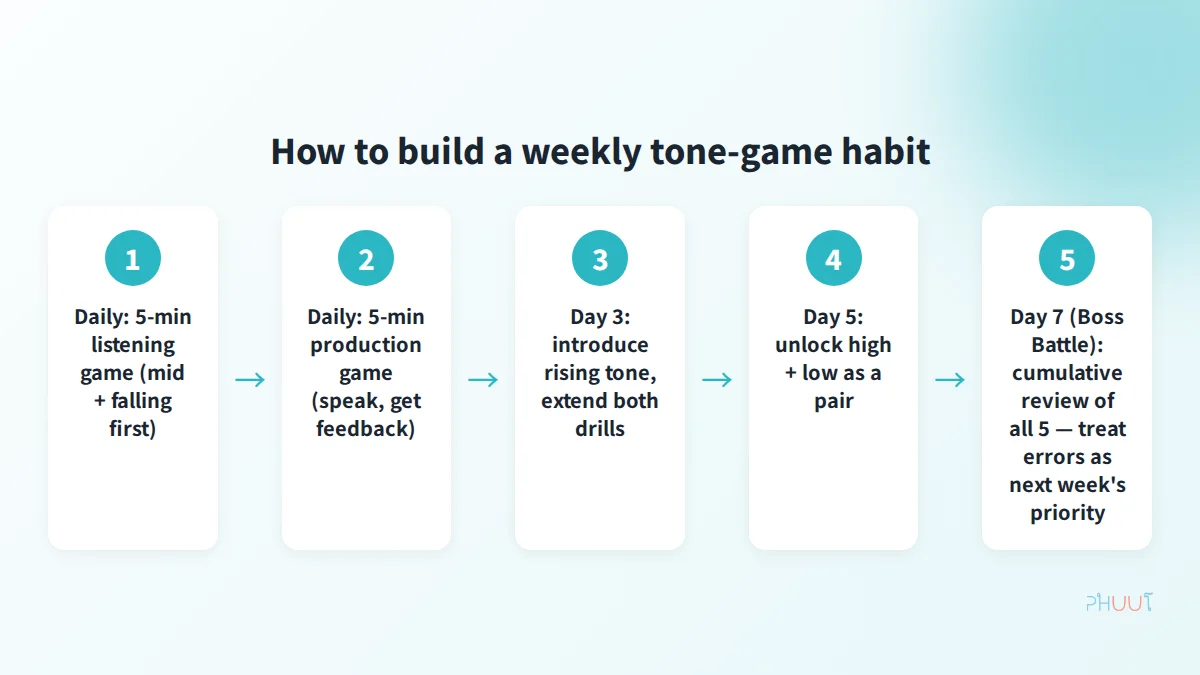
The A1 curriculum introduces words in tone-aware clusters. Mid-tone words appear first because mid is the easiest production target - flat, no movement, no direction. Falling-tone words come next. The curriculum doesn’t ask you to practice the high tone on Day 1. You encounter tones in the sequence where each new addition is clearly distinct from what you already know.
The listening discrimination mode
One of the 8 game modes presents two similar words - often a minimal pair - and asks you to identify which tone changed. มา (mid, to come) versus หมา (rising, dog). You hear both, you identify the change, you get immediate feedback. This builds the same auditory discrimination skill that Thai Tone Trainer trains, but inside vocabulary you’re actively learning rather than in tonal abstraction.
The pronunciation game
You see a word, speak it, and the AI evaluates the tone you produced. The game tells you whether your output matched the target. This is the production component the checklist above identifies as critical and the one most tools skip. Errors in this mode go into the spaced repetition queue - they’ll reappear in future sessions until you’ve answered correctly across multiple intervals.
Boss Battle: the weekly review mechanic
At the end of each week, all the words introduced that week appear in a single scored session. There’s mild time pressure. There’s a combo mechanic - drop a tone and the combo resets. Every tone class you’ve encountered that week shows up.
The reason this matters is specific: tone errors are much more likely under cognitive load. In a calm drill session where you’re focused on one word at a time, your production is as good as it gets. In a real Thai conversation, you’re tracking meaning, formulating a response, watching the other person’s face, and managing tone production simultaneously. The Boss Battle doesn’t replicate all of that, but it simulates the cumulative-pressure condition better than any individual drill session. You find out which tones are genuinely automatic and which ones you still drop when the stakes go up slightly.
Logging which tones you drop in a Boss Battle session is practical: those tones become the focus of your listening and production drills the following week.

Master Thai tones with real audio
Free on iOS & Android
Staring at tone charts doesn't work. With Phuut you record yourself, get instant feedback, and hear how close you actually are.
- AI conversation drills you on all 5 tones in context
- Native audio paired with Paiboon transliteration
- Voice recording with automatic accuracy feedback
- Practice minimal pairs like ข้าว vs ข่าว every day
Once your tone practice is running consistently, aspiration - the h vs. kh vs. ph distinction - is the next pronunciation layer to address. A natural way to apply tone game patterns to high-frequency vocabulary is to drill Thai numbers 1 to 100 - each number sits on a specific tone and the set covers every tone class in a single batch.
Start Small, Then Add Pressure
The 7-day routine below isn’t a schedule you need to follow rigidly. It’s a structure that shows how to sequence all 5 tones without hitting cognitive overload on day one.
The key principle: don’t add a new tone until the previous ones feel automatic in a game session. “Automatic” means you answer without hesitation, not that you answered correctly once.
Get the Thai Tone Quick-Reference Card (Free)
If you want a single-page reference for all 5 tones - with anchor words, minimal-pair examples, and the pitch shapes in plain English - enter your email below. It’s a PDF that fits on a phone screen.
If you want to test your actual tone production, try Phuut free on iOS. The pronunciation game mode gives you feedback on the tones you’re producing, which is the one thing a PDF can’t do.
Master Thai tones with real audio
Free on iOS & Android
Staring at tone charts doesn't work. With Phuut you record yourself, get instant feedback, and hear how close you actually are.
- AI conversation drills you on all 5 tones in context
- Native audio paired with Paiboon transliteration
- Voice recording with automatic accuracy feedback
- Practice minimal pairs like ข้าว vs ข่าว every day