
How to Learn Thai Script from Scratch (Adult Roadmap)
Affiliate disclosure: This article contains affiliate links. We may earn a small commission at no extra cost to you. As an Amazon Associate, we earn from qualifying purchases.
About the reviewer

Taishi Hirano
Phuut Founder
Founder of Phuut. Has observed how Japanese and English speakers stumble on Thai and built learning products around those patterns.
Follow Phuut on X →You’re in Bangkok. You look up at the sign above the restaurant doorway and see nothing - just shapes. Your phone’s translation app gives you three different romanized spellings of the word on the menu, and none of them match the sign outside. Your friend in Chiang Mai sends you a message in Thai and you can’t tell where one word ends and the next begins. Learning to learn Thai script from scratch feels overwhelming, so you keep putting it off. This article is the roadmap most Thai learning resources skip: a week-by-week adult learning sequence that takes you from zero to reading real words, backed by research and built on the one insight that changes everything - the script is not an obstacle. It’s the shortcut.
- Why Thai Script First - The Research-Backed Case
- Understanding the Thai Script System Before You Memorize Anything
- The 4-Week Roadmap: From Zero to Reading Thai
- Writing vs. Just Looking - Why Tracing Accelerates Learning
- How Phuut’s Thai Script Mode Fits Into This Roadmap
Why Thai Script First - The Research-Backed Case
Most people learning Thai assume the script is the hard part - something you tackle after you’ve got the basics. That assumption is backward.
Script-first learning is not the harder route. Research suggests it’s the faster one.
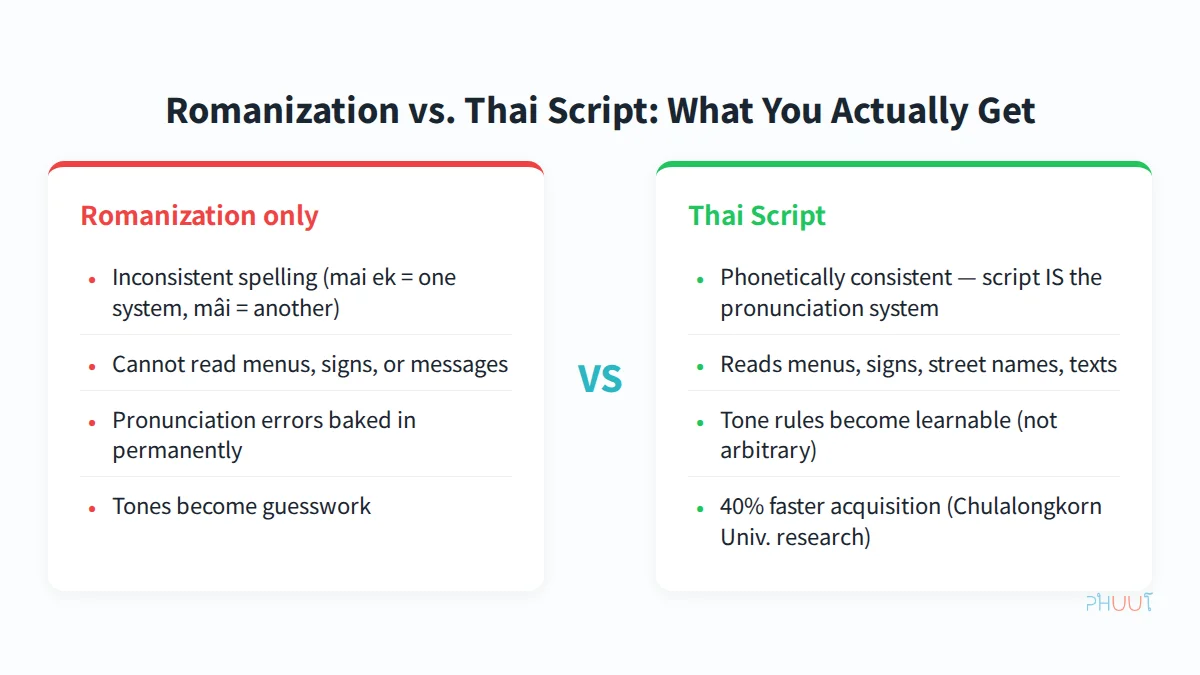
The reason this makes sense when you look at what Thai script actually encodes. Every Thai consonant carries a class - mid, high, or low - that determines the possible tones a syllable can carry. Every vowel mark has a fixed position around the consonant cluster, and that position tells you how to decode the syllable. The writing system is the pronunciation system. Romanization is a translation of it, and like all translations, it loses information.
When you read Thai script, the tone is baked into the letters. When you read romanization, the tone is a guess.
The Romanization Trap
Here’s the specific problem. Thai has several competing romanization systems - Royal Thai General System (RTGS), Paiboon, Haas - and none of them agree on spelling. The word for rice (ข้าว) is “khao” in RTGS and “kâao” in Paiboon. The word for “to go” (ไป) is “pai” in RTGS and “bpai” in Paiboon. Street signs often use neither system, just a phonetic approximation that the sign-maker felt matched.
So a self-learner who studies from three different sources ends up with three different spellings of the same word - and no way to verify pronunciation except by listening again. The “ph” in RTGS is an aspirated /p/ (think “pot” with a puff of air), not the English /f/ sound. But most beginners read it as /f/ and bake that error in permanently.
Here’s what the script reveals that romanization hides, across four real examples:
That last column - “Script reveals” - is what you lose when you rely on romanization. The falling tone on ข้าว (rice) is entirely predictable from the script. It’s not memorized; it’s derived. Romanization gives you neither the tools to derive it nor any indication that you should try.
The gains from script-first study compound quickly. By Week 3 you can read real-world Thai - menus, signs, messages, street names - because tone rules become learnable rather than arbitrary once you can see consonant class in the letters themselves. That combination breaks the dependency on romanization that creates inconsistent pronunciation in the first place.
Forty-four consonants looks like a lot. But you need only 9 to start reading real words in 3 days. The article’s roadmap in H2-3 starts there.
Understanding the Thai Script System Before You Memorize Anything
Before you memorize a single character, spend 20 minutes understanding the structure of the system. It’ll save you weeks.
The Thai script has three layers:
- 44 consonants organized into three classes (mid, high, low)
- 32 vowel forms arranged in 5 positional patterns around consonants
- 4 tone marks that modify the default tone of a syllable
That sounds like a lot. But the consonants have internal logic (shared sub-components, class groupings), the vowels follow position rules rather than random placement, and the tone marks are just 4 diacritics. Once you see the system, the scope feels very different.
The Three Consonant Classes
Every Thai consonant belongs to one of three classes. This class, combined with vowel length and any tone marks, determines which of the 5 tones the syllable carries. Tone rules are entirely predictable - once you know the class of the consonant you’re reading.
The best entry point is mid-class consonants. There are 9 of them, their tone rules have no exceptions, and 6 of them (ก ด ต บ ป จ) appear constantly in everyday Thai vocabulary. Starting with mid-class removes the class variable from the equation while you build your reading foundation.
For the practical purposes of Week 1 study, focus your energy on the first 7. ฎ and ฏ are archaic forms that appear rarely in modern Thai text - learn them for completeness, but don’t let them slow you down.
For a deeper treatment of how consonant classes govern every tone outcome in the language, see our full guide to Thai consonant classes.
Vowel Marks Are Positions, Not Just Symbols
English speakers read left to right, top to bottom, in a fixed linear order. Thai doesn’t work that way. Vowel marks wrap around the initial consonant in 5 possible positions: before, after, above, below, or surrounding it. You can’t read Thai in a single left-to-right pass - you scan the consonant cluster first, then locate the vowel marks.
The 5 positions are learnable in a single sitting. And once you know them, every new vowel mark you encounter is just a new member of a familiar family - not an isolated shape to memorize from scratch.
Our Thai vowels article covers all 5 positions and the full 32-vowel inventory in detail when you’re ready to move beyond the basics.
A Brief Word on Tone Marks
Thai has 4 tone marks: mai ek (่), mai tho (้), mai tri (๊), and mai jattawa (๋). They modify the default tone of a syllable - but which tone they produce depends on the consonant class of the syllable’s initial consonant. You’ll meet them properly in Week 4 of the roadmap. For now, just know they exist and what they look like.
The 4-Week Roadmap: From Zero to Reading Thai
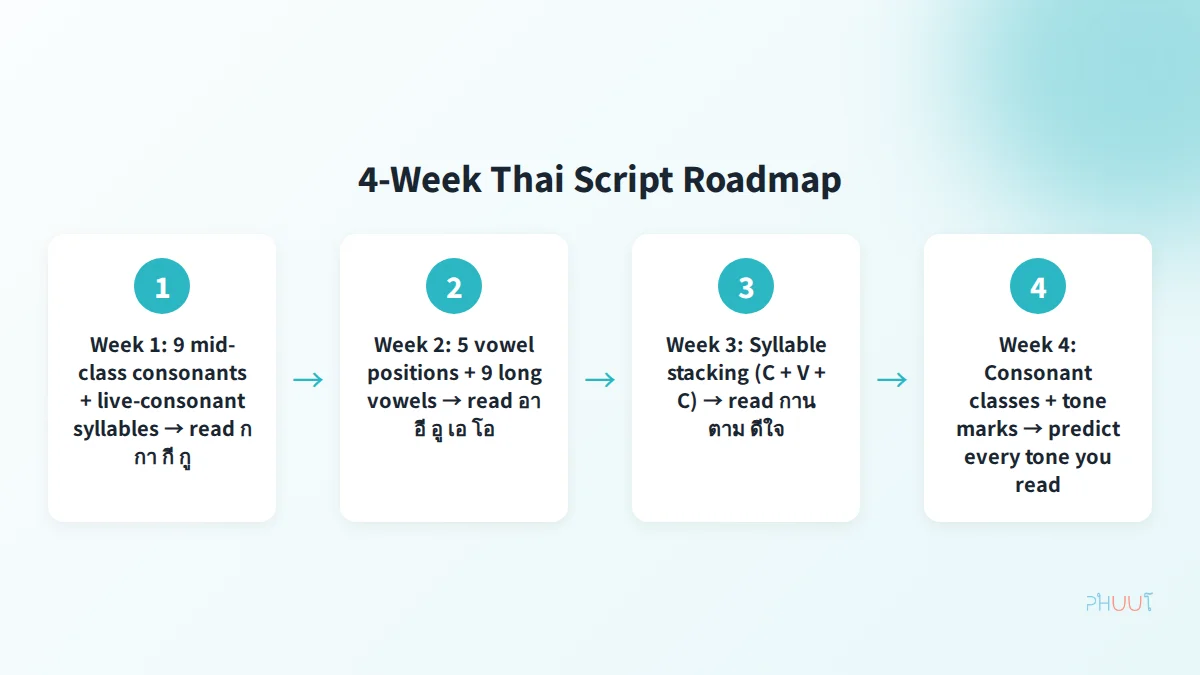
Here’s the core argument most Thai learning resources ignore: you don’t need all 44 consonants to start reading. You need 9. And you can get to those 9 in the first week, reading real Thai words by Day 3.
The problem with most approaches is that they dump the entire consonant table on you at once. The overwhelm kicks in around consonant 15, and most learners quietly give up and go back to their romanization phrasebook. The sequence below is designed specifically for adult learners with 30-60 minutes per day.
Week 1 in Detail: Your First Reading Wins
Week 1 is the most important week, because it either builds momentum or kills it.
You’re learning these 9 consonants:
Learn them by tracing - stroke order matters, and the next section explains why. Pair each with its mnemonic word (ก ไก่ = “gaw gai,” the chicken). These are the traditional Thai alphabet-learning rhymes, and they work.
By Day 3, try this: take each consonant you’ve learned and add the long vowel า after it. You’ve just created live syllables - กา (a crow, or a kettle), ตา (eye, or grandfather depending on tone), ดา (a proper name), บา (four, in counting), ปา (to throw). You’re reading Thai. Not perfect Thai, not tonal Thai yet - but real Thai characters forming real words.
By Day 5, add three more long vowels: ◌ี, ◌ู, and เ◌. Now you can read ดีใจ (happy), กีตาร์ (guitar), and start sounding out two-syllable words. The script is unlocking.
Week 3: The First Real Sentence
By Week 3, you’re combining consonants, vowel marks, and final consonants. Sonorant finals (ง น ม ล ย ว) and stop finals (ก ด บ) aren’t a new alphabet - they’re the same consonants you’ve been learning, just appearing in a different slot in the syllable structure.
This is when you first read สวัสดี (sawasdee, hello) and recognize the individual components rather than treating it as a magic string of symbols. That moment of decoding a real word is the tipping point most learners describe as the moment the script started to “click.”
Week 4: Tones Become Predictable
Tone rules are the final piece. Once you understand consonant class - and you’ve been building that foundation since Week 1 - the rules follow logically. Mid-class syllables: live syllable = mid tone, dead syllable = low tone. Add mai ek (่) and the tone drops; add mai tho (้) and it falls. The rules aren’t arbitrary once you can see the consonant class.
The Thai tones article gives you the complete rule system once you have your consonant class reading in place.
Writing vs. Just Looking - Why Tracing Accelerates Learning
Here’s a question most Thai learning guides skip entirely: should you write the characters, or just learn to recognize them?
The answer matters more than most people expect.
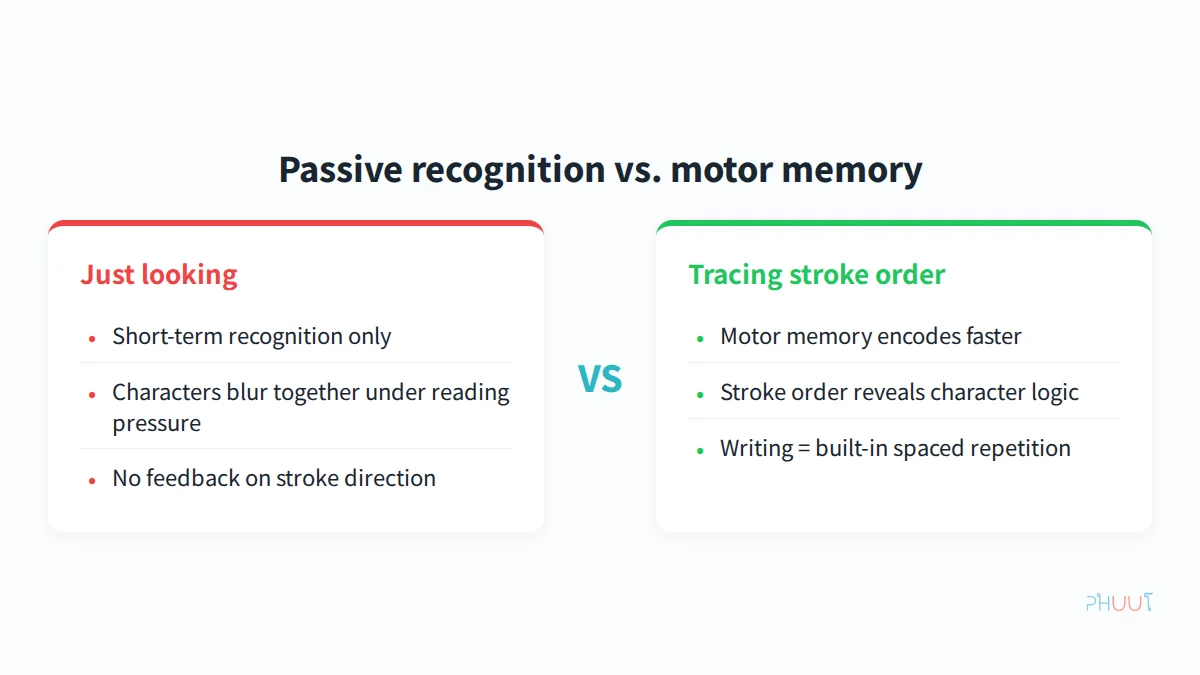
Tracing characters - following the correct stroke order with a pen or finger - encodes them significantly faster than staring at flashcards. Think about learning to ride a bike - once your hands know the balance, your brain stops having to think about it. Writing Thai characters works the same way. Motor memory and visual recognition memory are stored separately, and when you trace a character you’re building both at once. The two systems reinforce each other in recall.
The practical result: in Anki community forums and language learning subreddits, learners who trace characters consistently report automatic recognition within 1-2 weeks. Learners who rely on recognition-only drilling typically take 3-4 weeks to reach the same level - and under reading pressure (scanning a real menu, a street sign, a text message), the recognition-only memories tend to blur. The visual memories of similar-looking characters (and many Thai consonants share visual sub-components) compete with each other. Motor memories don’t have that problem.
There’s a second, less obvious benefit to stroke order: it reveals character structure. Thai consonants share sub-components. The circular base that appears in ก and ข and ค and ง is the same stroke. Once you learn stroke order, you start to see the families that characters belong to - and new characters become additions to known patterns, not random new shapes.
You don’t need to become a Thai calligrapher. Five minutes of tracing per study session - one new character at a time, with the 5-step drill above - has a disproportionately large payoff. The writing skill itself is secondary. The motor encoding is the goal.
How Phuut’s Thai Script Mode Fits Into This Roadmap
Most Thai learning apps treat the script as an afterthought - a character chart you can consult before getting back to vocabulary and phrases. Phuut’s Thai script mode is different in one specific way: it includes handwriting tracing with stroke-order feedback.
When you practice a consonant in Phuut’s script mode, you trace the character on screen following the correct stroke sequence. The app gives you immediate feedback on direction and order, not just whether you got the final shape right. This implements exactly the motor-encoding principle described in the previous section - the tactile drill with a diagnostic layer that paper practice alone doesn’t provide.
The broader app structure also reinforces the script roadmap in a way that helps with weekly progress. Vocabulary in Phuut’s A1 curriculum is introduced in consonant-class batches, which means the characters you’re learning in script mode show up immediately in vocabulary practice. The script roadmap and vocabulary roadmap reinforce each other rather than running in parallel without connection.
Phuut’s game modes - 8 in total, including a Boss Battle weekly review and pronunciation practice - create active recall under mild time pressure. That’s the real-world reading condition: you don’t get to stare at a sign for 30 seconds and sound out each character. Mild pressure during practice is useful.
Pricing is $4.99/month for Pro (which removes limits on hearts and AI conversation practice), with a free tier that covers the core script mode. If you’re working through the 4-week roadmap described here, the free tier is enough to get started.
If you want stroke-order tracing with automatic feedback built in, try Phuut’s Thai Script mode free on iOS.
A practical first application once the script clicks is reading Thai numbers - every consonant class, several common vowels, and the full tone-rule system show up in just the numbers 1 to 100. The Thai numbers guide doubles as a sanity check for how well your script practice is sticking.

Don't just read Thai — write it
Free on iOS & Android
Many learners can recognize Thai script but freeze when asked to write. Phuut's handwriting tab lets you trace letters directly on screen.
- Trace all 44 consonants and vowel marks on screen
- Stroke-order guidance with instant red-line feedback
- Paired Paiboon transliteration links sound to script
- 5 minutes a day builds writing muscle that boosts reading too
Short daily sessions - 20 to 30 minutes - consistently outperform long infrequent sessions for script drilling. The brain consolidates the motor patterns during rest, and returning to a character the next day after sleep produces faster retention than grinding through it for two hours in a single sitting. If you struggle to maintain focus during your study window, background focus music can help sustain concentration without becoming a distraction.
Frequently Asked Questions
Don't just read Thai — write it
Free on iOS & Android
Many learners can recognize Thai script but freeze when asked to write. Phuut's handwriting tab lets you trace letters directly on screen.
- Trace all 44 consonants and vowel marks on screen
- Stroke-order guidance with instant red-line feedback
- Paired Paiboon transliteration links sound to script
- 5 minutes a day builds writing muscle that boosts reading too