
Learn Thai Without Romanization: Tone Marks Explained
Affiliate disclosure: This article contains affiliate links. We may earn a small commission at no extra cost to you. As an Amazon Associate, we earn from qualifying purchases.
About the reviewer

Ramy Hirano
Phuut Founder
Founder of Phuut. Has observed how Japanese and English speakers stumble on Thai and built learning products around those patterns.
Follow Phuut on X →This article may contain affiliate links. We may earn a commission at no extra cost to you.
I was at a street stall near Hua Lamphong, the old Bangkok train station, trying to order rice. My phrasebook said “khao.” I said it. The vendor nodded, disappeared, and came back with something I did not order. She looked at my phrasebook, smiled, reached for a notepad, and wrote two words down: ข้าว and เข้า. Same romanization. Different marks above the ข. I had been trying to learn Thai without romanization for three weeks and already hit the wall that romanization always builds in the end: you can sound a word out, but you can’t tell which word it is, because the tone that distinguishes them is invisible in the letters.
What the vendor wrote on that notepad is what this article is about. Not the full 44 consonants. Not the complete tone system. The 4 marks - ไม้เอก ่, ไม้โท ้, ไม้ตรี ๊, ไม้จัตวา ๋ - and the one reading order that makes them usable: class first, mark second. That’s the minimal viable upgrade from romanization to script, and it’s available the moment you decide to learn it.
In this article
- Why Romanization Hits a Ceiling (and Where Exactly It Breaks)
- The 4 Thai Tone Marks: What They Look Like and What They Do
- How to Actually Read a Tone Mark (The 3-Step Workflow)
- From Tone Marks to Real Reading - What Changes When You Drop Romanization
Why Romanization Hits a Ceiling (and Where Exactly It Breaks)
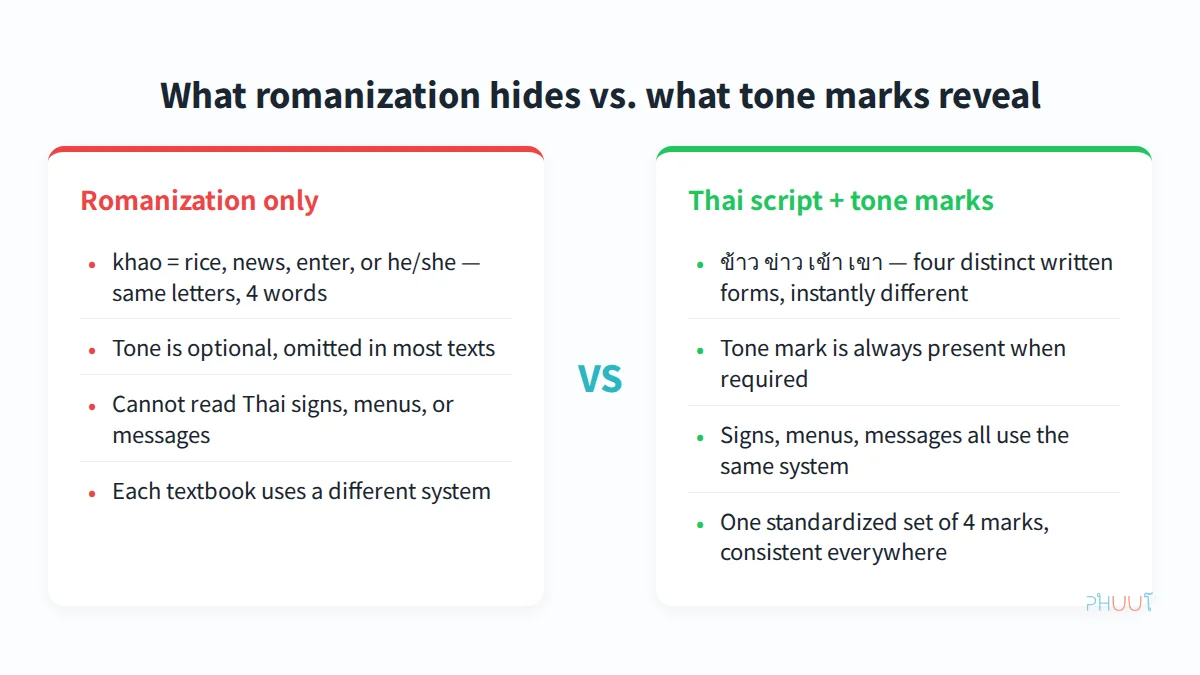
The problem with romanization is not that it’s wrong. For the first few weeks of Thai study, romanization is a functional tool. You can approximate sounds, build vocabulary, and follow a phrasebook without knowing a single Thai letter. The problem is structural: romanization was designed to represent sounds, and Thai tone isn’t entirely a sound property - it’s partly a writing-system property. It lives in the script in a way that has no reliable counterpart in any romanization convention currently in use.
Point: Romanization isn’t wrong - it’s structurally incomplete. It can’t represent tones reliably.
Thai has five competing romanization systems - RTGS (the official Thai government standard), Paiboon, Haas, AUA, and ISO 11940 - and none of them consistently encodes tone. RTGS, which is what you see on highway signs and official transliterations, encodes zero tonal information by design. Paiboon adds tone diacritics (à â á ǎ a), but only when authors bother to include them, and different textbooks and apps use different marks for the same tones. By the time you’ve worked through two different beginner resources, you’re reading two different romanization conventions simultaneously, and neither of them is reliably telling you what tone to produce.
Reason: The 5 tones are encoded in the script through tone marks and consonant class together. No romanization system captures both consistently.
The clearest demonstration of this is a single syllable: “khao.” In RTGS romanization, the following Thai words are all romanized as “khao”:
Four different words. Four different tones. One romanization spelling. The script tells them apart instantly - each has a different mark, or no mark, above the initial consonant ข - but the romanization can’t, because it was built to encode sound, not the tone system that rides alongside the sound.
Evidence: That table is not a footnote problem or a regional dialect variation. It’s the ceiling that every romanization system hits when it encounters Thai. The ceiling isn’t arbitrary. It’s structural. Thai tones are encoded in a two-variable system: consonant class and tone mark. Romanization can approximate one of those variables (sometimes, inconsistently) but never both at once.
Point reinforced: Here’s the good news that most articles about Thai tones fail to lead with. You don’t need all 44 consonants to step over the romanization ceiling. You need 4 tone marks and the knowledge of which class a consonant belongs to. That’s the minimum viable upgrade - and it’s what this article covers.
The 4 Thai Tone Marks: What They Look Like and What They Do
Point: There are 4 marks, 5 tones, and one design decision that explains the gap: the mid tone needs no mark.
Before walking through each mark, it’s worth resolving the asymmetry that confuses almost every beginner: if Thai has five tones (mid, low, falling, high, rising), why are there only four tone marks?
Once that clicks - “no mark” isn’t an absence of information, it’s a piece of information - the 4-mark system stops feeling incomplete and starts feeling logical. The mid tone is the default for mid-class consonants in live syllables. Writing a mark to produce the mid tone would be redundant. The script encodes tone marks only where they depart from the default.
Now, the four marks.
ไม้เอก (่) - mái èek
The simplest shape in the set: a single short vertical stroke written above the initial consonant of the syllable. The name means “first mark” - เอก (ek) is “one” in Thai - and the shape matches the name: one stroke, nothing more.
What it does:
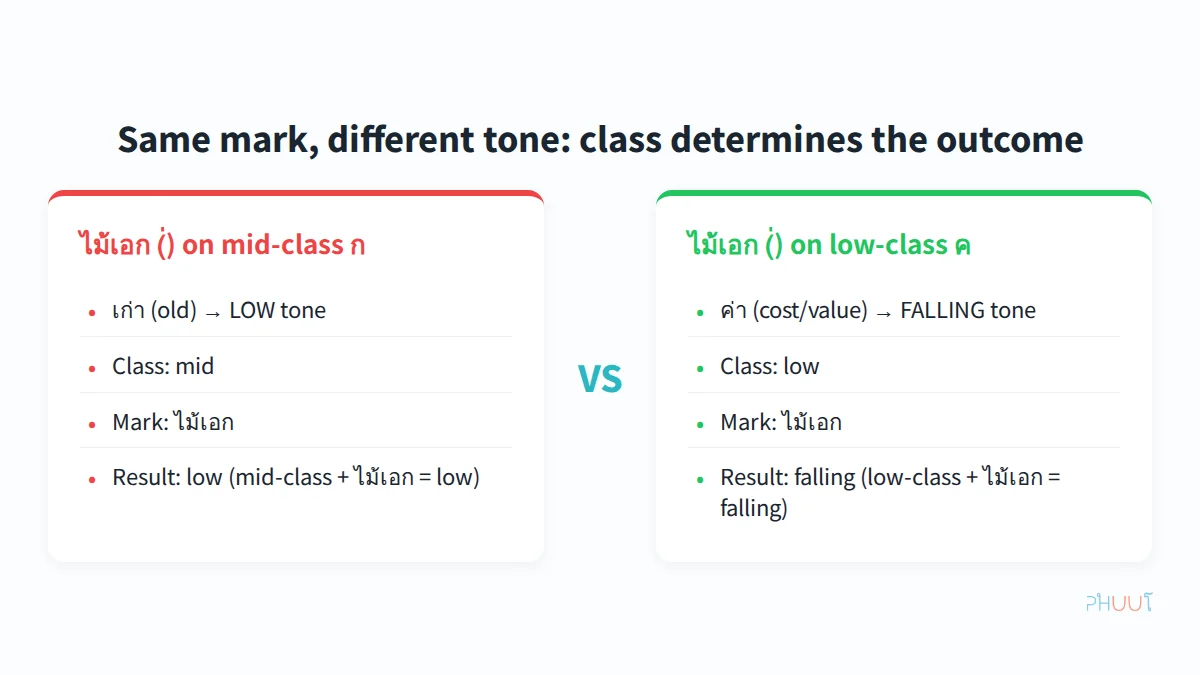
- On a mid-class consonant: low tone. Example: เก่า (gào, “old”) - mid-class ก plus ่ = low.
- On a high-class consonant: low tone. Example: ข่าว (khào, “news”) - high-class ข plus ่ = low.
- On a low-class consonant: falling tone. Example: ค่า (khâa, “cost/value”) - low-class ค plus ่ = falling.
Shape mnemonic: one stroke, one tone move. The mark is minimal; the outcome is the most common departure from the default across all three classes.
ไม้โท (้) - mái thoo
A curved shape that looks like a backwards 2 or a small hook, written above the initial consonant. The name means “second mark” - โท (tho) is “two.” The shape has more curves than ่: where ่ goes straight down, ้ curls.
What it does:
- On a mid-class consonant: falling tone. Example: เก้า (gâao, “nine”) - mid-class ก plus ้ = falling.
- On a high-class consonant: falling tone. Example: ข้าว (khâao, “rice”) - high-class ข plus ้ = falling.
- On a low-class consonant: high tone. Example: น้ำ (náam, “water”) - low-class น plus ้ = high.
Shape mnemonic: the curl signals more movement than the straight stroke of ่. Mid and high class both fall; low class - which runs in the opposite direction from the other two for this mark - rises to high. (That’s the one reversal that needs separate attention.)
ไม้ตรี (๊) - mái trii
A small looping character above the consonant. The name means “third mark” - ตรี (tri) is “three.” The shape is compact and circular, easy to miss on dense Thai text if you’re not looking for it.
What it does:
- On a mid-class consonant: high tone.
- High-class and low-class consonants: not used. This is the first of the two restricted marks.
Shape mnemonic: a small loop. The tone it produces - high - matches the feeling of something coiled tightly upward.
Practical note: ๊ (mai tri) appears mainly in loanwords and formal/royal registers - you’ll encounter it far less than ่ and ้ in everyday text.
ไม้จัตวา (๋) - mái jàt-ta-waa
A small cross or plus-sign shape above the consonant. The name means “fourth mark” - จัตวา (jattawa) is “four.” Of the four marks, this one looks least like a diacritic and most like a geometric character placed on top of the word.
What it does:
- On a mid-class consonant: rising tone. Example: กั๋ว with ๋ on mid-class ก - rising.
- High-class and low-class consonants: not used. The second restricted mark.
Shape mnemonic: a cross, a different shape entirely from the other three marks. The rising tone feels like the mark itself - going up in two directions at once.
Practical note: ไม้จัตวา is rarer still than ไม้ตรี in common text. It appears almost exclusively in loanwords and certain formal registers. For everyday reading fluency, focus on mastering ่ and ้ first; ๊ and ๋ will come naturally once the two-mark foundation is solid.
The restricted-class insight
Here’s the structural fact that explains why the tone grid looks the way it does - and that no top-10 article about Thai tones addresses:
High-class and low-class consonants cannot carry ไม้ตรี or ไม้จัตวา.
This isn’t a rule you need to memorize separately. It’s a consequence of the design: mid-class consonants are the most expressive class in the tone system. They can reach all 5 tones using no mark (mid), ่ (low), ้ (falling), ๊ (high), and ๋ (rising). High and low class each reach only 4 tones - because each is restricted to 2 marks plus the class defaults, and ๊ and ๋ aren’t available to them.
The practical payoff: when you see ๊ or ๋ on a Thai word, you already know the consonant is mid-class before you even look at it. The mark and the class are mutually constraining.
A good structured Thai reference grammar extends the class-mark grid with worked examples across every syllable type - live and dead, short and long vowels. If you want a printed reference to keep open while you drill, a Thai reference grammar is the strongest complement to the system this article lays out.
How to Actually Read a Tone Mark (The 3-Step Workflow)
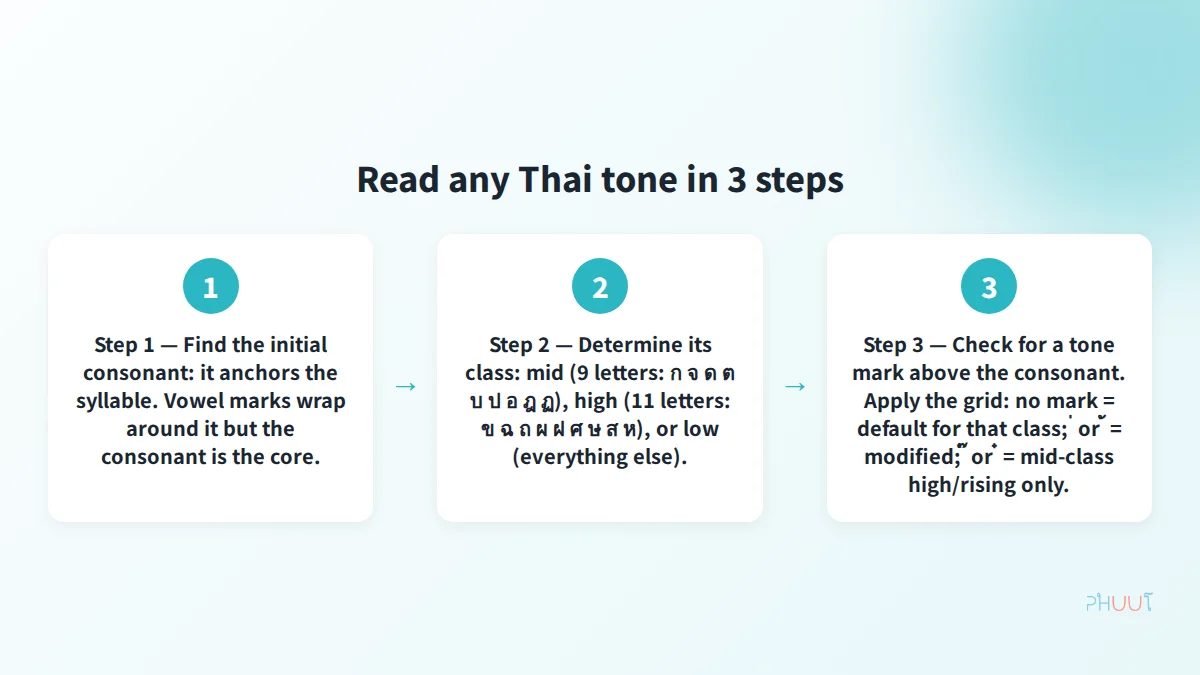
Point: The tone mark grid is only useful if you apply it in the right order. Class first, then mark. Every article about Thai tones shows the grid. None of them teach the order of operations.
Here is why the order matters. I was walking down Yaowarat Road - Bangkok’s Chinatown strip - a few months into reading Thai script, and I stopped at two signs almost next to each other. The first was a shop selling old furniture: เก่า (gào) in large characters, ่ above the ก. Low tone: the single stroke on a mid-class consonant. A second later, I saw a food stall banner with เคล้า (this is a cooking term, meaning to mix or knead ingredients together), also with ่ - but above ค, which is low-class. My brain, by reflex, said “low tone.” It was wrong. ่ on low-class ค produces falling tone.
Same mark. Different class. Different tone. This is not an exception. It is the design.
The reason this surprises learners is that most resources teach tone marks as if they were absolute instructions - ่ means low, ้ means falling. They’re not. They’re modifiers. The class of the initial consonant is the base setting; the mark is what you add to shift from that base.
Reason: Reading the mark before the class gives the wrong tone a significant portion of the time. The class-before-mark order isn’t a stylistic preference - it’s the only order that produces correct predictions.
The 3-step workflow
This workflow looks obvious once it’s written out, but the reason to write it out is that most Thai learners never make it explicit. They see a mark, try to recall what it “means,” and come up with something that’s sometimes right. Making the order of operations conscious - class first, always - is what converts the grid from a lookup chart into a prediction tool.
Evidence - the full grid:
Don’t try to memorize this grid whole. Use it as a lookup table while you build the 3-step habit. Once the habit is established, you’ll find you no longer need to consult it for ่ and ้ on mid and high class, because those four combinations will have become automatic.
A few observations the grid rewards:
- The mid-class row is the most complete: it has a defined tone for every mark plus both default types (live and dead). Mid-class is where you learn the full range of the system.
- The high-class row and the low-class row each have gaps (-) in the ๊ and ๋ columns. Those gaps aren’t errors in the table - they’re the restricted-class rule from H2-2, now visible as structure.
- ่ on mid and high class both produce low tone. ้ on mid and high class both produce falling tone. These pairs are the same across two of the three classes, which means once you’ve drilled mid-class, high-class drills at half the cognitive cost.
- Low class runs counterintuitively for both ่ and ้: where mid and high class fall (low, falling), low class reverses the direction (falling, high). That’s the one exception that requires separate attention.
Practice note: Begin with mid-class consonants and ่ and ้. That single combination - two marks on one class - covers a very large proportion of marked syllables in everyday Thai vocabulary. Add high-class next (same outcome for ่ and ้ as mid). Add low-class last, because it runs against the pattern you’ve already built.
For the 9 mid-class and 11 high-class consonants you need to classify syllables correctly (ฃ is obsolete; you’ll see 9 mid-class in practice), the Thai consonant classes article covers the memorization system - including the 20-letter shortcut that makes classification instant.
From Tone Marks to Real Reading - What Changes When You Drop Romanization
Point: Tone marks aren’t the hardest part of Thai reading - they’re the part that makes all other reading make sense.
There’s a specific experience that happens once the 3-step workflow starts to feel automatic. You look at a Thai word - one you already know from romanization - and instead of recognising it by shape or by guessing the sound, you predict its tone before you’ve fully processed the meaning. The information was always there in the script. You just couldn’t read it.
Some words you already know become readable in a new way once tone marks are visible to you:
- กา - no mark on mid-class ก in a live syllable. Mid tone, by the default rule. (crow; also the word for coffee pot)
- ข้าว - ้ on high-class ข. Falling tone. Rice.
- ดี - no mark on mid-class ด in a live syllable. Mid tone. Good.
- เก่า - ่ on mid-class ก. Low tone. Old.
- น้ำ - ้ on low-class น. High tone. Water.
Every one of those was a guessing game in romanization. Every one of those is a prediction in the script. The tone information is not implied or approximate - it’s written.
Reason: Once you can predict a syllable’s tone from its mark and class, you stop guessing. Signs, menus, and messages give you tonal information that was invisible in romanization. That’s the ceiling, behind you.
The practical milestone to aim for first: make ่ and ้ on mid-class consonants automatic. When you can read เก่า and เก้า without consulting the grid, move to high-class. Then low-class. The grid doesn’t need to be learned whole. It’s learned column by column, starting with the column that covers the most ground.
A word on what this article doesn’t cover: dead syllables. When a syllable ends in a stop consonant (ก, ด, บ, and their paired letters) or has a short vowel and no final consonant, the tone rules shift - the default tones for each class change, and the mark interactions follow different patterns. This article is specifically about live syllables and the 4-mark system as it applies to them. For the complete tone rule system, including dead syllables, the Thai tones article covers the full picture.
Evidence: The consonant + vowel + tone mark combination is the complete syllable. Mid-class ก + long า vowel + ้ tone mark = เก้า, nine, falling tone. Every variable is visible in the script. Romanization gives you “kao” and hopes you already know which word you mean.
Once tone marks are readable, the next piece of the script roadmap is the vowel system - the other visual component of a complete syllable. The Thai script beginner reading article covers the full sequence from zero to reading, including where tone marks and vowels fit in the learning order.
Phuut’s Thai script game mode practices exactly this intersection: consonant class and tone mark together, so the 3-step workflow becomes automatic recognition rather than deliberate calculation. Each drill presents the class and the mark in combination; you predict the tone. The repetition builds the habit that the grid alone cannot.
Once ่ and ้ on mid-class feel automatic, the romanization ceiling is behind you - and everything written in Thai starts to give you information romanization never could.

Once you can predict tones from marks and class, a single session with a native Thai speaker to drill the distinction out loud - especially ่ versus ้ on low-class consonants, where the direction reverses - locks in the auditory correlate of what you have been reading on the page. That closed loop between reading prediction and live pronunciation is the fastest way to turn the 3-step workflow into a reflex.

Don't just read Thai — write it
Free on iOS & Android
Many learners can recognize Thai script but freeze when asked to write. Phuut's handwriting tab lets you trace letters directly on screen.
- Trace all 44 consonants and vowel marks on screen
- Stroke-order guidance with instant red-line feedback
- Paired Paiboon transliteration links sound to script
- 5 minutes a day builds writing muscle that boosts reading too
If you want a free way to start drilling the class-mark combinations, Phuut is available on iOS. The Thai script game mode is the part to try first.
Frequently Asked Questions
Why can’t I just use romanization with tone diacritics?
You can - and for the first few weeks, it’s a reasonable bridge. The problem is consistency: no single romanization system with tone diacritics is standard across Thai textbooks, apps, signs, or menus. Paiboon uses à â á ǎ; some systems use numbers (1-5); others use IPA diacritics. When you switch between sources, the marks change. The Thai script’s tone marks, by contrast, are standardized across every Thai text ever printed - there’s one mark for each function, and they always appear the same way. The script is the only reliable system.
How many tone marks do I actually need to learn?
Four: ไม้เอก (่), ไม้โท (้), ไม้ตรี (๊), ไม้จัตวา (๋). Two of them (ไม้ตรี and ไม้จัตวา) appear almost exclusively on mid-class consonants and are relatively rare in everyday vocabulary. For practical reading fluency, mastering ไม้เอก and ไม้โท across all three consonant classes covers the vast majority of marked syllables you’ll encounter.
Do I need to learn all 44 Thai consonants before tone marks make sense?
No - and this is the key insight the article builds on. You need to know which of three classes a consonant belongs to. If you know the 9 mid-class and 11 high-class consonants, every other consonant is low-class by elimination. That’s 20 items, not 44. Tone marks become immediately useful once you can classify the initial consonant of a syllable.
Are tone marks always written in Thai?
Yes, when a tone mark is required, it’s always written - this is unlike romanization systems where tone diacritics are often omitted. However, most Thai syllables have no tone mark, because the default tone (determined by class and syllable type alone) is the most common case. In everyday Thai text you’ll see more unmarked syllables than marked ones. This is why the “no mark = default tone for that class” rule is so important.
What is the most common mistake English speakers make with Thai tone marks?
Reading the tone mark without checking the consonant class first. English speakers who have learned that ่ “means” low tone are confused when they encounter ่ on a low-class consonant and get falling tone instead. The mark is never absolute - it always modifies the class’s default behavior. The correct mental model is: “class establishes the floor; mark raises or lowers from there.”
Get the free Thai Tone Mark Cheat Sheet
The 4-mark / 3-class grid with visual shape guide, printable as a single PDF page. Covers everything in this article: all four mark shapes, the class-mark combinations, and the reading workflow. One page, printable.
By Phuut Editorial Team | Reviewed by Ramy Hirano | Last updated June 2026 | 14 min read
Don't just read Thai — write it
Free on iOS & Android
Many learners can recognize Thai script but freeze when asked to write. Phuut's handwriting tab lets you trace letters directly on screen.
- Trace all 44 consonants and vowel marks on screen
- Stroke-order guidance with instant red-line feedback
- Paired Paiboon transliteration links sound to script
- 5 minutes a day builds writing muscle that boosts reading too