
Thai Polite Particles: ครับ, ค่ะ, and คะ Explained
Affiliate disclosure: This article contains affiliate links. We may earn a small commission at no extra cost to you. As an Amazon Associate, we earn from qualifying purchases.
About the reviewer

Ramy Hirano
Phuut Founder
Founder of Phuut. Has observed how Japanese and English speakers stumble on Thai and built learning products around those patterns.
Follow Phuut on X →Thai polite particles: khrap and kha. They appear in every phrasebook from lesson one. The problem is that romanization gives you two labels for three distinct words. At a street food counter in Bangkok, the vendor says ค่ะ to close one sentence and คะ to end the next. The phrasebook shows “kha” for both. I checked the Thai script on my phone and the answer was right there: one character had a small mark sitting above the ค, the other didn’t. That single diacritic is the entire statement-vs-question distinction that romanization can’t show you.
In this article:
- Why “kha” looks like one particle when it is three
- What each particle looks like in Thai script
- How to choose the right particle every time
- How Phuut introduces these from your first A1 lesson
Why “Kha” Looks Like One Particle When It Is Three
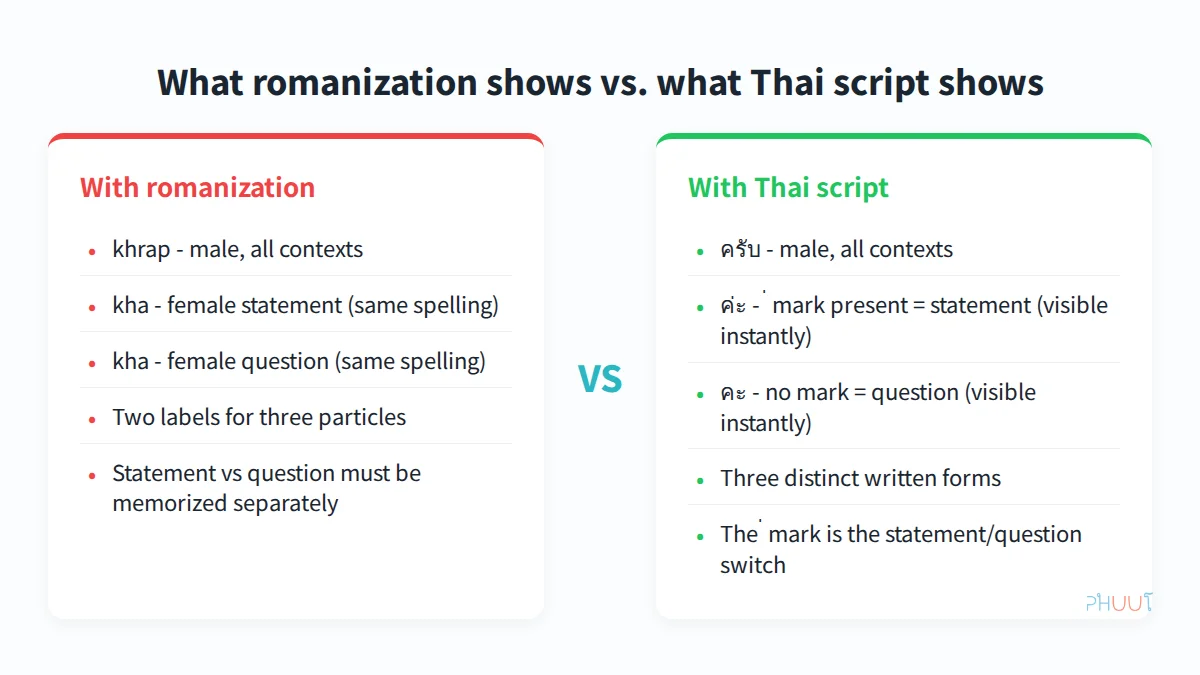
Pick up any Thai phrasebook and you’ll find two polite particles. Khrap, used by male speakers. Kha, used by female speakers. Clean, simple, two entries.
The trouble is that Thai has three particles, not two. Romanization collapses two of them into one label. The word “kha” in your phrasebook represents ค่ะ in one sentence and คะ in another. Those aren’t the same word. They have different tone marks, different tones, and different grammatical functions. Romanization doesn’t have the equipment to show you the difference.
Look at the romanization column in that table: “kha” appears twice. One entry covers female statements, the other covers female questions. Both are written as “kha” in every standard romanization system (RTGS, Paiboon, every app, every phrasebook you’ve encountered). That repetition isn’t a typo. No standard romanization method consistently encodes the distinction between ค่ะ and คะ, so they all collapse it into one label.
Thai script always shows it. ค่ะ has ไม้เอก (the ่ symbol) written above the ค - one entry from the full inventory of Thai tone marks. คะ has no ่ at all. One glance at the character tells you which particle you’re reading. That’s the discrimination romanization can’t make and Thai script makes automatically, every single time.
Male speakers get the simpler side of this. If you want to know how to use khrap in Thai, the answer is the simplest rule in Thai politeness: ครับ works for every sentence type - statements, questions, and “yes” answers all take the same particle. No tonal variation needed, no context switching, one rule. Female speakers manage two distinct particles because Thai encodes the statement-vs-question distinction in the particle itself. That’s not a flaw in the system; it’s information the script carries clearly. Romanization is what hides it.
This is what the “kha problem” feels like in practice. You’ve heard two different tones, looked up the romanization, found one label, and walked away thinking there’s some tonal nuance you’re missing. The nuance is right there: ไม้เอก, the ่ diacritic on ค. Without the script, you’re trying to reconstruct a distinction from a writing system that doesn’t encode it.
What Each Particle Looks Like in Thai Script
The fastest way to straighten out the three particles is to look at them in Thai script. Not phonetic spellings. Not romanization. The actual characters.
ครับ (khrap) is the male speaker’s particle. It has a consonant cluster (คร) at the start, but don’t let that distract you from the usage rule, which is the simplest of all three: male speaker, any context, place it at the very end. Statements, questions, answering “yes,” softening a request: every sentence type takes ครับ with no tonal variation required.
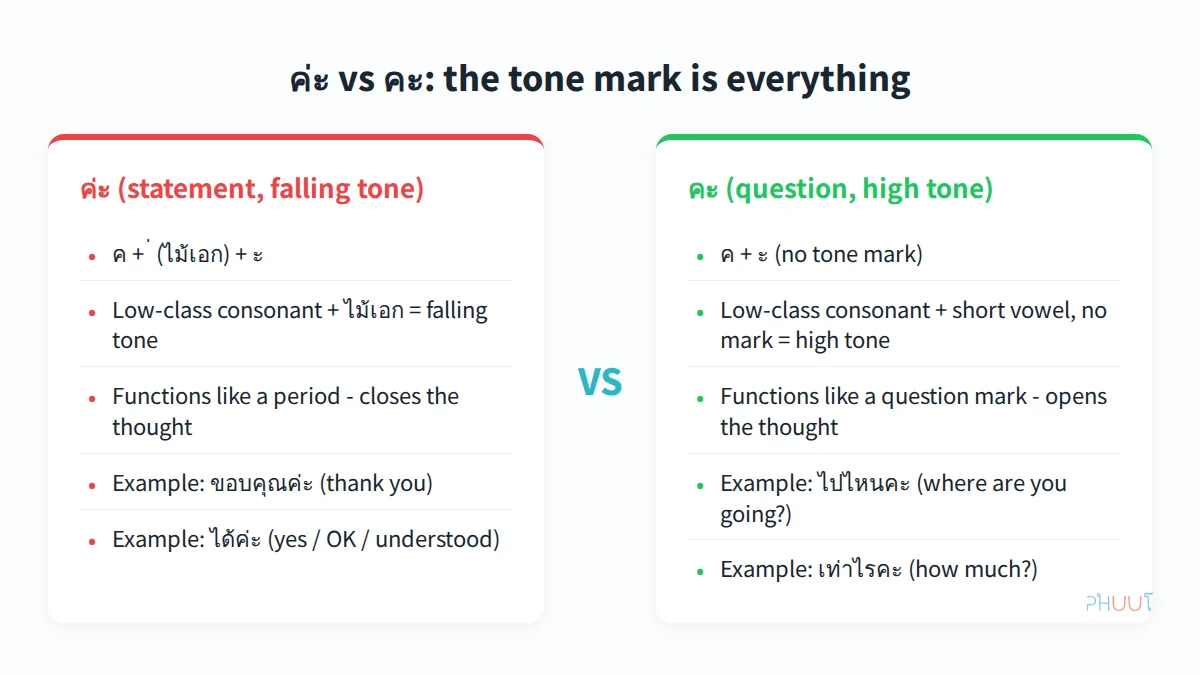
ค่ะ (kha, falling tone) is the female statement particle. Look at the character: ค, then the ่ character - ไม้เอก - sitting above it, then ะ. ไม้เอก is the signal. ค (kho khwai) is a low-class consonant in Thai. When a low-class consonant carries ไม้เอก in a dead syllable - a syllable ending in a short vowel or stop consonant - the result is a falling tone: the pitch starts high and drops. ค่ะ is exactly that kind of syllable.
What the tone mark is doing here goes beyond pronunciation. The ่ in ค่ะ functions as a grammatical binary switch: mark present = statement, falling tone, closure. Every female statement ends this way. ขอบคุณค่ะ (thank you). ได้ค่ะ (yes, understood). อร่อยมากค่ะ (very delicious). All of them: ค plus ่ plus ะ.
คะ (kha, high tone) is the female question particle. Look at this character now: ค, then ะ, and nothing else. No ่ anywhere. A low-class consonant in a dead syllable with a short vowel and no tone mark produces a high tone (sometimes described informally as “rising” in beginner resources, but the technical classification is high). The pitch sits above your comfortable speaking range and holds flat.
Its absence does the same grammatical work as ไม้เอก in ค่ะ, but in the opposite direction. No ่ means question, high tone, openness. Every female question ends this way. ไปไหนคะ (where are you going?). เท่าไรคะ (how much?). เป็นอย่างไรบ้างคะ (how are you?). All of them: ค plus ะ, nothing above.
Write both side by side on any piece of paper: ค่ะ on the left, คะ on the right. The only difference is the ่. That difference, visible at a glance, is the entire statement-vs-question distinction. There’s no easier way to keep them straight than to see them in the script, because ่ is either there or it isn’t.
If you’re reading Thai text (a menu, a text message, a social media post from a Thai account you follow), this is how you work out what someone is communicating. Look at the ค. A ่ above it means the speaker is stating something or agreeing. No ่ means they’re asking. The script does that work automatically. Romanization never could.
The ไม้เอก rule you’ve just seen - low-class consonant plus ่ plus short vowel equals falling tone - is one specific cell in Thai’s broader tone rule table. That table covers three consonant classes, five tone marks, and how dead and live syllables interact with each. A good Thai grammar reference lays the whole grid out clearly, and the ค่ะ/คะ distinction is much easier to hold in memory once you see exactly where it sits in that larger system.
How to Choose the Right Particle Every Time
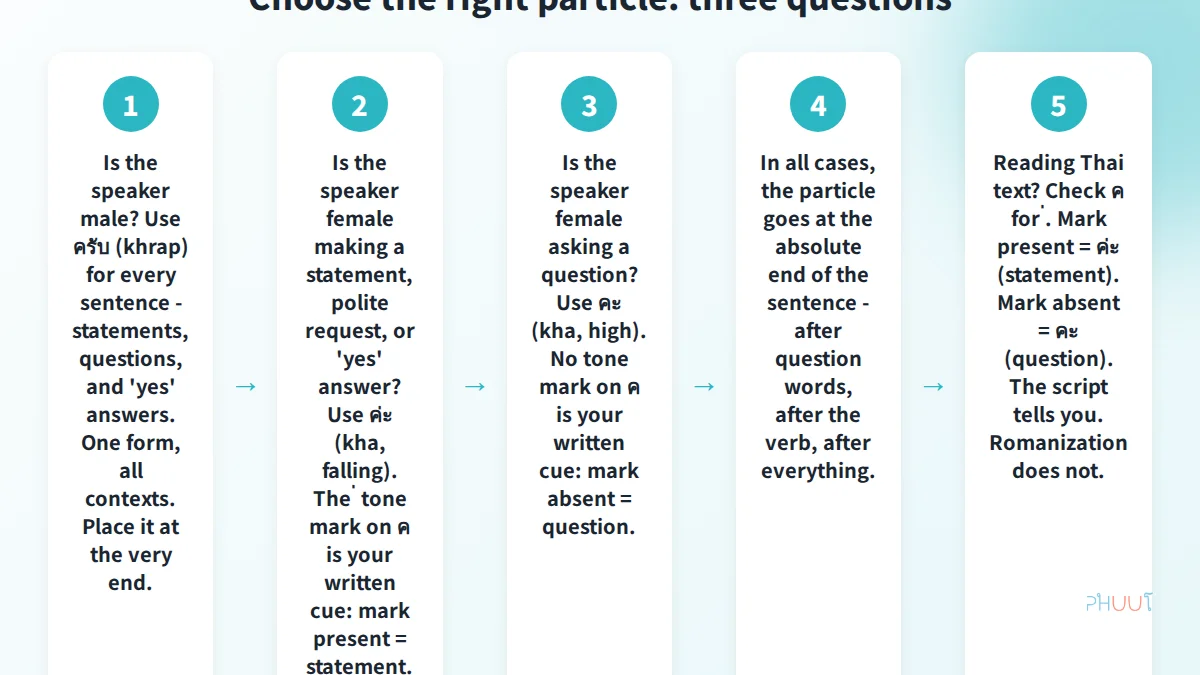
The decision comes down to three questions. You can run through them in under a second once the habit forms.
The most common error is using ค่ะ where คะ belongs, or the reverse. It matters more than most beginner resources let on. ค่ะ with its falling tone signals closure: a completed thought, a statement, an agreement. คะ with its high tone signals openness: an inquiry, a request for information. End a question with ค่ะ and you create a mismatch between tone and intent that Thai speakers notice. In a face-to-face exchange, the surrounding words and context usually save the meaning. On a phone call, where those cues disappear entirely, the particle carries more of the communicative load.
Practice this recognition directly: find five Thai text messages or social media captions, locate every ค่ะ or คะ, check for ่, and classify each sentence as statement or question before reading the surrounding context. This builds the recognition reflex so identification becomes automatic rather than deliberate. For readers who want to understand exactly how ่ (ไม้เอก) behaves across different consonant classes, the full tone marks guide covers the broader system. This article uses one specific application of ไม้เอก; that guide shows how the full tone rule grid works across every consonant class.
How Phuut Introduces These from Your First A1 Lesson
Polite particles are not a grammar footnote you reach at lesson 20. They’re A1 vocabulary. They appear in virtually every Thai sentence from the first day: greetings, orders, questions, confirmations. Without ครับ or ค่ะ or คะ, you’re not producing polite Thai, and polite Thai is what every early interaction requires.
At Phuut’s A1 Tourist level, you work through 594 words - the foundational tier: the vocabulary a first-time visitor actually needs for real interactions in Thailand. ครับ and ค่ะ are in that set not because they’re simple to learn, but because Thai conversation is functionally incomplete without them. Every ordering exchange at a street stall, every taxi direction, every shop transaction uses one of the three particles.
How you encounter these particles for the first time matters. In Phuut’s A1 drills, you see them in Thai script from the start - including the full ค่ะ character with ่ in position and the คะ character without it. The first time you encounter ค่ะ in an A1 exercise, you see the tone indicator right there on the character. The first time you see คะ, you notice there’s no ่ above it. You don’t arrive at “these are the same romanized word with different tones.” You arrive at “these are visibly different characters with different functions.” That distinction, built from your very first lesson, is what prevents the “kha confusion” from forming in the first place.
Learning the particles in Thai script from A1 level means you never need to upgrade your mental model later. There’s no intermediate correction where you realize romanization was incomplete and have to rebuild. The written signal is the rule. Seeing it from lesson one is the most durable way to internalize it.
The full Phuut curriculum runs to 3,850 words across four levels: A1 Tourist, A2 Explorer, B1 Resident, and B2 Local. The 594-word A1 set is deliberately focused: the interactions that actually happen on a first visit to Thailand. ครับ/ค่ะ/คะ are woven through it because they’re woven through every Thai sentence.
If you want to see how ครับ and ค่ะ fit into full greeting exchanges from the first day, the Thai Bangkok greetings guide walks through สวัสดี and other early phrases where the particles appear throughout. For sentence-final particles beyond the three politeness markers (นะ, เลย, สิ, and others), conversational Thai for beginners is the natural next article, covering the broader phrase context those particles live in.
To test the script-first approach before committing to anything: write ขอบคุณ on paper, add ค่ะ to the right, then write the line again with คะ at the end. The only visible difference is the ่ on ค่ะ. That comparison is the lesson: the written forms carry the distinction that no romanization system can.

Learn only the Thai you'll actually use
Free on iOS & Android
Generic vocab lists waste your time. Phuut curates vocabulary based on CEFR levels and Thai proficiency tests — only words that matter.
- CEFR A1–B2 and Thai proficiency-test words only
- Paiboon transliteration baked into every entry
- Sentence patterns and classifiers surface inside real conversations
- Spaced repetition (SRS) tunes review to your memory curve
Once you have the particle rules clear, hearing the falling tone of ค่ะ and the high tone of คะ from a native speaker in real conversation is the fastest reinforcement of everything covered here. You can understand the tones on the page; the next step is using them under actual conversational conditions, with real-time feedback. A session with a qualified Thai tutor puts you in exactly that position: you practice the particles in real speech, you’re corrected in the moment, and you leave with the tonal distinction anchored to an actual exchange rather than a written example.

Learn only the Thai you'll actually use
Free on iOS & Android
Generic vocab lists waste your time. Phuut curates vocabulary based on CEFR levels and Thai proficiency tests — only words that matter.
- CEFR A1–B2 and Thai proficiency-test words only
- Paiboon transliteration baked into every entry
- Sentence patterns and classifiers surface inside real conversations
- Spaced repetition (SRS) tunes review to your memory curve