
Thai Cultural Words for Beginners: 6 Beyond Translation
Affiliate disclosure: This article contains affiliate links. We may earn a small commission at no extra cost to you. As an Amazon Associate, we earn from qualifying purchases.
About the reviewer

Ramy Hirano
Phuut Founder
Founder of Phuut. Has observed how Japanese and English speakers stumble on Thai and built learning products around those patterns.
Follow Phuut on X →Most lists of Thai cultural words for beginners stop at the gloss. I once watched a learner offer ไม่เป็นไร (mai pen rai) to a shopkeeper who’d just found out her delivery was cancelled. He’d learned it as “no problem”. She heard “your problem isn’t one”, and the conversation closed in a single beat. The gloss wasn’t wrong. Six words carry a social expectation that no English packaging holds, and two things fix them: the written form, which tells you how each word sounds, and the boundary, which tells you when to stay quiet.
In this article:
- The six Thai cultural words that translation flattens
- Why romanization cannot teach you these words
- Thai cultural vocabulary in Thai script: meaning and limit
- Mai pen rai and the misuse patterns that backfire
- How Phuut teaches culture words in script
- Thai cultural words: questions people ask
The Six Thai Cultural Words That Translation Flattens
Here is the whole set, script first, romanization in brackets: สนุก (sanuk), เกรงใจ (kreng jai), ไม่เป็นไร (mai pen rai), ใจเย็น (jai yen), น้ำใจ (nam jai), กินข้าวหรือยัง (kin khao rue yang). Six words. You have probably met three of them already, in a phrasebook or a blog post about Thai culture.
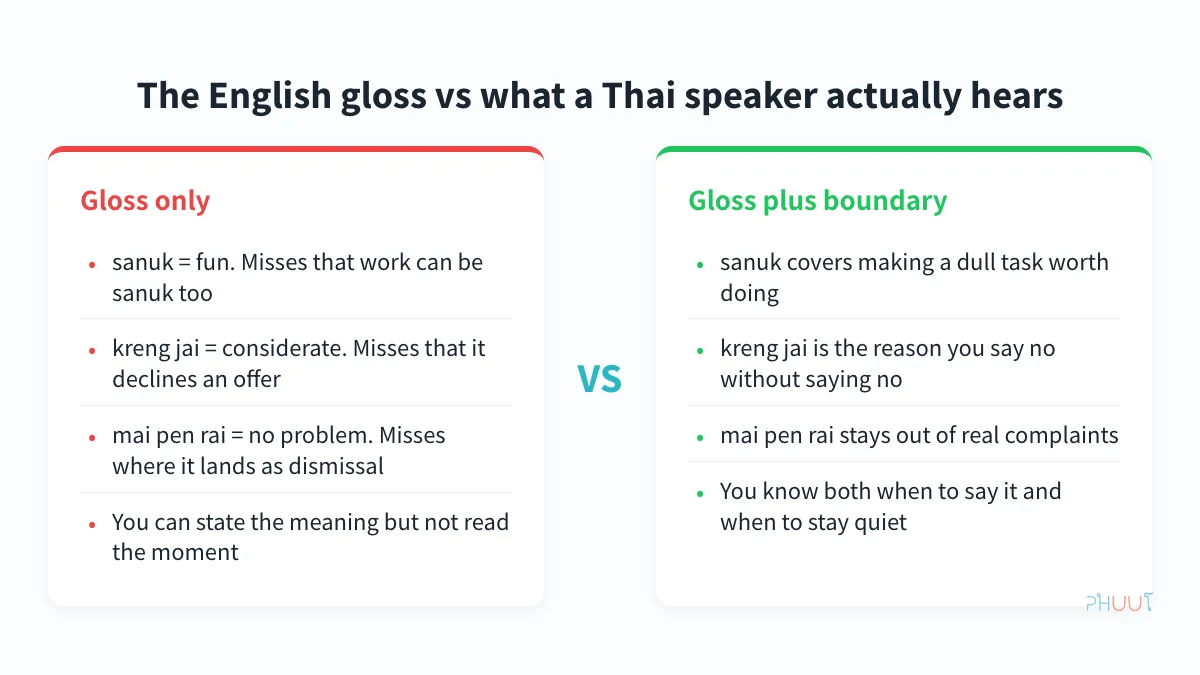
Start with สนุก, because it shows the problem most cleanly. Every dictionary gives you “fun”. An English speaker won’t use “fun” about a data-entry shift, a four-hour bus ride, or a Tuesday afternoon meeting. Ask a Thai speaker whether the work was สนุก, though, and it’s a real question with a real answer. So the gloss isn’t wrong so much as narrower than the Thai word, and the part it cuts off is the part you need.
All six have that shape. Each one arrives with an English label that covers the denotation and quietly drops the trigger conditions: the situations that make the word the right thing to say. You can define every word on this list today and still misfire tonight. Calling that a vocabulary gap misses what’s happening. It’s a usage gap, and it responds to a different kind of learning.
What makes a word “culture-carrying”
Most vocabulary swaps cleanly. หมา is dog, น้ำ is water, and the gloss does the whole job. A culture-carrying word is different: its meaning depends on a social expectation both speakers already share. เกรงใจ is not just “considerate”, it is the specific reluctance to impose that makes declining an offer the polite move. So the gloss hands you the denotation and quietly withholds the trigger conditions. You end up able to define the word and unable to use it, which is the exact gap this article closes.
Two things close that gap, and the rest of this page delivers them in order. First, the written form. Reading สนุก instead of “sanuk” hands you the tone, the vowel length and the behaviour of the final consonant, none of which survives in the Latin spelling. Second, the boundary: for each word, the specific moment where saying it makes things worse.
| # | Thai | Paiboon | Usual gloss | What the gloss drops |
|---|---|---|---|---|
| 1 | สนุก | sà-nùk | fun | Applies to work and dull tasks too, not just leisure. Not a synonym for “interesting” |
| 2 | เกรงใจ | kreeng-jai | considerate | It is the reluctance to impose, which is why it works as a reason for declining |
| 3 | ไม่เป็นไร | mâi-pen-rai | no problem | Releases someone from a small obligation. It does not answer a real complaint |
| 4 | ใจเย็น | jai-yen | calm | Said as reassurance, not as an instruction to a person who is angry at you |
| 5 | น้ำใจ | náam-jai | kindness | Specifically unpaid, unprompted generosity. Not service you paid for |
| 6 | กินข้าวหรือยัง | kin-khâao-rʉ̌ʉ-yang | have you eaten yet? | A care-check between people who know each other, not a dinner invitation |
Most Thai vocabulary needs none of this treatment. A single gloss finishes the job and you move on, which is why a phrasebook gets you through ordering food. These six are what people mean by Thai words with no English translation, and it’s exactly why a phrasebook entry leaves you stranded on them.
One framing note before the script. This is about how six words behave in conversation, not about what Thai people are like. Culture vocabulary usually gets written up as a list of national traits with a Thai word attached to each, and that framing is useless when you’re standing in front of someone deciding whether to open your mouth. Every entry below answers a narrower question instead: what does this word do, and where does it stop working?
Why Romanization Cannot Teach You These Words
Romanization drops three things: tone, vowel length, and what the final consonant is doing. Those are three of the four variables that decide whether a Thai listener recognises the word you just said. The letters “mai pen rai” work as a memory aid for something you already heard. They aren’t instructions for producing it.
Take ไม่ on its own. The small mark above it is ่, called mai ek. Underneath sits ม, which belongs to the low class. Low class plus mai ek gives a falling tone, so the syllable is mâi: pitch starts high, then drops. Now try deriving that from “mai”. There’s nothing in those three letters to derive it from. Someone looking at ไม่เป็นไร can work the tone out from the page; someone looking at “mai pen rai” can only copy whatever they think they heard.
Why the same tone mark gives different tones
Thai consonants fall into three classes: high, mid and low. The tone you produce comes from the class plus the tone mark plus whether the syllable is live or dead. Take ไม่ again. The tone mark is ่ (mai ek), and the initial is ม, a low-class consonant. Low class plus mai ek gives a falling tone, so it is mâi. If the initial were high class, the same mark would give a low tone. That is why romanized “mai” is unusable as a pronunciation guide: the letters are identical whichever tone you mean. The written form is not decoration, it is the instruction.
Two of these six words hide an irregularity that romanization actively works against.
น้ำ is the first. The vowel sign is ำ, which normally marks a short vowel, and yet น้ำ standing on its own is read long, as náam. Thai reference works generally flag this as an irregular spelling rather than a rule you can extend. Inside the compound น้ำใจ you’ll find it transcribed both ways, and it shortens further in rapid speech, so “náam-jai” and “nám-jai” are both in circulation. None of that ambiguity is visible in the letters “nam jai”. The script at least shows you which vowel sign you’re dealing with, so the exception has somewhere to attach itself.
หรือ in กินข้าวหรือยัง is the second. That silent ห at the front exists to drag the low-class ร into behaving like a high-class consonant, which gives the full form a rising tone: rʉ̌ʉ. “Rue” hints at none of that. In ordinary fast speech the syllable also contracts, usually written รึ. Sources don’t agree on what tone that contracted form carries, which is worth knowing before you try matching what you hear at a food stall against what’s on the page.
เกรงใจ is a milder case, still worth flagging. Its vowel is a long เ, so the first syllable is kreeng. Learners who meet the word as “kreng jai” copy a short vowel straight into their speech, because a short vowel is what the spelling handed them.
Words 5 and 6 also happen to carry the cleanest proof that romanization can’t pin a word down. Two of the syllables you’ve just read sit in sets where the Latin spelling is identical and the word is not.
| Romanized the same | Thai | Tone | Means |
|---|---|---|---|
| khao | ข้าว | falling | rice |
| khao | ขาว | rising | white |
| khao | ข่าว | low | news |
| nam | น้ำ | high | water |
| nam | นำ | mid | to lead |
Learn กินข้าวหรือยัง and you’ve picked up three separate words spelled “khao”. The same goes for น้ำใจ, which hands you the น้ำ / นำ pair, where deleting one tone mark turns water into “to lead”. A page that gives you “khao” and “nam” isn’t being concise. It’s withholding the thing that tells the words apart.
Read a Thai culture word from its script in 4 moves
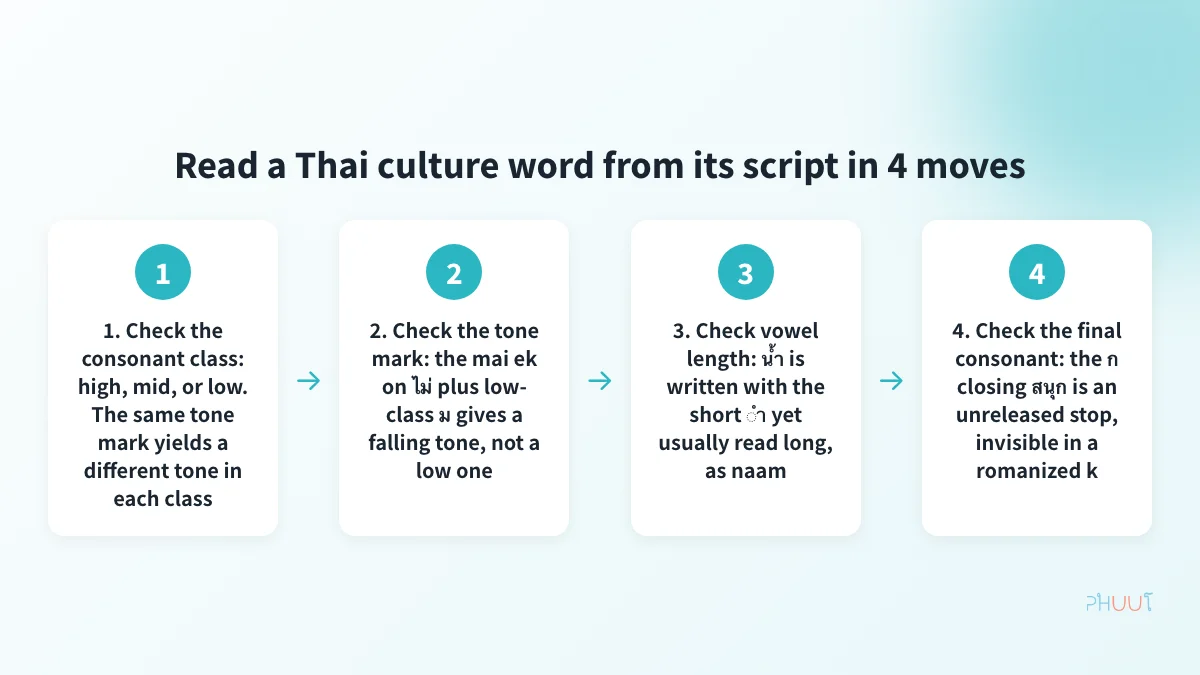
- Find the consonant class of the initial. High, mid or low. This decides what every tone mark will do next, so it comes first.
- Look for a tone mark. ไม่ carries ่ (mai ek) over a low-class ม, which produces a falling tone. The same mark over a high-class initial would produce a low tone.
- Read the vowel and check its length. The ำ on น้ำ normally marks a short vowel, yet the word alone is read long, as náam, which is why references call the spelling irregular. เกรงใจ has a long เ, so it’s kreeng, not the short “kreng” romanization suggests.
- Check the final consonant. The ก closing สนุก is an unreleased stop, which also makes the syllable dead and shifts the tone. A romanized final k tells you none of this.
| Word | Initial and class | Tone mark | Vowel and final | Result |
|---|---|---|---|---|
| สนุก | ส high, leading น | none | short u, final ก is a dead stop | Both syllables low: sà-nùk. The final ก is unreleased |
| เกรงใจ | ก mid with ร cluster | none | long เ, final ง is live | Both mid tone, and the vowel is long: kreeng, not “kreng” |
| ไม่เป็นไร | ม low | ่ mai ek on ไม่ | live syllables throughout | Low class plus mai ek gives falling: mâi, then two mid tones |
| ใจเย็น | จ mid, ย low | none | mai taikhu ็ shortens the เ in เย็น | Both mid tone, and the vowel in เย็น is short |
| น้ำใจ | น low | ้ mai tho on น้ำ | ำ normally short, yet read long in isolation | Low class plus mai tho gives high tone, and น้ำ alone is náam, not “nam” |
| กินข้าวหรือยัง | ข high, ร low under a silent leading ห | ้ on ข้าว | ว as an offglide, ือ long | ข้าว falls, and the silent ห makes หรือ rise: rʉ̌ʉ |
None of this makes romanization bad. It makes romanization lossy, and these six words are where the loss costs you most. This page prints the familiar spellings, sanuk and kreng jai and the rest, because that’s how you found it. Each of them sits in brackets behind the Thai, though, because brackets are where a memory aid belongs. For the longer version of that argument, why romanization stalls Thai learners makes the general case. The full tone grid that this section borrows two cells from is laid out in how Thai tone marks work with consonant classes.
One thing the script can’t give you matters more here than it does for ordinary vocabulary. A wrong tone gets corrected, because the listener simply didn’t catch the word. Misuse a word socially, though, and nobody corrects you, because pointing it out would itself be impolite. You can get เกรงใจ wrong for a year and never find out. A session with a native tutor, where you try these words on a real person and ask directly which ones landed, closes a loop that self-study can’t reach.

Thai Cultural Vocabulary in Thai Script: Meaning and Limit
Same four beats for every word: how the script reads, what it actually means, when to use it, and when not to.
สนุก (sà-nùk)
Script. ส is high class and leads น, there’s no tone mark, the vowel is short, and the final ก is a dead stop, so both syllables come out low: sà-nùk. That final ก never gets released, which is why the word sounds clipped in a way “sanuk” doesn’t suggest.
What it means. Enjoyment treated as a property of an activity. Work qualifies. So do chores, a class, and a long journey.
Use it when you’re asking whether something was worth doing, or explaining why you keep going at something dull in a lighter way.
Do not use it when the occasion is solemn, and not when what you actually mean is “interesting”. That’s น่าสนใจ, a completely separate word.
เกรงใจ (kreeng-jai)
Script. ก is mid class with an ร cluster, the เ vowel is long, and the ง final is live, so both syllables are mid tone and the first one is long: kreeng, not “kreng”. This is the first of three words here built on ใจ, heart, and worth noting how ใจ is spelled: with ใ, not ไ. Only about 20 Thai words take ใ, so the set is small enough to simply memorise.
What it means. A reluctance to place a burden on someone else.
Use it when you’re declining an offer you’d genuinely like, or explaining why you didn’t ask for something.
Do not use it when you mean shy (อาย) or polite (สุภาพ). Those are different words doing different jobs.
ไม่เป็นไร (mâi-pen-rai)
Script. Only one syllable carries a tone mark. Low-class ม plus mai ek gives falling, so ไม่ is mâi, and เป็น and ไร are both mid.
What it means. It releases the other person from a small obligation.
Use it when someone apologises for something minor, or thanks you, or when you want to bring the temperature down. In most exchanges you will hear it with a politeness particle attached, and the ครับ and ค่ะ politeness particles are worth having straight before you start using the phrase in earnest.
Do not use it when someone has raised a real complaint, or when you are the person responsible for the problem and would be using it to close the subject. That is where three friendly syllables read as a refusal to engage.
ใจเย็น (jai-yen)
Script. จ is mid class, ย is low class, both syllables land on mid tone, and the ็ (mai taikhu) over เย็น shortens the vowel. Second ใจ word, same ใ spelling.
What it means. Composure. Literally “cool heart”, and the direct opposite of ใจร้อน (jai-ráwn), hot heart. That pairing is how Thai builds most of its character vocabulary, so the ใจ words tend to arrive with their opposites attached.
Use it when you’re reassuring someone under stress, usually doubled as ใจเย็นๆ to soften it further.
Do not use it when the person is angry at you. It carries exactly the problem “calm down” carries in English, and instructions escalate.
น้ำใจ (náam-jai)
Script. น is low class, and ้ (mai tho) gives it a high tone. Its vowel sign ำ normally marks a short vowel, yet น้ำ alone is read long, as náam, which is the irregularity from the last section. Drop the tone mark and you get นำ, “to lead”. Literally, then, the water of the heart: the third and last of the ใจ words here.
What it means. Unprompted generosity, the kind nobody owed you.
Use it when you want to acknowledge a favour that was freely given. ขอบคุณสำหรับน้ำใจ does that in one line.
Do not use it when the kindness was paid for or transactional. Applying it to a service you bought drains the word of the thing that makes it worth saying.
กินข้าวหรือยัง (kin-khâao-rʉ̌ʉ-yang)
Script. กิน is mid tone, ข้าว is high class with mai tho so it falls, หรือ takes a rising tone because of that silent leading ห sitting over low-class ร, and ยัง is mid. Literally “have you eaten rice yet”.
What it means. A care-check. It sits roughly where “how are you doing” sits in English, and the rice isn’t really the subject.
Use it when there’s already some relationship. Answer ยัง (not yet) and you may well get fed, which is more or less the point of asking.
Do not use it when the person is a stranger or the setting is formal.
Three of these words are heart words
เกรงใจ, ใจเย็น and น้ำใจ all contain ใจ, heart. Thai builds a large family of character and emotion words this way: ใจร้อน (hot heart, short-tempered) sits opposite ใจเย็น, and น้ำใจ is literally the water of the heart. Notice the spelling too. ใจ uses ใ (sara ai mai muan), not ไ, and only about 20 Thai words take ใ. Memorise this small set and you have picked up a script rule as a side effect.
Mai Pen Rai and the Misuse Patterns That Backfire
Three mistakes account for most of the damage, and not one of them is a pronunciation mistake.
Reaching for ไม่เป็นไร as a repair tool. A learner who’s been told it means “no problem” naturally reaches for it when a problem exists. Direction is the thing to remember: the phrase works downward, from small obligations, and never upward into complaints. Someone tells you their delivery arrived broken, you say ไม่เป็นไร, and you’ve just told them their problem isn’t one.
Aiming ใจเย็น at the wrong person. Offered to someone stressed about a deadline, it reads as support. Aimed at someone who’s angry with you, the same two syllables read as an instruction, and instructions escalate. The word did not change. The relationship between the two speakers did.
Treating เกรงใจ as a personality description. It answers “why didn’t you ask” and “why are you declining”. Describing a temperament isn’t its job, which is precisely where the “considerate” gloss sends English speakers. Call someone a เกรงใจ sort of person and a Thai speaker will follow you, but you’ve bent the word out of shape.
Notice what those three have in common. Each one is a word applied in the right general area and the wrong specific moment, which is why more vocabulary wouldn’t have helped. So the transferable rule is this: learn a culture word with the moment it fails attached to it. Definitions are cheap and widely available. Boundaries are what stop you misfiring, and they’re the part nobody writes down.
For the greeting in position 6, the flip side is worth having too. Thai greetings that open a conversation in Bangkok covers the openers that do work on someone you’ve just met, which is exactly where กินข้าวหรือยัง shouldn’t go.
Quick reference, one line each:
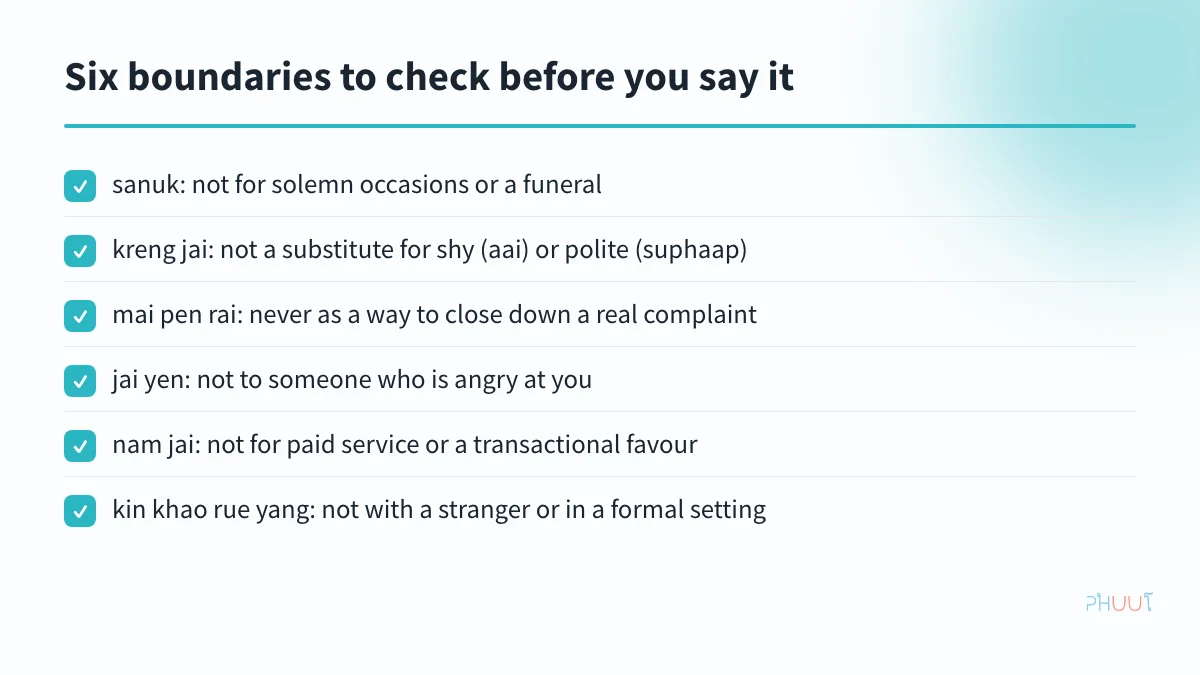
- สนุก: not for solemn occasions
- เกรงใจ: a reason, not a temperament
- ไม่เป็นไร: never over a real complaint
- ใจเย็น: never at someone angry with you
- น้ำใจ: unpaid generosity only
- กินข้าวหรือยัง: people you already know
Reading a boundary is easy. Holding six of them in mind while a conversation moves at speed is the hard part, and that’s the honest limit of learning these words from a page.
How Phuut Teaches Culture Words in Script
Three things in the app map onto the three arguments above, so here they are in the same order.
A Thai script mode, so the written form is the thing you practise. One of Phuut’s 8 game modes is dedicated to Thai script, and a pronunciation practice mode sits alongside it. That pairing is what turns the argument in the second section into something you can act on: you read ไม่เป็นไร, you say it, and you find out whether the falling tone actually came out. Reading the tone off the page and producing it are two separate skills, and practising them in the same session is what connects them.
Spaced repetition, because boundaries need repeat exposure. Review runs on spaced repetition, which is exactly what these six words ask for. A definition sticks after one pass. A boundary does not. The word has to come back when you’ve half forgotten it, ideally in a different context from the one you first met it in, before “not during a real complaint” feels automatic rather than recalled.
A level structure that says when culture words belong. Phuut runs four levels, A1 Tourist through A2 Explorer and B1 Resident to B2 Local, across roughly 3,850 words and phrases (594 at A1, 694 at A2, 1,125 at B1, 1,441 at B2). Culture-register vocabulary sits naturally past the tourist tier. You need it once you’re having conversations rather than transactions, and the level map is there so you can see where you are instead of guessing.
Free to start, and Pro is $4.99 per month if you want it without limits. Available on iOS and Android.

The Thai you'll actually need in Thailand
Free on iOS & Android
Tourist phrases don't get rent paid or a doctor's appointment. Phuut, designed by long-term residents, covers banking, housing, healthcare — the daily reality of living in Thailand.
- Lessons for visa, rental, hospital, banking scenes
- AI conversations simulate clerks, landlords, civil servants
- Native audio + Paiboon transliteration keeps pronunciation crisp
- 5 minutes a day to preview what your week actually needs
Thai Cultural Words: Questions People Ask
Do I really need Thai script to learn these six words?
For the glosses, no. For the pronunciation, yes. Six words is also a very small first reading set, which is the practical argument: you aren’t taking on the whole script here, just six shapes.
Is ไม่เป็นไร really dismissive? I hear it constantly.
Not dismissive by default. Dismissive by placement. It reads as generous when it releases someone from a small obligation, and as a refusal to engage when it answers a real complaint. Same three syllables, opposite effect.
How is เกรงใจ different from just being polite?
Watch what a Thai speaker says back to it. When a host wants to override your เกรงใจ, they say ไม่ต้องเกรงใจ (mâi dtâwng kreeng-jai), roughly “no need to hold back”. Nobody ever tells you to stop being polite (สุภาพ), because politeness is about form. They do tell you to stop worrying about being a burden, and that worry is what เกรงใจ actually names.
How many culture words should a beginner learn at once?
Fewer than you’d think, and each one paired with its boundary. Six is realistic for a first pass. Spaced repetition helps here because a boundary needs to resurface in a different context from the one you met it in, which is how Phuut schedules review.
Can I say กินข้าวหรือยัง to a Thai colleague?
Yes, once there’s some relationship. Two answers cover you when it comes back at you: กินแล้ว (kin-láew), already eaten, or ยัง (yang), not yet. Say ยัง and you may well get fed, which is half the point of asking. What it isn’t is a first line to a stranger or a way to open a formal meeting.
The gloss was never enough on its own. Read สนุก instead of “sanuk” and the tone, the vowel length and the final consonant come with it. Attach a boundary to each word and you stop reaching for ไม่เป็นไร when someone’s genuinely upset. Six words is a small set. Learned this way, with the script in front of you and the line drawn, they change how the next conversation goes.
Everything above works from the page. The part that does not is hearing สนุก with its unreleased final ก, or ไม่ with its falling tone, and then producing it yourself while someone checks whether you got there.
The Thai you'll actually need in Thailand
Free on iOS & Android
Tourist phrases don't get rent paid or a doctor's appointment. Phuut, designed by long-term residents, covers banking, housing, healthcare — the daily reality of living in Thailand.
- Lessons for visa, rental, hospital, banking scenes
- AI conversations simulate clerks, landlords, civil servants
- Native audio + Paiboon transliteration keeps pronunciation crisp
- 5 minutes a day to preview what your week actually needs
The Thai you'll actually need in Thailand
Free on iOS & Android
Tourist phrases don't get rent paid or a doctor's appointment. Phuut, designed by long-term residents, covers banking, housing, healthcare — the daily reality of living in Thailand.
- Lessons for visa, rental, hospital, banking scenes
- AI conversations simulate clerks, landlords, civil servants
- Native audio + Paiboon transliteration keeps pronunciation crisp
- 5 minutes a day to preview what your week actually needs