
Thai Words from Thai Dramas — What They're Actually Saying
Affiliate disclosure: This article contains affiliate links. We may earn a small commission at no extra cost to you. As an Amazon Associate, we earn from qualifying purchases.

About the reviewer

Phuut Editorial Team
Thai Language Learning
The editorial team behind Phuut, a Thai-learning app for English-speaking learners, sharing real-world Thai usage and study techniques.
Follow Phuut on X →You’re three episodes into Ticket to Heaven and you’ve noticed that Fourth keeps saying something the subtitles translate as “I love you” — but sometimes it sounds shorter, sometimes longer, and occasionally the subtitle says “I like you” instead. You’re not imagining a difference. Thai has a tiered vocabulary of affection, and the drama is using it deliberately. This guide is a reference for BL and GMMTV fans who want to know what those Thai words from Thai dramas actually mean — not a grammar lesson, just the four vocabulary zones you’ll hear in every series: confessions and romantic phrases, honorifics like Phi and Nong, emotional particles, and exclamations.
In this article:
- Why Thai drama dialogue has two channels (and why subtitles only show one)
- Confessions and romantic phrases — the words that drive every plot
- Friendship and phi/nong — the sibling system that is not about siblings
- Honorifics and nicknames — the Phi/Nong system every BL fan hears constantly
- Particles and exclamations — the layer subtitles almost always miss
- Thai nickname culture — why every character has a one-syllable name
Why Thai Drama Dialogue Has Two Channels (And Why Subtitles Only Show One)
Watch any GMMTV drama with English subtitles and you’ll notice a nagging feeling: the subtitle says “I love you” but somehow the scene feels heavier than that. Or a character says something the subtitle renders as “don’t go” but the moment lands like a full emotional confrontation. You’re picking up on something real.
Thai drama dialogue operates on two simultaneous channels. The first is the literal channel — the words, the meaning a subtitle can translate. The second is the emotional-register channel — the layer encoded in particles, pronoun choices, and vocabulary tiers that signals formality, intimacy, urgency, and emotional stance. English subtitles translate channel one almost exclusively.
Here is a concrete example. A character says: ผมชอบคุณนะครับ (phom chôop khun na khrap).
The subtitle might read: “I like you.”
But what the Thai actually communicates is a specific emotional posture: first-person male formal pronoun (ผม, phom), feelings at the like-not-love vocabulary tier (ชอบ, chôop — not รัก, rák), a softening plea particle (นะ, na), and a polite formal register maintained throughout (ครับ, khrap). The character is confessing while staying carefully, vulnerably formal. He’s not yet comfortable enough to drop the politeness. That’s a specific emotional stance — and “I like you” doesn’t carry it.
This is why understanding Thai words from Thai dramas changes how you watch, not just what you hear. Once you recognize the second channel, you start reading scenes differently. The vocabulary tier tells you where the characters are emotionally. The particles tell you how they feel about saying what they’re saying. The honorifics tell you where they are in the relationship.
This guide is structured around the four vocabulary zones where the second channel is most active: confessions, honorifics, particles, and exclamations. If you want to go deeper into a structured study method for turning episodes into Thai lessons, the Thai drama study guide covers that methodology in full.
Before diving into vocabulary, one more thing worth knowing: Thai has five tones, and the same romanized spelling can represent completely different words depending on tone. Every item in this guide includes Thai script and Paiboon romanization with tone marks so you can hear what you’re reading accurately — the same notation system Phuut uses.
For a full treatment of Thai tones and how they work, the dedicated tones article goes through all five with audio examples and minimal pairs.
Confessions and Romantic Phrases — The Words That Drive Every Plot
The reason a well-written BL drama can sustain a twelve-episode slow burn without feeling dishonest is that Thai vocabulary gives writers six distinct words for six stages of attachment. The subtitle “I like you” and “I love you” both render different Thai words — and the choice of word tells the audience exactly where a character’s feelings stand on a very precise scale.
Here is the full ladder.
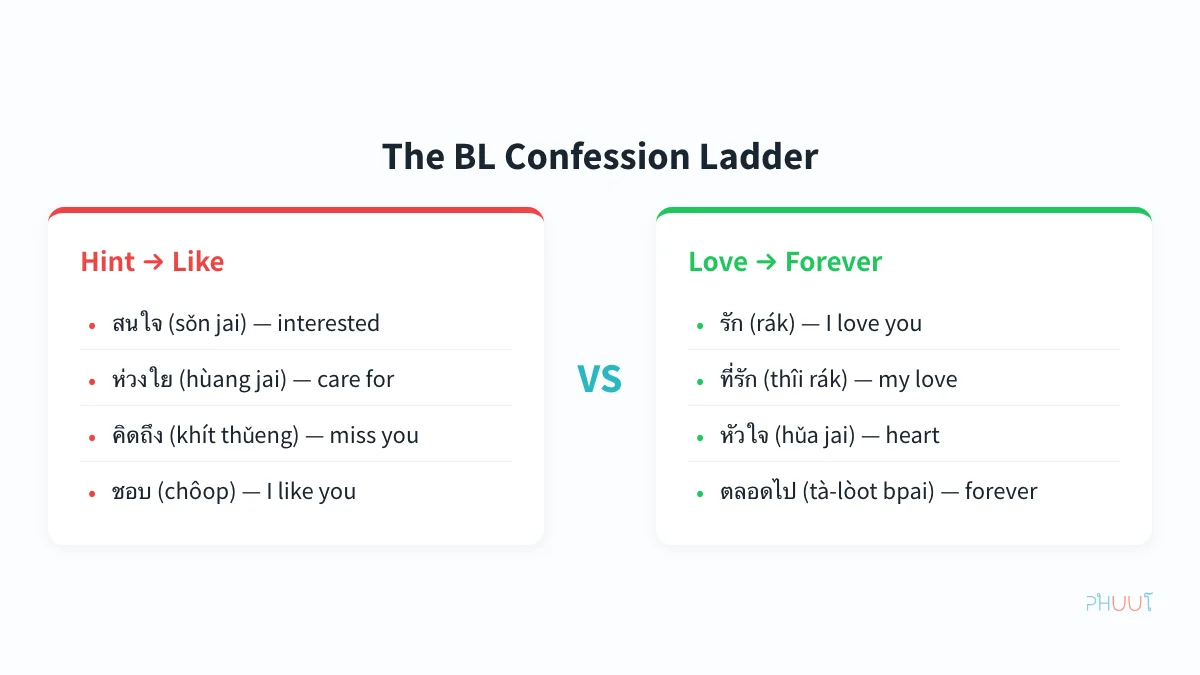
The pattern you’ll notice in GMMTV writing: characters almost never skip rungs. In Only Friends, the on-again-off-again relationship between Boston and Nick is tracked through vocabulary oscillation — when Nick says ชอบ (chôop, to like) he’s deliberately staying below the rák threshold even when his behavior suggests otherwise. The writers are using the Thai vocabulary ladder as a plot device. Once you know the ladder, you read his restraint as a character choice, not just a subtitle.
In Ticket to Heaven, the word ห่วงใย (hùang jai — to worry about, to care for) appears long before รัก. This is the classic BL slow-burn substitution: ห่วงใย is deniable. “I’m just worried about you” can coexist with “we’re just friends” in a way that ผมรักคุณ cannot. Paiboon: hùang jai, falling + mid tones. You’ll hear it in scenes where a character hasn’t yet admitted feelings but can’t stop hovering.
I Told Sunset About You uses คิดถึง (khít thǔeng — to miss someone) as an emotional confession substitute. When Teh says it to Oh-aew before either of them has named what they are, it functions as a confession the subtitles flatten into “I miss you.” But in the second-channel reading: khít thǔeng is the first acknowledgment that someone has become necessary.
Common romantic phrases with full treatment:
| Thai | Paiboon | Meaning | Register note |
|---|---|---|---|
| ผมรักคุณ | phom rák khun | I love you (formal) | ผม = male formal first person; คุณ = polite you |
| ผมรักเธอ | phom rák ter | I love you (intimate) | เธอ (ter) = intimate/romantic second person |
| ผมชอบคุณ | phom chôop khun | I have feelings for you | Below the love threshold — the mid-arc confession |
| คิดถึงมาก | khít thǔeng mâak | I miss you so much | มาก = a lot / so much; intensifies the verb |
| อยู่ด้วยกันนะ | yùu dûai gan na | Let’s stay together, okay? | The นะ (na) softens this into a plea rather than a statement |
| ไม่ต้องไปไหน | mâi tông bpai nǎi | Don’t go anywhere | Heard in departure confrontation scenes |

Friendship and Phi/Nong — The Sibling System That Is Not About Siblings
Thai people navigate relationships through an age-hierarchy system, and Thai dramas reflect this in every conversation. Understanding the vocabulary cluster around friendship and seniority changes how you hear the space between characters.
The starting point is เพื่อน (phûean, mid tone) — friend. It sounds simple, but in Thai BL dramas เพื่อน carries narrative weight: characters say “เราเป็นเพื่อนกัน” (we’re friends) precisely at the moment the audience can see they’re becoming more. It’s the vocabulary of denial. The word is doing work.
| Thai | Paiboon | Meaning | Usage note |
|---|---|---|---|
| เพื่อน | phûean | friend | ”เราเป็นเพื่อนกัน” — often said in early-arc denial scenes |
| พี่น้อง | phîi nóong | older-and-younger / close group | Friend group with family-like bond; connotes loyalty |
| แก | gae | you (casual, equal-status) | Used between close friends of same age; warmer than เธอ in peer contexts |
| กู | guu | I / me (very informal) | Between very close male friends; marks peer equality; blunt register — do not use with strangers or acquaintances |
| มึง | mueng | you (very informal) | Paired with กู; marks close same-age male friendship — sounds rude and offensive outside that specific close-friend context |
A word on กู and มึง: you’ll hear these in friend-group dialogue scenes in dramas like Only Friends and My School President. Between close same-age friends they’re normal and even affectionate. Said to anyone else — a teacher, a senior, a stranger — they register as aggressive or insulting. If you’re learning Thai to actually speak it, treat these as listen-only until you understand the register well.
Here is how แก and พี่ sound in the same conversation:
เฮ้ แก ไปไหนมา? hêe gae bpai nǎi maa? Hey, where did you go?
ไปหาพี่โอม กับแก๊งก่อนนะ bpai hǎa phîi oom gàp gaaeng gɔ̀ɔn ná Going to find P’Ohm with the gang first, okay?
Notice that both pronouns appear in two consecutive lines: แก (gae) marks the speaker addressing an equal — same age, same status, no hierarchy — while พี่โอม (P’Ohm) in the very next breath signals that P’Ohm is senior. BL characters often operate in this dual register simultaneously: casual peer address with each other, formal honorifics for anyone older. When a character who has been using แก with someone shifts to เธอ, or drops the พี่ prefix before a name for the first time, the vocabulary is announcing a relationship stage change before the plot does.
Honorifics and Nicknames — The Phi/Nong System Every BL Fan Hears Constantly
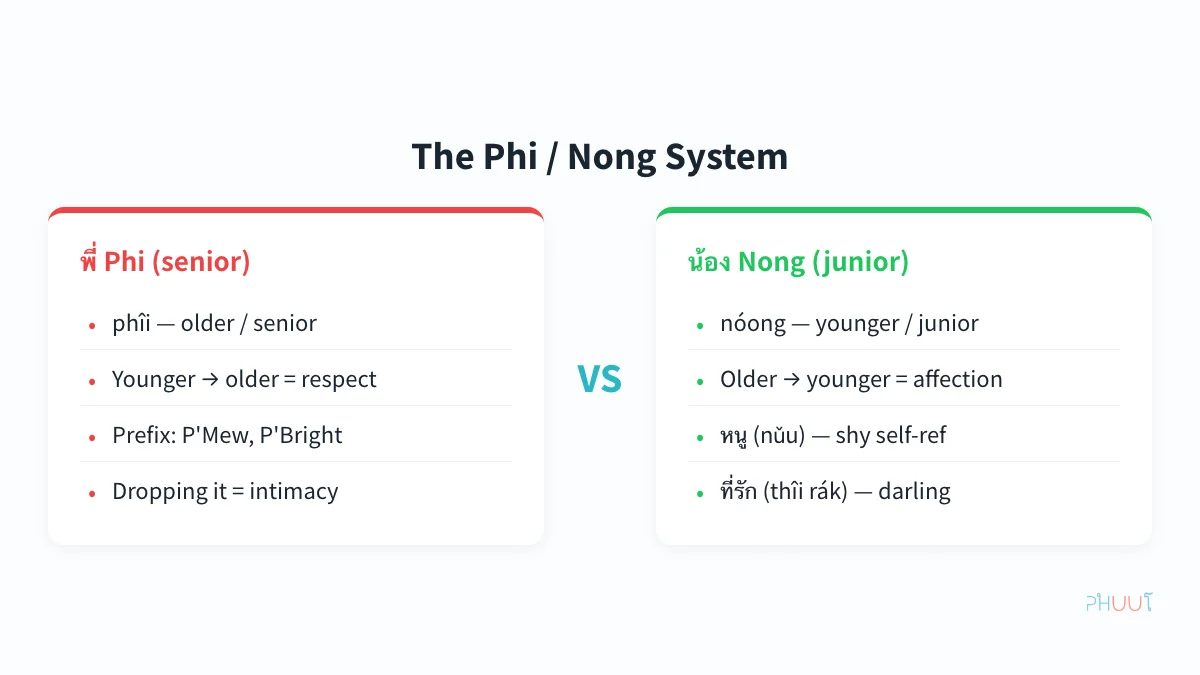
Thai dramas use a precise honorific vocabulary that signals exactly where two characters stand in their relationship.
| Term | Paiboon | Who uses it | What it signals |
|---|---|---|---|
| พี่ (P’/Phi) | phîi | Younger person → older person | Respect + closeness; also used as affectionate nickname prefix in established couples (P’Mew, P’Bright) |
| น้อง (Nong) | nóong | Older person → younger person | Affectionate diminutive; the ‘junior’ in a phi-nong relationship |
| หนู (Nu) | nǔu | Self-reference by younger speaker | Signals deference or cuteness; common in shy/introverted BL characters |
| อ้าย (Ai) | âai | Northern Thai dialect: older brother figure | Heard in Chiang Mai-set dramas — not standard Thai |
| แฟน (Faen) | faen | Partners | Borrowed from English ‘fan’ — means boyfriend/girlfriend in Thai |
| ที่รัก (Tee Rák) | thîi rák | Between lovers | Term of endearment: ‘darling / my love’ |
One note on อ้าย (Ai): this is specifically Northern Thai dialect, not standard Central Thai. You’ll hear it in dramas set in Chiang Mai or the north — I Told Sunset About You and Moonlight Chicken both use it. If you only know Bangkok-register Thai you won’t encounter Ai naturally; its appearance in a drama signals a northern setting or character.
Now the part that changes how you watch every scene: the Phi drop.
When a character transitions from calling someone “Phi [name]” to using their name or nickname alone, that shift isn’t trivial. In Thai social terms it’s the equivalent of moving from last-name to first-name in English — but more charged, because the Phi-to-name transition also dissolves the formal hierarchy. You’re no longer acknowledging that the other person is your senior. You’re treating them as your equal. Or your person.
In 2gether: The Series, track Sarawat’s speech toward Tine through the first several episodes. He begins with “Phi Tine” — the proper formal address for someone slightly senior. The transition to “Tine” alone doesn’t happen immediately. When it does, it’s quiet, and the subtitles don’t flag it. But in the Thai second channel it’s a declaration. The series uses this shift more deliberately than almost anything in the plot.
หนู (Nu, nǔu) is worth noting because it appears frequently in shy or younger BL characters using it as self-reference. Standard Thai has multiple first-person pronouns — ผม (phom, formal male), เรา (rao, casual), ฉัน (chǎn, neutral/female), หนู (Nu, used by younger speakers to signal deference). When a BL character self-refers as หนู while speaking to a senior character, they’re signaling “I’m the younger, deferential one in this dynamic.” It’s a deliberate register choice. In My School President, the younger main character Tinn uses หนู throughout early episodes when addressing older figures — and tracking when that usage stops is one of the cleaner ways to watch his arc develop. The pronoun shift is quiet and undocumented in subtitles, but any Thai viewer catches it immediately.
Particles and Exclamations — The Layer Subtitles Almost Always Miss
Thai end-particles are short syllables appended to sentences that modify their emotional meaning without changing their literal content. There’s no direct English equivalent. “Don’t go” and “don’t go, นะ” are technically the same statement — but the นะ makes the second version a plea, a soft ask, something tender and anxious. Subtitles translate the first; they almost never render the second.
Here are the particles you’ll hear in every Thai drama:
| Particle | Paiboon | Emotional function | Drama example |
|---|---|---|---|
| นะ | na | Softening, gentle plea, reassurance | ไม่ต้องไปนะ — “don’t go, okay?” |
| ครับ | khrap | Male politeness/formality | ผมรักคุณครับ — formal confession |
| เลย | looei | Intensifier, emphasis | ไม่อยากให้ไปเลย — “I really don’t want you to go” |
| สิ | si | Mild insistence / ‘come on’ | บอกฉันสิ — “just tell me” |
| จริงๆ | jing jing | Really / seriously / for real | รักจริงๆ — “I really do love you” |
| นะครับ / นะคะ | na khrap / na khâ | Softened polite request | Combined particle: extra gentle register |
The ครับ / ไม่มีครับ distinction is particularly useful for tracking intimacy. ครับ (khrap) is the male politeness particle — Thai men attach it to sentences when speaking with people they respect or in formal situations. Most BL characters use ครับ constantly with teachers, parents, and seniors. The moment they drop it with their love interest, the register has shifted. “I love you” with ครับ and “I love you” without ครับ are the same words with completely different intimacy levels — and every Thai viewer hears the difference even if the subtitles don’t show it.
The male/female speech split also explains a lot of what makes BL dramas feel distinctive — the deliberate use or abandonment of gendered speech markers is itself a storytelling device. The table below maps the defaults and the BL subversions.
Exclamations are a separate category — these are set expressions, not grammatical particles, but they appear so frequently that BL fans hear them constantly and subtitles handle them inconsistently:
| Thai | Paiboon | Meaning | When you’ll hear it |
|---|---|---|---|
| โอ้โห | ôo hoo | Wow / impressed / admiring | Surprise at something impressive; audience reactions in live broadcast segments |
| เฮ้ย | hêei | Hey! / casual protest / surprise | Comedic outburst; mild objection; friends talking casually |
| อ้าว | âao | Oh no / mild dismay | Character reacts to unexpected bad news or minor conflict |
| จริงๆ เหรอ | jing jing rǒe | Really? Seriously? | Disbelief; processing an unexpected confession or revelation |
| ไม่เป็นไร | mâi bpen rai | Never mind / it’s okay | The most common Thai drama conflict-resolution phrase — heard in every forgiveness scene |
| โห | hoo | Impressed / exasperated sigh | Admiring someone’s skill or exhausted by someone’s behavior — context distinguishes |
ไม่เป็นไร (mâi bpen rai) deserves particular attention because it appears in virtually every Thai drama conflict scene and carries more weight than “never mind.” In Thai culture it often functions as a graceful exit from conflict — a deliberate choice to let something go rather than escalate. When a BL character says ไม่เป็นไร after something painful, it isn’t dismissal; it’s usually restraint.
For foundational conversational vocabulary beyond drama-specific terms, everyday Thai phrases for beginners covers the most common daily expressions with the same Paiboon notation used here.
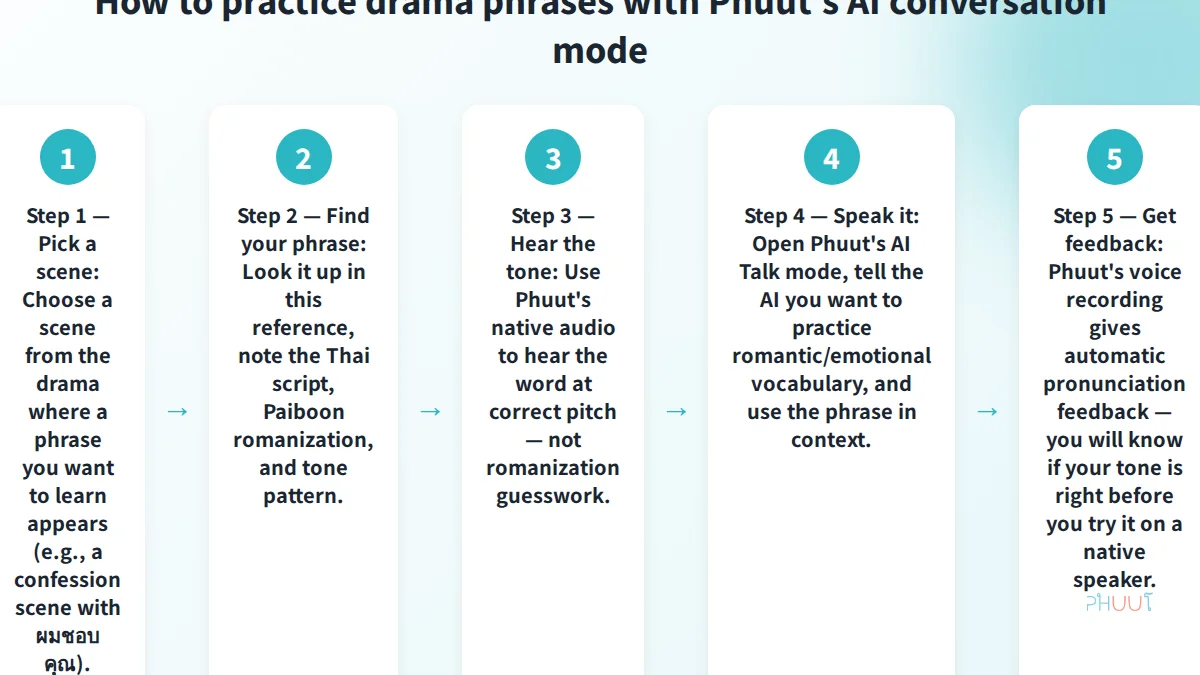
To hear these particles and exclamations at the correct tone — which matters, since the wrong tone changes the meaning entirely — Phuut’s native audio gives you pronunciation for individual vocabulary items. Open AI conversation practice for Thai and tell the AI you want to practice emotional vocabulary from Thai dramas. It will use these particles naturally in context.

Thai Nickname Culture — Why Every Character Has a One-Syllable Name
You’ve noticed that Thai drama characters — and the actors playing them — all seem to have very short names. Win. Bright. Tay. Mew. Ohm. Sand. Fourth. Gemini. This isn’t coincidence or a stage-name system invented for the industry.
Thai people have two name layers. The first is their formal full name — ชื่อจริง (chûe jing, “real name”) — which is typically long and derived from Pali or Sanskrit. These names appear on official documents and are rarely used in daily conversation. The second layer is the ชื่อเล่น (chûe lên, “playful name”) — a short nickname, usually one or two syllables, given at or near birth and used by everyone who knows you in daily life.
GMMTV actor names like Bright, Win, Tay, Mew, Ohm are their actual chue len. Their legal names are Vachirawit (Bright), Metawin (Win), Tawan (Tay), Suppasit (Mew), Pawat (Ohm). In dramas, characters follow the exact same system. When P’Win calls someone by their chue len, he’s using the most familiar form of their name combined with the most respectful form of address — which is why the combination carries emotional weight.
The moment that matters: when a character stops using P’ before the chue len and uses the chue len alone for the first time, that shift marks a relationship threshold. The drama isn’t being subtle — it’s using the Thai naming system as a plot device, and every Thai viewer in the audience catches it instantly.
| Thai | Paiboon | Meaning | Drama context |
|---|---|---|---|
| ชื่อจริง | chûe jing | formal / legal name | Rarely heard in drama dialogue; appears on document props |
| ชื่อเล่น | chûe lên | playful nickname | The name everyone actually uses — short, familiar, often English-adjacent |
| พี่ [ชื่อเล่น] | phîi [name] | P’[name] — senior + familiar | P’Win, P’Mew, P’Tay — age-respectful prefix combined with the most intimate form of address |
| น้อง [ชื่อเล่น] | nóong [name] | Nong[name] — junior + affectionate | Older characters address younger ones this way; conveys warmth and protectiveness |
| [ชื่อเล่น] alone | [name] only | bare nickname | Using chue len without P’ for the first time = crossing a relationship threshold |
| แฟน | faen | boyfriend / girlfriend / partner | ”แฟนเธอ” = your partner; borrowed from English “fan,” repurposed as romantic partner |
If you want to extend your reading ability to the Thai script you see in drama title cards and name graphics, learning to read Thai script is achievable in four to six weeks with the right approach — and once you can read the alphabet, following bilingual cast credits becomes a language exercise that happens automatically every episode.
Practice What You Have Just Read
All four vocabulary zones in this guide — confessions, honorifics, particles, exclamations — require correct tone to land correctly. Reading Paiboon romanization tells you the shape of a word. Hearing it at pitch tells you how to actually say it.
You now have the vocabulary — the next step is hearing it in your own voice. Phuut’s AI Talk mode lets you practice Thai drama phrases with real pronunciation feedback: the AI responds to what you say, and the tone checker tells you whether your รัก landed with a falling tone or slipped to rising. Try saying ผมรักเธอ (phom rák ter) out loud, then open the app to check whether your falling tones on รัก and เธอ are landing correctly. The first level is free on iOS.

The Thai you'll actually need in Thailand
Free on iOS & Android
Tourist phrases don't get rent paid or a doctor's appointment. Phuut, designed by long-term residents, covers banking, housing, healthcare — the daily reality of living in Thailand.
- Lessons for visa, rental, hospital, banking scenes
- AI conversations simulate clerks, landlords, civil servants
- Native audio + Paiboon transliteration keeps pronunciation crisp
- 5 minutes a day to preview what your week actually needs
The Thai you'll actually need in Thailand
Free on iOS & Android
Tourist phrases don't get rent paid or a doctor's appointment. Phuut, designed by long-term residents, covers banking, housing, healthcare — the daily reality of living in Thailand.
- Lessons for visa, rental, hospital, banking scenes
- AI conversations simulate clerks, landlords, civil servants
- Native audio + Paiboon transliteration keeps pronunciation crisp
- 5 minutes a day to preview what your week actually needs