
How to Learn Thai with Thai Dramas (BL Fan's Guide)
Affiliate disclosure: This article contains affiliate links. We may earn a small commission at no extra cost to you. As an Amazon Associate, we earn from qualifying purchases.

About the reviewer

Ramy Hirano
Phuut Founder
Founder of Phuut. Has observed how Japanese and English speakers stumble on Thai and built learning products around those patterns.
Follow Phuut on X →You’re deep in episode 7 of Only Friends and P’Mew says something to Sand that makes the whole fandom explode - but you caught only a word or two of actual Thai. You’ve watched 20 episodes now. You hear Thai every night. Yet when someone speaks to you in Thai on the street, you freeze. The emotional investment you already have in these characters is the single most powerful learning asset you own - and right now it’s going entirely to waste. This guide gives you a practical method to learn Thai with Thai dramas: the same episodes you’re watching anyway, turned into real, retained skill.
In this article:
- Why Thai Dramas Actually Work (And Where They Fall Short)
- Active vs. Passive Watching - The Difference That Actually Matters
- The 5-Step Episode Study Method
- What Dramas Cannot Teach (And How to Fill the Gaps)
Why Thai Dramas Actually Work (And Where They Fall Short)
You’ve probably heard of “immersion” as a language learning strategy. The idea is simple: surround yourself with the target language and your brain will eventually absorb it. The problem with pure immersion for a beginner is that it only works when you understand enough of what you’re hearing to anchor new information to existing meaning. If you understand 0% of what you hear, you retain close to 0%.
Thai BL dramas solve this problem neatly.
When you watch Only Friends or I Told Sunset About You with English subtitles, you understand the emotional and narrative content completely. You know Mew is telling Sand he’s hurt. You know Pat is trying to explain why he was at Pran’s apartment. That comprehension creates the scaffolding that makes new Thai vocabulary stick. When Sand replies and you hear รัก (rak - love) for the first time, you know exactly what it means in that moment - not as a dictionary entry, but as a word spoken by someone you care about in a scene that matters to you.
The motivational edge BL and GMMTV fans have over the average language learner is not trivial. Most language learners are studying in the abstract: they chose a language because it seems useful or interesting. BL fans have genuine parasocial investment in specific actors, specific characters, specific scenes. That emotional charge becomes a phonological mnemonic asset - what I call the tonal anchor.
Here’s what this looks like in practice. If you’ve watched 2gether: The Series, you’ve heard Tine say ไป (bpai - “to go”) dozens of times. That specific delivery - the flat mid-tone pitch of Gulf Kanawut’s voice in scenes where Tine is walking away - becomes your personal reference for the mid tone. It is not an abstract tone diagram. It is a specific actor’s voice in a scene you remember. When you encounter ไป written in Thai later, you hear that voice in your head and the tone clicks into place. When I worked through 2gether scenes this way, ไป was the first word I stopped second-guessing - Gulf’s flat, unhurried delivery just locked it in.
No textbook teaches you this. It requires emotional investment in the source material. You already have that investment. You just need the method to convert it.
Where dramas fall short
Dramas are a powerful input environment, but they cannot do three things that structured study can. They cannot teach you the 5-tone system systematically - which consonant class produces which tone. They cannot teach you to read Thai script (since English subtitles render the Thai invisible). And they expose you to vocabulary in plot order, not in the sequence a CEFR curriculum would sequence it - so you pick up “betrayal” and “heartbreak” before you learn “how much does this cost.”
A structured app practice session - 15-20 minutes daily - fills the three gaps dramas cannot cover: explicit tone rules, script reading, and CEFR-aligned vocabulary progression. Think of dramas and structured practice not as alternatives but as a training pair: one provides emotional context, the other provides the systematic framework.
Active vs. Passive Watching - The Difference That Actually Matters
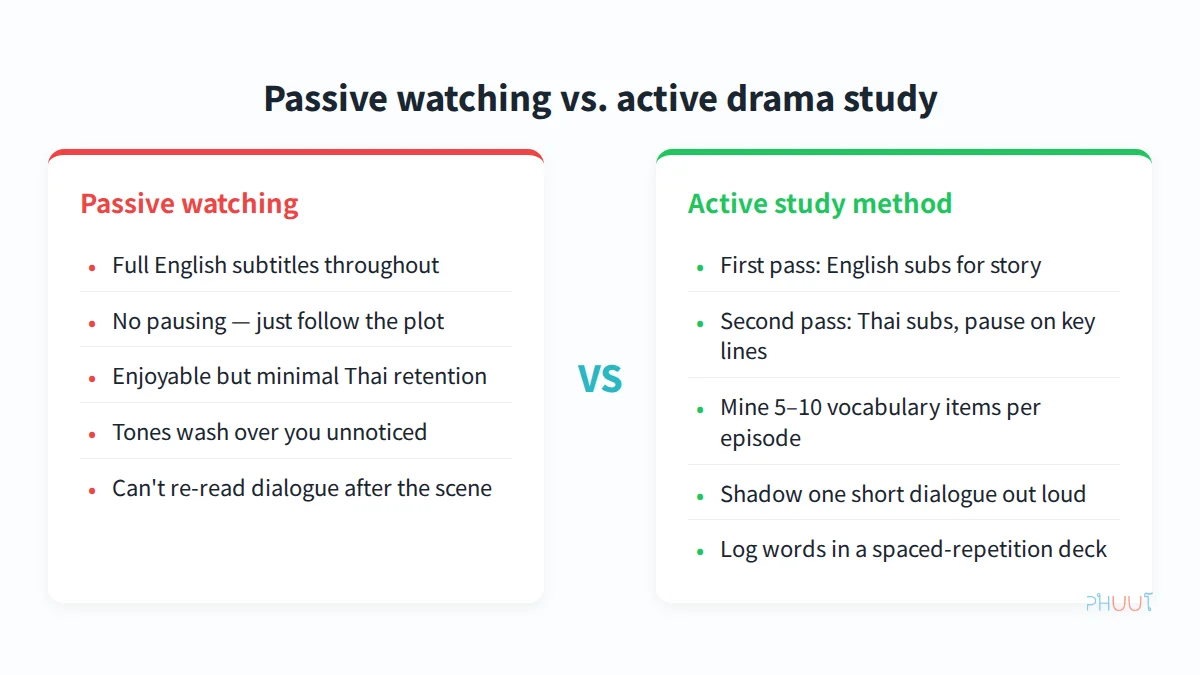
Most people who say they’ve been “studying Thai through dramas” have actually been watching Thai dramas passively - English subtitles on, no pausing, no vocabulary mining, no shadowing. This is enjoyable and it is not nothing: your ear develops familiarity with Thai phonology, rhythm, and sound patterns. But familiarity is not retention. After 20 episodes of passive watching, most learners can recognise a handful of words. They cannot produce them under pressure, they cannot read them in Thai script, and they cannot recall them outside the drama context.
The difference between passive watching and active study is method, not time. You can convert any episode you are already planning to watch into a genuine study session without doubling your viewing time. The episode still gets watched. The story still lands. You just interact with the Thai audio and subtitles differently during two of the passes.
Before you choose which drama to start with, the choice of method matters more than the choice of title. That said, here is how the most popular Thai BL dramas compare as language learning material - ranked by register, difficulty, and why they work for learners.
One question that comes up immediately when BL fans start using dramas for study: “Is the Thai in BL dramas real Thai? It seems different from what I see in phrasebooks.”
It is different - and the difference is a feature, not a bug.
When you study Thai from BL dramas, you are not learning incorrect Thai or slang that will confuse people. You are learning the informal male register that millions of Thai men use in everyday conversation. The first-person pronoun ผม (phom) and the softening particle นะ (na) you hear in almost every BL episode are how Thai men actually speak to people they’re comfortable with. The politeness particle ครับ (khrap) is standard male speech across all levels of formality. None of this needs to be unlearned when you move to “real” Thai - it is already real Thai.
The 5-Step Episode Study Method
Here is the key insight that makes drama study sustainable: you do not need to add a study session on top of your regular watching. A 45-minute episode, approached with this method, takes about 50 minutes total. The additional five minutes come from the shadow pass and the deck pass - not from watching the episode twice end-to-end.
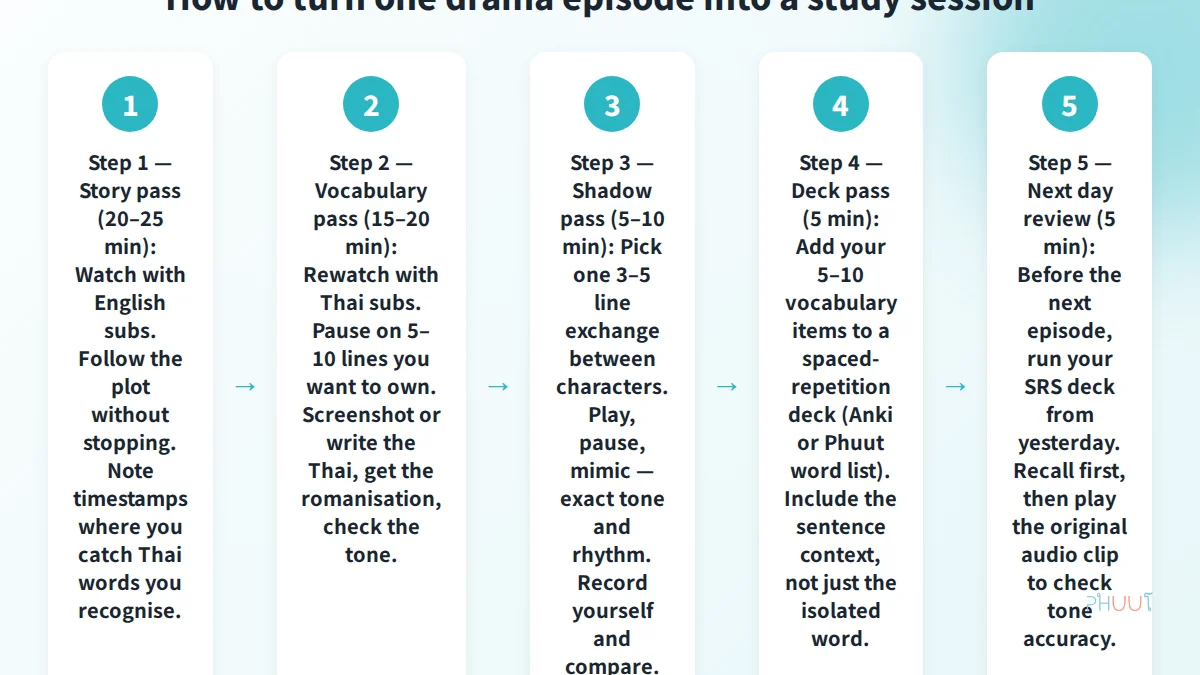
The method has five passes, each with a specific purpose and a time budget.
Step 1 - Story pass (20-25 min)
Watch the full episode with English subtitles. Follow the plot without stopping. Your only active task: note timestamps when you catch a Thai word you recognise or want to learn. Don’t pause, don’t look anything up. This pass is for story comprehension and passive ear training. Emotional investment stays intact.
Step 2 - Vocabulary pass (15-20 min)
Switch to Thai subtitles (or dual subtitles if available). Rewatch using your timestamp notes as a guide and pause on 5-10 lines where you want to own the vocabulary. For each line: screenshot or write the Thai, identify the romanisation, and check which tone the key word carries. You are not trying to memorise everything - five words learned well beats twenty words glimpsed.
Practical tip: Start with concrete nouns and common verbs. Words like ไป (bpai - go), มา (maa - come), รัก (rak - love), บ้าน (baan - home/house) appear across every drama and every situation. They give you the highest return per word mined. If you keep catching the same confessions, honorifics, and particles without knowing what they mean, the Thai words you actually hear in GMMTV dramas breaks down phi/nong honorifics, the ชอบ → รัก confession ladder, and emotional particles like นะ and เลย - a ready-made shortlist to mine from.
Step 3 - Shadow pass: Thai drama shadowing in 5-10 minutes
Pick one 3-5 line exchange between characters - ideally one that involves vocabulary you just mined. Play the first line, pause, mimic out loud: exact tone, exact rhythm. Record yourself on a voice memo app and play it back. You will immediately hear where your tones are drifting. Actors who speak more slowly and deliver lines with clear emotional separation are the best shadowing partners for Thai drama shadowing. BillBright in I Told Sunset About You and TayNew in 2gether are consistently recommended by learners for their clean, deliberate delivery - each syllable is distinct.
You do not need to sound perfect. The purpose of the shadow pass is not performance - it is noticing. You are building the feedback loop that passive watching never provides: the moment you hear the gap between your version and the actor’s version is the moment learning happens.
Step 4 - Deck pass (5 min)
Add your 5-10 vocabulary items to a spaced-repetition deck. The critical rule: include the full sentence as context, not just the isolated word. Record which character said it and the emotional tone of the scene. “รัก - love (Pat to Pran, episode 5 - the rain scene)” is a far stronger memory anchor than “รัก - love.” The emotional context is your tonal anchor. The sentence context shows you how the word behaves in real speech. Both matter for retention.
Step 5 - Next-day review (5 min)
Before you start the next episode, run your spaced-repetition deck from the previous session. Recall first - try to produce the Thai before you check. Then, for any words you’re uncertain about, play the original audio clip from your screenshot or timestamp note. Your goal is tone accuracy on recall, not just word recognition. Recognition is passive. Recall is what you need when speaking.
This five-step cycle is 50 minutes for a 45-minute episode. It is a different way to watch, not an additional hour of study. The story pass is still watching for pleasure; the vocabulary pass is a focused rewatch of scenes you already cared about. Shadow pass is five minutes of mouthing along to your favourite actors. Deck pass is five minutes of admin, and tomorrow’s review is five minutes before you open Netflix.
What Dramas Cannot Teach (And How to Fill the Gaps)
The most useful thing a drama study guide can do is be honest about where dramas cannot take you. There are three specific gaps - and knowing them in advance lets you plug them deliberately rather than discovering them by frustration.
Gap 1: You still can’t read a new Thai word aloud - you need the tone rules dramas never teach
You will hear all five tones across 20 episodes of BL drama. You will develop an ear for them in context. But you will not learn which consonant class produces which tone, or why ก (ko gai) in a particular syllable produces a mid tone while ข (kho khai) in the same syllable produces a rising tone. That rule system - the intersection of consonant class, tone mark, and syllable type - is what allows you to read an unfamiliar Thai word and know how to say it without ever having heard it before.
The 5-tone system and which consonant class produces which tone is the kind of explicit, systematic knowledge that dramas cannot deliver. It requires deliberate instruction. A tone game mode - where you actively produce a tone and get feedback on whether you got it right - is the mirror image of drama listening: dramas give you input; the game gives you output feedback.
Gap 2: Thai subtitles are locked behind a script you haven’t learned yet
Thai subtitles are in Thai script. If you cannot read the script, you are dependent on romanisation forever - and romanisation has a ceiling. There is no single standard (Paiboon and RTGS write the same word differently), and romanisation locks you out of everything written: menus, signs, messages from Thai friends, the Thai subtitles you need for the vocabulary pass above.
Learning Thai script in 4-6 weeks of 15 min/day focused study is realistic for most learners. The script looks intimidating - 44 consonants, 32+ vowel forms - but it is phonetically regular. Once you know the rules, Thai spelling maps to sound consistently. Research in Thai language pedagogy suggests that learners who tackle the script within their first few months progress significantly faster than those who stay with romanisation only. The short-term pain of learning the script pays off every single time you use Thai subtitles to study.
Phuut’s Script mode pairs stroke-order tracing with reading practice - you’re not just memorising shapes in isolation, but connecting written forms to the sounds you are already hearing in dramas. It is the most direct bridge between your drama watching and your script reading.
Gap 3: Dramas teach vocabulary in plot order, not the order you actually need it
Dramas expose you to vocabulary in plot order. You will learn รัก (rak - love) in episode 1 and ทรยศ (thorayot - betrayal) in episode 3, but miss basic A1 items like เท่าไร (tao rai - how much) for months because the drama never needed that word in a dramatically relevant scene. A structured vocabulary curriculum - A1 Tourist through B2 Local - runs in parallel to drama study to ensure your foundation is complete.
The convergence point - where drama vocabulary and structured vocabulary meet - is AI conversation practice. Once you have built a drama vocabulary base and a structured app foundation, AI conversation practice is where those two inputs combine into production. You have been hearing Thai in emotional context for weeks. Now you can try saying it yourself, at your own pace, without a partner’s judgment - ask the AI to roleplay a coffee-shop scene using vocabulary you mined from the last three episodes.

Build a Thai habit that actually sticks
Free on iOS & Android
Willpower isn't a strategy. Phuut bakes proven learning science into the app so you just need to tap for 5 minutes a day.
- Spaced repetition (SRS) tuned to forgetting curves
- CEFR A1–B2 and Thai proficiency-test vocabulary only
- Paiboon transliteration fixes the read-but-can't-speak gap
- Free on iOS & Android — the structure handles the discipline for you
The sustainable daily routine
The combination that works: one episode a day using the 5-step method (50 min) plus 15-20 min of structured app practice. That is roughly an hour a day total. At that pace, you are on track for A1 tourist Thai in approximately 5 months (~150 contact hours) and conversational B1 in under two years - faster than passive watching alone would ever get you, and fuelled by content you genuinely want to consume.
One practical thing protects that daily streak: access to the dramas themselves. Availability shifts by country - several GMMTV titles sit in some Netflix catalogues but not others, and a few stay on Thai-only platforms. If you travel to Thailand, or a title you’re studying isn’t licensed where you live, a VPN with servers in the right region keeps your study material reachable so a single licensing gap doesn’t break the habit.

Watch Thai Dramas. Actually Learn Thai.
The drama gives you the emotional context. Phuut gives you the structure. Together they make Thai stick. Phuut maps A1 to B2 Thai - script, tones, vocabulary, and AI speaking practice in one CEFR-aligned curriculum. Free to start on iOS.
Build a Thai habit that actually sticks
Free on iOS & Android
Willpower isn't a strategy. Phuut bakes proven learning science into the app so you just need to tap for 5 minutes a day.
- Spaced repetition (SRS) tuned to forgetting curves
- CEFR A1–B2 and Thai proficiency-test vocabulary only
- Paiboon transliteration fixes the read-but-can't-speak gap
- Free on iOS & Android — the structure handles the discipline for you
Build a Thai habit that actually sticks
Free on iOS & Android
Willpower isn't a strategy. Phuut bakes proven learning science into the app so you just need to tap for 5 minutes a day.
- Spaced repetition (SRS) tuned to forgetting curves
- CEFR A1–B2 and Thai proficiency-test vocabulary only
- Paiboon transliteration fixes the read-but-can't-speak gap
- Free on iOS & Android — the structure handles the discipline for you