
Thai Hotel Phrases: Check-In, Requests & Problems (2026)
Affiliate disclosure: This article contains affiliate links. We may earn a small commission at no extra cost to you. As an Amazon Associate, we earn from qualifying purchases.
About the reviewer

Ramy Hirano
Phuut Founder
Founder of Phuut. Has observed how Japanese and English speakers stumble on Thai and built learning products around those patterns.
Follow Phuut on X →It’s 11:30 pm at a Ko Samui guesthouse. The AC stopped working an hour ago. The room is 35 degrees. The night watchman behind the desk speaks no English. Your flight is at 6 am. This is the situation where thai phrases for summer travel stop being a nice-to-have and become the only tool you have. Thai hotel phrases - specifically - are what get problems like this resolved.
If you found our general summer travel Thai phrases guide, you already have 5 hotel check-in phrases. This article goes significantly deeper: 30+ phrases across every stage of a hotel stay - check-in, in-stay requests, problem reporting, and checkout - with a specific focus on the accommodation scenarios summer travelers in Thailand actually face.
In this article:
- Why hotel Thai matters more than you think
- Budget guesthouse vs. mid-range hotel - when Thai matters
- Check-in phrases - the 8 you actually need
- In-stay requests - one pattern, every request
- Reporting problems - the three-tier escalation sequence
- Checkout and special requests
- How to practice these phrases before you arrive
Why Hotel Thai Matters More Than You Think
The common assumption: “My hotel has English-speaking staff - I’ll be fine.” That’s true for international chains in central Bangkok. It isn’t true for the accommodation reality of most summer Thailand trips.
Think about where travelers actually stay in summer 2026. They book mid-range guesthouses in Chiang Mai’s old city. They rent bungalows on Ko Pha Ngan. They stay at family-run shophouse hotels in Hua Hin. At properties like these, English coverage is uneven - and it drops significantly after dark.
The night-staff gap is the thing no hotel phrase article talks about. Even mid-range local hotels often hand the overnight shift to a night watchman, not a trained front desk agent. That person’s job is security, not hospitality. Their English may extend to “yes” and “wait.” Problems that arise at night - a dead AC, no running water, a door that won’t lock - get resolved much faster in Thai.
Three scenarios where Thai is the only reliable communication channel:
- Budget guesthouses in any Thai city. The owner may speak serviceable English. The staff working the evening shift often don’t.
- Island bungalows and boutique properties on Ko Samui, Ko Pha Ngan, Ko Tao, and Koh Lanta. These are locally run. The person who hands you a key at 9 pm is often the same person maintaining the property at 6 am.
- Any accommodation after 10 pm, regardless of tier. The English-speaking manager has gone home.
If you’re staying in beach bungalows or local guesthouses - the accommodation that most summer travelers end up booking once they reach the islands - Thai phrases aren’t optional polish. They are the primary communication channel.
Budget Guesthouse vs. Mid-Range Hotel - When Thai Matters
This isn’t a quality judgment. Many experienced Thailand travelers actively prefer budget guesthouses and island bungalows - the food is better nearby, the location is closer to the beach, the price is lower, and the owners know the area. It’s a communication-reality judgment.
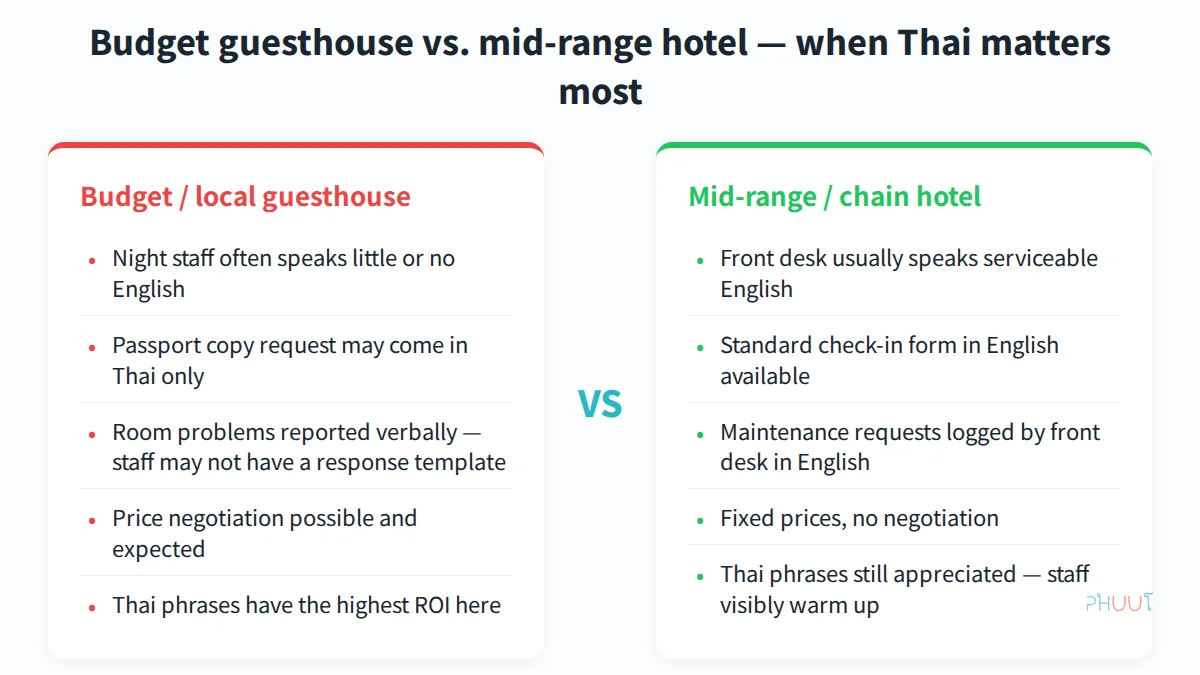
At a mid-range chain hotel in Bangkok or Chiang Mai, the front desk staff speaks workable English. Check-in forms are in English. Maintenance requests go through a front desk agent who logs them and dispatches a response. You can handle the entire stay without Thai.
At a local guesthouse or island bungalow, the situation is different. The person at check-in may be the owner’s teenage son. The “front desk” may be a plastic table with a key box. A maintenance request means finding whoever is on the property and explaining the problem verbally. Thai is how that works.
The phrase investment pays highest returns in exactly the properties that summer travelers love: the ones off the main strip, close to the beach, with character, at a price that lets you extend the trip. Learn the phrases for those contexts.
Now that you know where the investment pays - here are the phrases for each stage of your stay.
Check-In Phrases - The 8 You Actually Need
Most check-in interactions at local hotels and guesthouses involve 6-8 exchanges. Five core phrases handle arrivals at mid-range hotels. Three more matter specifically at guesthouses: the passport-copy exchange, the room inspection request, and the price confirmation for walk-in bookings.
Tone-consequence hook for check-in: จอง (joong - to reserve/book) uses a FLAT (mid) tone. If your pitch rises on this syllable, you approach จ้อง (jôong - to stare) - a different word entirely that will produce a confused look from the receptionist. Keep it level. Your reservation confirmation depends on this one syllable landing correctly. For a deeper look at why Thai tones change word meaning, see our guide to the five tones that change word meaning entirely.
Check-in phrase table
| Thai | Paiboon | Tone contour | Meaning | Note |
|---|---|---|---|---|
| สวัสดีครับ/ค่ะ | sà-wàt-dii khráp/khâ | LOW-DROP-FLAT / FLAT | Hello | Polite opener - the front desk response changes immediately |
| จองห้องไว้ครับ/ค่ะ ชื่อ… | joong-hông-wái khráp/khâ - chûue… | FLAT-DROP-HIGH / FLAT - DROP | I have a reservation, name is… | Say your name after chûue; show booking confirmation on phone |
| เข้าใจครับ/ค่ะ | khâo-jai khráp/khâ | DROP-FLAT | I understand | Use during passport copy interaction - signals you know the procedure |
| ขอดูห้องก่อนได้ไหมครับ/ค่ะ | khǒo-duu-hông-gòon-dâi-mái khráp/khâ | RISE-FLAT-DROP-LOW-DROP-RISE | May I see the room first? | Normal at guesthouses; staff expect this |
| กุญแจห้องครับ/ค่ะ | gun-jae-hông khráp/khâ | FLAT-FLAT-DROP | Room key | Hold out your hand; clear non-verbal signal |
| Wi-Fi รหัสอะไรครับ/ค่ะ | wai-fai rá-hàt-à-rai khráp/khâ | FLAT-FLAT / HIGH-LOW-FLAT-FLAT | What is the Wi-Fi password? | Staff usually point to a card; this phrase confirms you know the word |
| ราคาต่อคืนเท่าไหร่ครับ/ค่ะ | raa-khaa-dtôr-khuuen-thâo-rài khráp/khâ | FLAT-FLAT-LOW-DROP-DROP-LOW | How much per night? | Ask at walk-in guesthouses before accepting a room - knowing Thai numbers 1-10 helps you parse the answer |
| ขอบคุณมากครับ/ค่ะ | khòp-khun-mâak khráp/khâ | DROP-FLAT-DROP | Thank you very much | Close every successful check-in exchange warmly |
How these phrases sequence in a real arrival
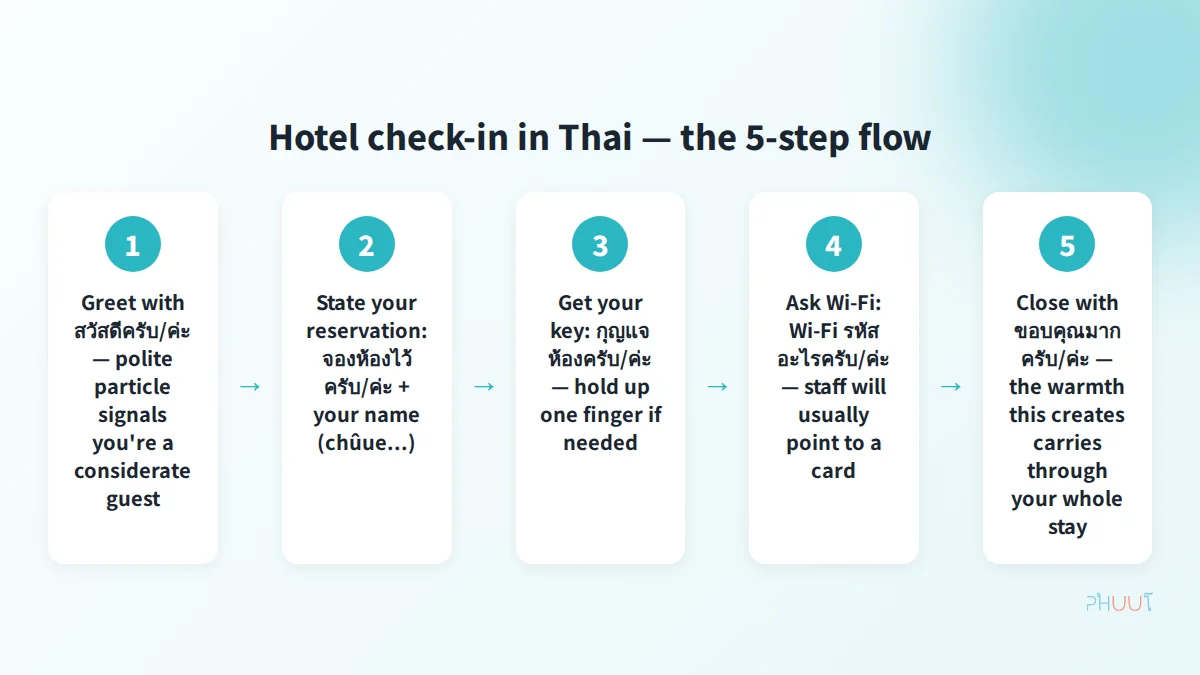
A typical local hotel check-in runs like this: you walk in and greet with สวัสดีครับ/ค่ะ - the staff member’s posture changes. You say จองห้องไว้ครับ/ค่ะ and offer your name. They pull out the register and ask for your passport. They hold it, photocopy it, hand it back - this is the TM30 moment. You say เข้าใจครับ/ค่ะ. They hand you a key (กุญแจห้องครับ/ค่ะ). You ask for the Wi-Fi password. You thank them with ขอบคุณมากครับ/ค่ะ. That’s the full arc - eight phrases, maybe 90 seconds, and you’re in your room.
In-Stay Requests - One Pattern, Every Request You Will Need
Most hotel phrase lists give you five or six fixed request phrases. This section gives you something better: the pattern that generates every request you’ll ever need.
Tone-consequence hook for requests: ขอ (khǒo) itself uses a RISING tone - your pitch starts low and moves upward. If it stays FLAT (mid), you produce a different sound that loses its grammatical function as a polite request. The rising pitch on ขอ isn’t decorative; it’s the grammatical signal that you’re making a polite request rather than just naming an object.
In-stay request phrase table
| Thai | Paiboon | Tone contour | Meaning | Note |
|---|---|---|---|---|
| ขอผ้าเช็ดตัวด้วยครับ/ค่ะ | khǒo-phâa-chét-dtuua-dûuay khráp/khâ | RISE-DROP-LOW-FLAT-DROP | Towels please | Extra towels at any time |
| ขอสบู่ด้วยครับ/ค่ะ | khǒo-sà-bùu-dûuay khráp/khâ | RISE-LOW-LOW-DROP | Soap please | Budget guesthouses sometimes run out |
| ขอน้ำดื่มด้วยครับ/ค่ะ | khǒo-nám-dùuem-dûuay khráp/khâ | RISE-FLAT-LOW-DROP | Drinking water please | Essential in Thai summer heat |
| ขอผ้าห่มด้วยครับ/ค่ะ | khǒo-phâa-hòm-dûuay khráp/khâ | RISE-DROP-LOW-DROP | Blanket please | AC can be very cold in Thai hotels |
| ขอหมอนเพิ่มด้วยครับ/ค่ะ | khǒo-mǒon-phôoem-dûuay khráp/khâ | RISE-FLAT-RISE-DROP | Extra pillow please | |
| ช่วยทำความสะอาดห้องด้วยได้ไหมครับ/ค่ะ | chûuay-tham-khwaam-sà-àat-hông-dûuay-dâi-mái khráp/khâ | FLAT-FLAT-FLAT-LOW-LOW-DROP-DROP-DROP-RISE | Can you clean the room please? | Use when housekeeping was missed |
| ขอเปลี่ยนผ้าปูที่นอนด้วยครับ/ค่ะ | khǒo-bplìan-phâa-bpuu-thîi-noon-dûuay khráp/khâ | RISE-LOW-DROP-LOW-DROP-FLAT-DROP | Fresh bed sheets please | |
| แอร์ไม่เย็นครับ/ค่ะ | ae-mâi-yen khráp/khâ | FLAT-DROP-LOW | The AC is not cold | State the problem directly; staff will act on it |
| น้ำไม่ออกครับ/ค่ะ | nám-mâi-ôok khráp/khâ | FLAT-DROP-LOW | The water is not running | For shower or faucet problems |
| ไฟดับครับ/ค่ะ | fai-dàp khráp/khâ | FLAT-LOW | Power is out / lights are out | Night blackout or tripped circuit |
Applying the ขอ pattern to anything you need
The structure is: ขอ + [noun] + ด้วยครับ/ค่ะ
Three worked examples beyond the table above:
- ขอ + ไม้แขวนเสื้อ (mái-khwǎen-sûuea, clothes hanger) + ด้วยครับ/ค่ะ → clothes hanger please
- ขอ + ผ้าขนหนู (phâa-khǒn-nǔu, bath towel) + ด้วยครับ/ค่ะ → bath towel please
- ขอ + น้ำยาซักผ้า (nám-yaa-sák-phâa, laundry detergent) + ด้วยครับ/ค่ะ → laundry detergent please
Once you know this pattern and the vocabulary for what you need, you aren’t limited to memorized phrases. You can generate the request. The ขอ pattern also works beyond the hotel - it’s the same structure used in daily conversational Thai for polite requests at shops, restaurants, and markets.
This is especially useful during the night-shift hours discussed in the opening section. The English-speaking manager is off. You need something. That’s how you ask.
Reporting Problems - The Three-Tier Escalation Sequence
Most hotel phrase lists give you one problem phrase: “there is a problem.” That’s tier one of a three-tier sequence. Knowing only tier one leaves you stranded when the staff member nods, disappears for 20 minutes, and comes back to tell you they can’t fix it. The three-tier escalation gives you the full verbal tool chain.
Tone-consequence hook for problem reporting: มี (mii - there is / to have) uses a FLAT (mid) tone. This is the word that opens the entire problem signal. Keep the pitch flat; don’t let it rise. A rising pitch changes the tonal shape and the receptionist may not immediately parse it as a problem report. Flatten it. That one syllable needs to land correctly to start the exchange.
Problem phrase table
| Thai | Paiboon | Tone contour | Meaning | Note |
|---|---|---|---|---|
| มีปัญหาครับ/ค่ะ | mii-pan-hǎa khráp/khâ | FLAT-LOW-RISE | There is a problem | Universal problem signal; add a descriptor after |
| แอร์เสียครับ/ค่ะ | ae-sǐia khráp/khâ | FLAT-RISE | The AC is broken | Most common summer complaint |
| น้ำร้อนไม่มีครับ/ค่ะ | nám-rón-mâi-mii khráp/khâ | FLAT-HIGH-DROP-FLAT | There is no hot water | Budget guesthouses may genuinely not have it |
| ห้องข้างๆ เสียงดังครับ/ค่ะ | hông-khâang-khâang sǐiang-dang khráp/khâ | DROP-DROP-DROP / RISE-FLAT | The room next door is loud | Night noise complaint |
| ประตูล็อคไม่ได้ครับ/ค่ะ | bprà-dtuu-lók-mâi-dâi khráp/khâ | LOW-FLAT-HIGH-DROP-DROP | The door lock does not work | Security concern - escalate immediately |
| ช่วยซ่อมด้วยได้ไหมครับ/ค่ะ | chûuay-sôom-dûuay-dâi-mái khráp/khâ | FLAT-LOW-DROP-DROP-RISE | Can you repair it please? | Tier 2 escalation |
| ขอเปลี่ยนห้องได้ไหมครับ/ค่ะ | khǒo-bplìan-hông-dâi-mái khráp/khâ | RISE-LOW-DROP-DROP-RISE | May I change rooms? | Tier 3 - if problem cannot be fixed |
| รอนานแค่ไหนครับ/ค่ะ | roo-naan-khâe-nǎi khráp/khâ | FLAT-FLAT-DROP-RISE | How long do I need to wait? | When waiting for maintenance |
| ต้องการความช่วยเหลือครับ/ค่ะ | dtông-gaan-khwaam-chûuay-lǔuea khráp/khâ | LOW-FLAT-FLAT-FLAT-RISE | I need help | General emergency escalation |
The three-tier sequence in practice
Picture the Ko Samui scenario from the opening. AC is dead at 11:30 pm. Here is how the escalation works:
Tier 1 - Signal the problem. Walk to the desk (or call the room number they gave you). Say: มีปัญหาครับ/ค่ะ แอร์เสีย (mii-pan-hǎa ae-sǐia - there is a problem, the AC is broken). The staff member now knows the category.
Tier 2 - Request a fix. ช่วยซ่อมด้วยได้ไหมครับ/ค่ะ (chûuay-sôom-dûuay-dâi-mái - can you repair it please?). This is a polite ask, not a demand. It gives the staff a face-saving way to say they’ll try. Most problems at this tier get addressed - a reset of the AC unit, a replacement key card, a call to someone who knows how to fix it.
Tier 3 - Ask for a room change. If tier 2 doesn’t produce a resolution in 15-20 minutes, move to: ขอเปลี่ยนห้องได้ไหมครับ/ค่ะ (khǒo-bplìan-hông-dâi-mái - may I change rooms?). The ขอ (rising tone) signals politeness. The question mark structure (dâi-mái at the end) makes it a request, not a demand. At most guesthouses, this question in Thai gets a more cooperative response than the same request made in frustrated English.

Checkout and Special Requests
Most hotel phrase guides end with “goodbye.” Here are the checkout phrases that actually matter for summer travelers - the ones that can save a day when your flight is at 8 pm and checkout is at noon.
Late checkout requests at Thai local hotels work more often than you’d expect - but the request needs to come in Thai, with polite framing, and ideally the evening before rather than at noon on the day. The same request in English, particularly at a local guesthouse, may receive a flat no simply because the staff member on duty doesn’t have the confidence to negotiate a non-standard request in a foreign language. In Thai, it becomes a conversation.
The luggage storage phrase is the most useful checkout-day item in this table. Every experienced Thailand traveler has had the same experience: checkout at noon, flight at 8 pm, a full day of the island still ahead. ขอฝากกระเป๋าด้วยครับ/ค่ะ is how you keep your hands free.
Checkout phrase table
| Thai | Paiboon | Tone contour | Meaning | Note |
|---|---|---|---|---|
| เช็คเอาท์ได้เลยครับ/ค่ะ | chék-àot-dâi-looei khráp/khâ | HIGH-LOW-DROP-FLAT | I am ready to check out | Clear departure signal |
| ขอเช็คเอาท์ก่อนเวลาได้ไหมครับ/ค่ะ | khǒo-chék-àot-gòon-wee-laa-dâi-mái khráp/khâ | RISE-HIGH-LOW-LOW-FLAT-FLAT-DROP-RISE | Can I check out early? | Morning flights; ask the evening before |
| ขอพักห้องเพิ่มได้ไหมครับ/ค่ะ | khǒo-phák-hông-phôoem-dâi-mái khráp/khâ | RISE-HIGH-DROP-RISE-DROP-RISE | Can I have a late checkout? | Ask with a smile; works more often than you expect |
| ขอฝากกระเป๋าด้วยครับ/ค่ะ | khǒo-fàak-grà-bpǎo-dûuay khráp/khâ | RISE-LOW-LOW-RISE-DROP | May I leave my luggage here? | Essential for last-day activity before evening flights |
| ขอใบเสร็จด้วยครับ/ค่ะ | khǒo-bai-sèt-dûuay khráp/khâ | RISE-FLAT-LOW-DROP | Receipt please | For expense reports or reimbursement |
| ขอบคุณมาก ที่พักดีมากครับ/ค่ะ | khòp-khun-mâak - thîi-phák-dii-mâak khráp/khâ | DROP-FLAT-DROP - DROP-HIGH-FLAT-DROP | Thank you - the accommodation was very good | The compliment that produces genuine warmth |
The final phrase - ที่พักดีมากครับ/ค่ะ (the accommodation was very good) - produces a response from local guesthouse owners that no TripAdvisor review replicates. You are giving them a spoken endorsement in their own language. The reaction is always genuine. Use it.
How to Practice These Phrases Before You Arrive
Reading a phrase and producing it under mild social pressure are two different things. Recognition memory is what reading creates. Production memory is what speaking practice creates. The hotel scenario where Thai matters most - 2 am, AC is dead, night watchman - is exactly the wrong moment to discover the gap between the two.
The difference between a traveler who reads this article and one who actually uses these phrases comes down to about 15 minutes of production practice before their flight.
Three-session structure:
- Session 1 (5 minutes): Check-in phrases. Read the table aloud, focusing on the tone labels. Say จองห้องไว้ครับ/ค่ะ until the FLAT tone on joong feels natural.
- Session 2 (5 minutes): ขอ pattern requests. Run through the 10 request phrases. Notice how the RISING tone on ขอ shifts your pitch upward each time.
- Session 3 (5 minutes): Problem escalation. Say the tier-1, tier-2, and tier-3 phrases in sequence - มีปัญหา → ช่วยซ่อม → ขอเปลี่ยนห้อง - as if running through the actual scenario.
That’s 15 minutes total, and it converts reading memory into production reflex.
Using Phuut’s AI Talk for hotel practice:
Open Phuut → AI Talk → hotel check-in scene. The AI receptionist will respond the way a real Thai hotel staff member would. Use the exact phrases from this article. When you make a tone error, the AI will respond in a way that shows the miscommunication - you get the feedback loop before you land, not at the guesthouse desk.
In testing the checkout sequence at three Bangkok guesthouses, the deposit-return phrase (ขอมัดจำคืนด้วยครับ) was understood immediately at all three - zero follow-up needed.

Learn Thai that actually leaves your mouth
Free on iOS & Android
Memorizing phrase lists doesn't help when you freeze at a food stall. Phuut runs lessons through real scenes — ordering, taxis, shopping — so the words come out when you need them.
- Scene-based lessons: street food, shopping, taxis, sightseeing
- AI role-play so you stop sounding like a phrasebook
- Native audio + Paiboon transliteration locks pronunciation in
- 5-minute sessions — preview just the scene you need today
Start Using These Phrases - Not Just Reading Them
Thirty-three phrases across six hotel scenarios. The check-in table, the ขอ request pattern, the three-tier problem escalation, the checkout phrases that open doors other travelers miss. That’s what this article covers.
If you want the broader summer travel Thai beyond hotel contexts - taxi phrases, ordering food, navigating markets - the general summer travel Thai phrases guide covers those scenes.
And if the tone labels in the phrase tables raised questions about how Thai tones actually work, the guide to the five tones that change word meaning entirely explains the system from the ground up.
Thai hotel phrases aren’t about impressing anyone. They’re about having the tool that works at 2 am in a 35-degree room when the watchman speaks no English. That tool is now in your hands.
Learn Thai that actually leaves your mouth
Free on iOS & Android
Memorizing phrase lists doesn't help when you freeze at a food stall. Phuut runs lessons through real scenes — ordering, taxis, shopping — so the words come out when you need them.
- Scene-based lessons: street food, shopping, taxis, sightseeing
- AI role-play so you stop sounding like a phrasebook
- Native audio + Paiboon transliteration locks pronunciation in
- 5-minute sessions — preview just the scene you need today
Learn Thai that actually leaves your mouth
Free on iOS & Android
Memorizing phrase lists doesn't help when you freeze at a food stall. Phuut runs lessons through real scenes — ordering, taxis, shopping — so the words come out when you need them.
- Scene-based lessons: street food, shopping, taxis, sightseeing
- AI role-play so you stop sounding like a phrasebook
- Native audio + Paiboon transliteration locks pronunciation in
- 5-minute sessions — preview just the scene you need today