
Thai Phrases for Summer Travel: Hotel, Taxi, Market & Beach (2026)
Affiliate disclosure: This article contains affiliate links. We may earn a small commission at no extra cost to you. As an Amazon Associate, we earn from qualifying purchases.

About the reviewer

Ramy Hirano
Phuut Founder
Founder of Phuut. Has observed how Japanese and English speakers stumble on Thai and built learning products around those patterns.
Follow Phuut on X →You have just landed at Suvarnabhumi in July. The taxi driver outside arrivals quotes you 800 baht for what the app shows as a 200-baht metered ride to your hotel. You do not know the six words that would end this conversation in your favor. This guide on thai phrases for summer travel gives you those six words - and 32 more, organized by the four scenes that dominate every summer Thailand trip. Each phrase includes Thai script, Paiboon romanization, and a tone label per syllable. No abstract grammar. Just the phrases, in the order you will need them.
What you’ll learn in this article:
- The polite particle ครับ/ค่ะ - the one thing that changes how every Thai interaction goes
- 5 hotel check-in phrases for a smooth arrival and a good stay
- 6 taxi and Grab phrases including the meter phrase that saves real money
- 8 night market phrases including the bargaining sequence
- 7 beach and island food phrases including spice level and the compliment vendors love
- How to practice these phrases before your flight - not just read them
Before You Memorize Anything - The One Element That Changes Every Interaction
Before you touch a single phrase in this guide, learn two syllables. ครับ (khráp) for men, ค่ะ (khâ) for women. These are the polite ending particles that Thai attaches to almost any sentence to signal courtesy and goodwill.
The reason this matters more than any phrase list: Thai is a social language in which politeness signals do an enormous amount of work. A foreigner who says สวัสดีครับ (sà-wàt-dii khráp - hello, polite particle) is received differently at a hotel desk, in a taxi, and at a market stall than a foreigner who says สวัสดี alone. The particle costs nothing to learn - it is one syllable - and its effect on how Thais respond to you is immediate and consistent.
Watch it work across three basic phrases:
| Phrase | Without particle | With particle | What each communicates |
|---|---|---|---|
| Greeting | สวัสดี | สวัสดีครับ/ค่ะ | Polite particle signals respect; staff switch to helpful mode |
| Price question | เท่าไหร่ | เท่าไหร่ครับ/ค่ะ | Particle converts a demand into a polite inquiry |
| Thank you | ขอบคุณ | ขอบคุณครับ/ค่ะ | Particle makes the thanks feel warm rather than perfunctory |
Every phrase in this article includes ครับ/ค่ะ. Once you understand what it is and why it is there, you will use it automatically - and every subsequent phrase you attempt will land better because of it.
Understanding the romanization system in this article
Paiboon is a romanization system that marks the tone of every Thai syllable with a diacritic: no mark = mid tone, à = low, â = falling, á = high, ǎ = rising. This article uses Paiboon throughout rather than tourist romanization (“sawadee,” “khop khun”) because tourist spellings carry no tone data - you read the word but have no idea whether each syllable falls, rises, or stays flat, which is the most important information in Thai. To take one concrete example: tourist romanization gives you “sawadee krap” with no pitch guidance, while Paiboon’s sà-wàt-dii khráp tells you the first syllable is low, the second falling, and the final particle mid - a pronunciation map, not a spelling guess.
Hotel Thai - 5 Phrases for a Smooth Check-In and a Good Stay
Thai hotel staff at mid-range and above properties speak serviceable English. Arriving with five Thai phrases anyway changes the relationship from “tourist to be processed” to “respectful guest who made an effort” - and that shift produces better rooms, faster service, and warmer smiles throughout your stay.
Thailand’s hotel industry processes hundreds of guests who make zero effort with Thai. The traveler who says สวัสดีครับ at the front desk stands out immediately and positively. That social goodwill persists across every subsequent request - for extra pillows, restaurant recommendations, or a later checkout. It is the same dynamic as using any local language in any country: the effort is the signal, not the fluency.
Tone-consequence hook for hotels: The word ห้อง (hôong - room) uses a falling tone. Flatten that pitch to mid and you approach หอง - a non-word the receptionist will not recognize. Let your pitch fall across the syllable: start mid, drop to low. That single correct contour on ห้อง, combined with ครับ/ค่ะ, is enough to signal clearly that you are asking about your room.
Hotel phrase table (5 phrases)
| Thai | Paiboon | Tone contour | Meaning | Note |
|---|---|---|---|---|
| สวัสดีครับ/ค่ะ | sà-wàt-dii khráp/khâ | LOW-DROP-FLAT / FLAT | Hello | Use on arrival; the front desk response is immediate warmth |
| จองห้องไว้ครับ/ค่ะ ชื่อ… | joong-hôong-wái khráp/khâ - chûue… | FLAT-DROP-HIGH / FLAT - DROP | I have a reservation, name is… | Say your name after chûue; staff will check the system |
| Wi-Fi รหัสอะไรครับ/ค่ะ | wai-fai rá-hàt à-rai khráp/khâ | FLAT-FLAT HIGH-LOW FLAT-FLAT | What is the Wi-Fi password? | Most hotels will point to a card; this phrase shows you know the word |
| มีปัญหาครับ/ค่ะ | mii-pan-hǎa khráp/khâ | FLAT-LOW-RISE | There is a problem | Use to report AC issues, missing towels, noise - staff respond better to this than to English demands |
| ขอบคุณมากครับ/ค่ะ | khòp-khun-mâak khráp/khâ | DROP-FLAT-DROP | Thank you very much | Use at checkout and after any helpful service |
Five phrases. They handle arrival, confirmation, connectivity, problem reporting, and departure. That is the complete arc of a hotel stay in a single phrase set.
Taxi and Grab Thai - 6 Phrases Including the One That Saves Real Money
One phrase in Bangkok taxi Thai pays for every minute you spend on this article: เปิดมิเตอร์ด้วยครับ/ค่ะ (pòoet-mí-tôoe-dûuay khráp/khâ - turn on the meter please). Not knowing it routinely costs 3-5x the metered fare on street-hailed rides.
Taxi drivers sometimes quote flat rates before activating the meter. Flat rates from airports and tourist areas are almost always higher than what the meter would show for the same distance. A polite request to turn on the meter is completely standard practice - drivers expect it from informed passengers, and compliance is the norm. You are not being confrontational. You are being a savvy passenger.
For Grab, the dominant ride-hailing app in Thailand, this phrase is irrelevant because the fare is set by the app before you confirm. But Grab is not always available. Ko Samui airport transfers, Phuket taxi stands, Chiang Mai city rides, and street hails anywhere in Thailand fall outside Grab’s reliable coverage. That is exactly when you need the meter phrase.
Tone-consequence hook for taxis: สี่แยก (sìi-yɛ̂ɛk - intersection) is one of the most common navigation words you will say in a Bangkok taxi, and its first syllable is less forgiving than it looks. สี่ (sìi) uses a low tone. Let it slip toward a rising or unleveled pitch and you are in the territory of สี (sǐi - colour). Suddenly you have asked to stop at “colour junction” - a destination that does not exist, and a driver who is now searching his memory for something that is not on any map. Keep สี่ low and level across the syllable. If you are unsure of the tones on a destination name, state the frame phrase and hand over a written address - the frame does its job, the written name fills the gap.
Taxi and transport phrase table (6 phrases)
| Thai | Paiboon | Tone contour | Meaning | Note |
|---|---|---|---|---|
| ไปที่…ได้ไหมครับ/ค่ะ | pai-thîi-…-dâi-mái khráp/khâ | FLAT-DROP-[dest]-DROP-RISE | Can you go to [place]? | Say destination in the gap; show a map if unsure of pronunciation |
| เปิดมิเตอร์ด้วยครับ/ค่ะ | pòoet-mí-tôoe-dûuay khráp/khâ | LOW-HIGH-FLAT-DROP | Turn on the meter please | Say this before the car moves - it saves 3-5x on city rides |
| ตรงไปครับ/ค่ะ | trong-pai khráp/khâ | FLAT-FLAT | Straight ahead | Direction during the ride; point simultaneously |
| จอดตรงนี้ครับ/ค่ะ | jòot-trong-níi khráp/khâ | LOW-FLAT-HIGH | Stop here please | Clear signal to pull over at your destination |
| เท่าไหร่ครับ/ค่ะ | thâo-rài khráp/khâ | DROP-LOW | How much? | Confirm the fare at destination if no meter was used |
| ขอบคุณครับ/ค่ะ | khòp-khun khráp/khâ | DROP-FLAT | Thank you | Always close the ride on a positive note |
These are the six words that open every Bangkok taxi ride - the ones worth having ready before the door closes. The meter phrase is the reason a pre-trip Thai phrase session has a measurable return on investment. Every other phrase in this article improves your experience. That one phrase protects your money.

Night Market Thai - 8 Phrases Including the One That Gets You a Lower Price
Chatuchak on a Saturday morning: every stall, every vendor, every price is negotiable - but only if you know the two-phrase rhythm that starts it. Thai night markets from Bangkok to Chiang Mai to Ko Samui’s Fisherman’s Village run on a two-phase interaction any summer traveler can master. Establish the price. Then, at the right venues, negotiate it.
ลดได้ไหมครับ/ค่ะ (lót-dâi-mái khráp/khâ - can you reduce the price?) is one of the most practical phrases in Thai for a market visitor because it signals cultural engagement rather than tourist obliviousness. At open-air markets, weekend markets, and independent craft stalls, vendors often come down 10-20% when asked politely with a smile. Even when the price holds, the ask builds genuine goodwill - the vendor sees you as a participant in the cultural exchange rather than a target.
One essential boundary: this phrase is for open-air markets and independent stalls only. 7-Eleven, department stores, pharmacies, and shopping malls have fixed prices. Using ลดได้ไหม at a convenience store will produce a confused stare, not a discount.
Tone-consequence hook for markets: ลด (lót - reduce, discount) uses a FLAT (mid) tone - your pitch stays level, neither rising nor falling across the syllable. If your tone drops instead of staying flat, you approach a different syllable shape the vendor will not associate with bargaining. Keep ลด level. The two syllables that do the heavy lifting in ลดได้ไหม are dâi (falling - “can”) and mái (rising - question particle). Getting those two right makes the full bargaining opener intelligible even if ลด itself takes a second attempt.
Night market and shopping phrase table (8 phrases)
| Thai | Paiboon | Tone contour | Meaning | Note |
|---|---|---|---|---|
| ราคาเท่าไหร่ครับ/ค่ะ | raa-khaa-thâo-rài khráp/khâ | FLAT-FLAT-DROP-LOW | How much is it? | More complete than เท่าไหร่ alone; good for clothing and crafts |
| ลดได้ไหมครับ/ค่ะ | lót-dâi-mái khráp/khâ | FLAT-DROP-RISE | Can you reduce the price? | The bargaining opener; smile mandatory; open-air markets only |
| แพงไปครับ/ค่ะ | phaeng-pai khráp/khâ | FLAT-FLAT | That’s too expensive | Polite counter-signal; use gently, not aggressively |
| เอาราคานี้ได้เลย | ao-raa-khaa-níi-dâi-looei | FLAT-FLAT-FLAT-HIGH-DROP-FLAT | I’ll take it at this price | Closes a successful negotiation warmly |
| ขอดูหน่อยได้ไหม | khǒo-duu-nòoi-dâi-mái | RISE-FLAT-LOW-DROP-RISE | May I look at it? | Before handling merchandise - vendors appreciate the politeness |
| มีสีอื่นไหม | mii-sǐi-ùuen-mái | FLAT-RISE-LOW-RISE | Do you have another color? | Useful for clothing, scarves, bags |
| ใส่ถุงด้วยครับ/ค่ะ | sài-thǔng-dûuay khráp/khâ | LOW-RISE-DROP | In a bag please | Takeaway packaging request |
| ขอบคุณครับ/ค่ะ | khòp-khun khráp/khâ | DROP-FLAT | Thank you | Whether you buy or not - always close politely |
The bargaining sequence follows a natural four-beat rhythm: ask the price, ask for a reduction, signal if you think it is too high, close if you agree. Eight phrases handle everything from that first price question to the warm closing, regardless of what you end up buying.
If you want to lock in the tone patterns for all eight market phrases before your trip, Anki (free, open-source) works well for spaced-repetition review of Thai vocabulary. Create one card per phrase, write the Paiboon romanization on the front, and the tone label plus Thai script on the back.
Beach and Island Thai - 7 Phrases for Food, Water, and Vendors
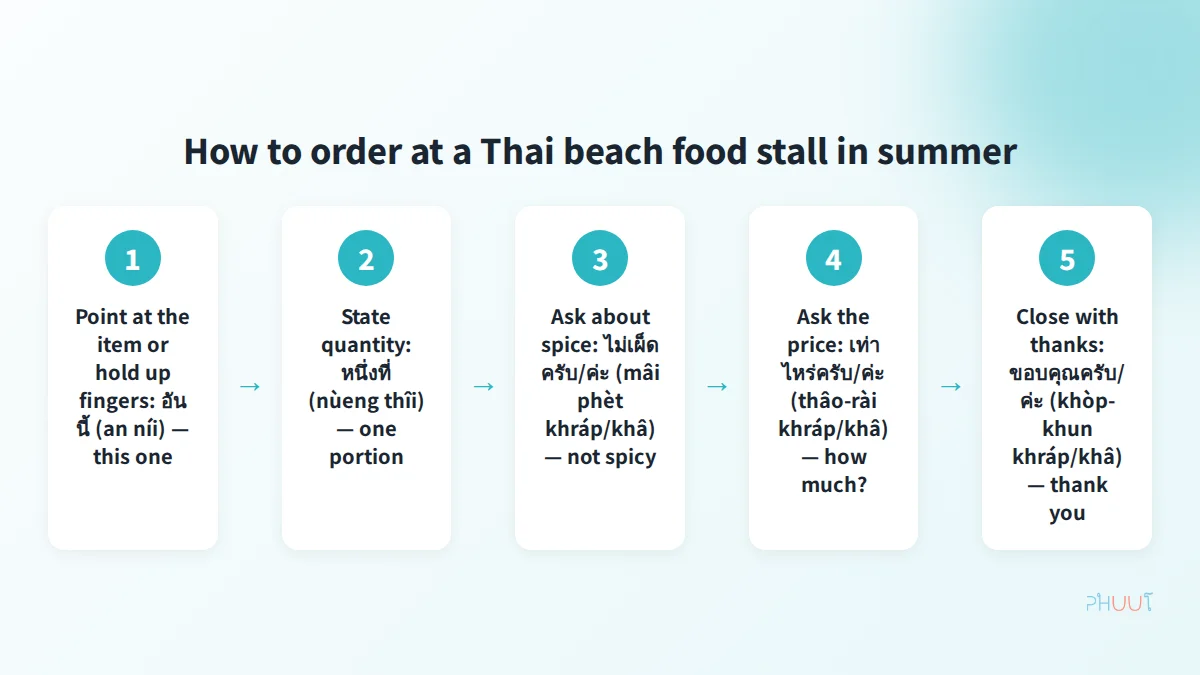
Ko Tao’s beachside restaurants, Ko Pha Ngan’s night food stalls, the pad thai cart on Phuket’s Patong beach - they all run on the same ordering loop. Arrive, look, order, specify spice, pay. Seven phrases handle the complete cycle. One compliment phrase at the end produces a warm smile every single time you use it correctly.
Spice management earns this much attention in a summer phrase guide because Thai summer heat makes ไม่เผ็ดครับ/ค่ะ (mâi-phèt khráp/khâ - not spicy) more than a preference - it is a practical necessity for many visitors. Restaurant and stall spice levels for local Thai dishes can be significantly higher than what visitors expect. Saying this phrase before you order is the difference between the meal you wanted and a meal that is genuinely uncomfortable in 35-degree heat.
The compliment phrase อร่อยมากครับ/ค่ะ (a-ròoi-mâak khráp/khâ - very delicious) is in a category of its own. Beach food vendors on Ko Samui, Ko Pha Ngan, and Ko Tao deal with foreign tourists constantly. A tourist who looks up after eating and says this phrase - with the right tones - produces an immediate and genuine smile. It costs nothing. It is one of the warmest social gestures available to a traveler who speaks almost no Thai.
Tone-consequence hook for beach food: อร่อย (a-ròoi - delicious) requires a flat pitch on the first syllable followed by a falling drop on the second. Getting the contour approximately right produces that genuine smile. Getting it flat or rising throughout may still convey the general idea from context, but the warm smile comes specifically from the tones landing correctly - the vendor hears real pronunciation effort, not just a word shape.
Beach and island food phrase table (7 phrases)
| Thai | Paiboon | Tone contour | Meaning | Note |
|---|---|---|---|---|
| อันนี้ครับ/ค่ะ | an-níi khráp/khâ | FLAT-HIGH | This one | Point at the item while saying; universal ordering gesture |
| ไม่เผ็ดครับ/ค่ะ | mâi-phèt khráp/khâ | DROP-LOW | Not spicy | Critical in summer heat; say before you order, not after |
| เผ็ดนิดหน่อย | phèt-nít-nòoi | LOW-DROP-LOW | A little spicy | Mild spice level; swap ไม่เผ็ด with this if you want some heat |
| เท่าไหร่ครับ/ค่ะ | thâo-rài khráp/khâ | DROP-LOW | How much? | Price check before or after eating |
| ขอน้ำเปล่าด้วยครับ/ค่ะ | khǒo-nám-plào-dûuay khráp/khâ | RISE-FLAT-LOW-DROP | Water too, please | Essential in Thai summer heat; never skip this one |
| ใส่ถุงด้วยครับ/ค่ะ | sài-thǔng-dûuay khráp/khâ | LOW-RISE-DROP | In a bag please | Takeaway from a beach stall |
| อร่อยมากครับ/ค่ะ | a-ròoi-mâak khráp/khâ | FLAT-DROP-DROP | Very delicious | The compliment that makes every vendor smile - use it |
That last phrase is not optional. Every vendor on every beach in Thailand has heard “thank you” in English a thousand times. Hearing อร่อยมากครับ/ค่ะ in their own language, with the tones close enough to right, lands differently. Use it.
How to Practice These Phrases Before Your Flight - Not Just Read Them
Reading a phrase list builds recognition. Producing a phrase under the mild social pressure of a real interaction - even a simulated one - builds the reflex. A traveler who has practiced each scene in a conversation context will not freeze at the hotel desk. One who has only read the list often does.
Why the failure mode is so predictable: passive reading creates recognition memory, not production memory. You read “เปิดมิเตอร์ด้วยครับ” and feel confident. Then the taxi driver says something unexpected and you have decoded the phrase, but you have never had to produce it under the time pressure of a real exchange - the taxi is waiting, the driver is looking at you, and your mouth has not done this before. The phrase stays in your reading memory and will not come out of your mouth when you need it.
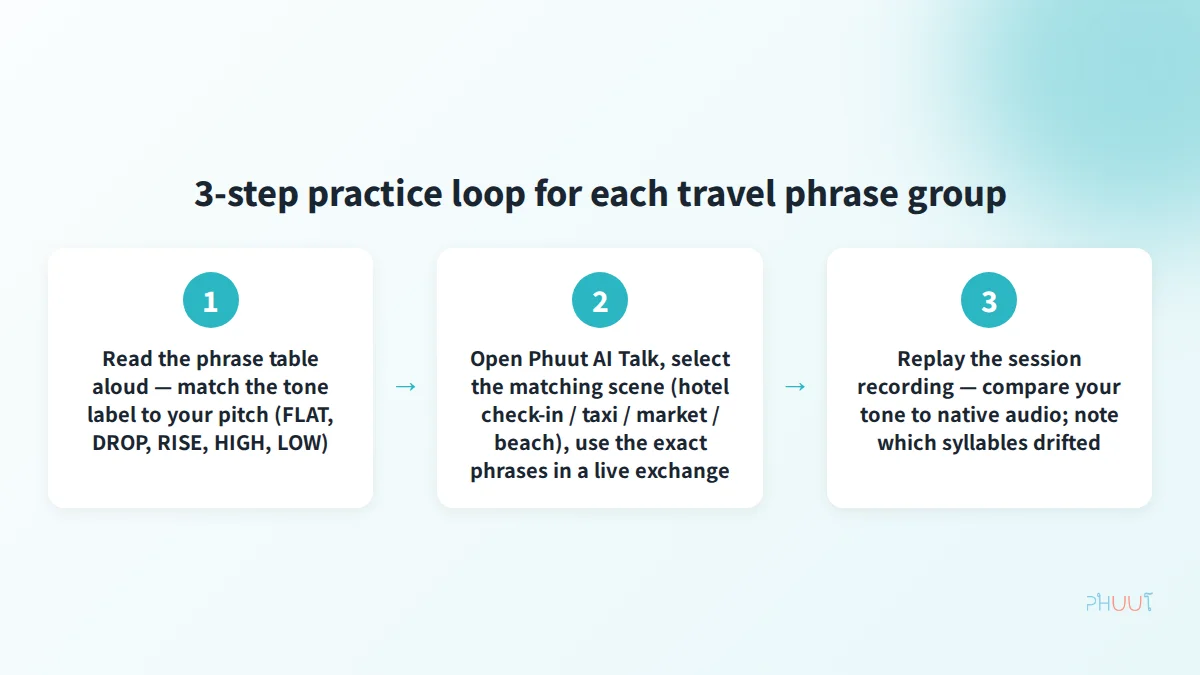
Active practice before departure is the only thing that builds production reflexes. Here is the three-step loop that converts each phrase table in this article into a production reflex:
Step 1: Read aloud, match the tone label to your pitch. Take the hotel phrase table. Read each phrase aloud three times, not subvocalized but actually spoken. Match your pitch to the tone labels: FLAT means no pitch movement, DROP means start mid and let it fall, HIGH means hold your pitch noticeably above your natural speaking level, LOW means bring it slightly below. Your mouth needs to practice the shape, not just your brain.
Step 2: Open Phuut AI Talk, select the matching scene, produce the phrases in a live exchange. Phuut’s AI Talk mode generates scenario-based conversations, not vocabulary prompts. Select the hotel check-in scene, the taxi scene, the market scene, or the beach food scene. Use the exact phrases from the tables above in a simulated exchange with the AI, which responds as a hotel receptionist, a taxi driver, a market vendor, or a beach stall owner. This is where preparation becomes reflex - you say เปิดมิเตอร์ด้วยครับ/ค่ะ and the AI taxi driver responds; you do not look at a list, you produce it.
Step 3: Replay the recording, compare your pitch to native audio. After the exchange, replay your session recording. You are not listening for perfection. You are checking whether the pitch moves in the right direction for each syllable. Note which syllables drifted from the tone label. That awareness is enough to correct the production the next time through.
Two or three 5-minute AI Talk sessions per scene - approximately 30 minutes total across all four scenes - is enough to convert these phrases from passive reading into active reflexes before departure. That is shorter than the inflight entertainment selection process. Do it before you board.
If you want to practice these phrases in a real-conversation context before your flight, Phuut’s AI Talk mode runs each of the four travel scenes covered in this article with a native-voice AI. Try it free on iOS.

Learn Thai that actually leaves your mouth
Free on iOS & Android
Memorizing phrase lists doesn't help when you freeze at a food stall. Phuut runs lessons through real scenes — ordering, taxis, shopping — so the words come out when you need them.
- Scene-based lessons: street food, shopping, taxis, sightseeing
- AI role-play so you stop sounding like a phrasebook
- Native audio + Paiboon transliteration locks pronunciation in
- 5-minute sessions — preview just the scene you need today
Ready to go deeper?
- Conversational Thai for Beginners: 40 Phrases for Greetings, Food and Getting Around - more Thai phrases across the greetings, street food, and transport contexts you’ll use beyond the four scenes above
- Thai Language Tones: What Every Beginner Gets Wrong - Thai has five tones that completely change word meaning; this article explains why they are hard for English speakers and how to fix it
- How to Count in Thai - knowing Thai numbers 1-10 helps confirm fares and prices at every scene in this article
- Duolingo Doesn’t Have Thai - Here’s What to Use Instead (2026) - if your summer trip turns into structured Thai learning after you return
Learn Thai that actually leaves your mouth
Free on iOS & Android
Memorizing phrase lists doesn't help when you freeze at a food stall. Phuut runs lessons through real scenes — ordering, taxis, shopping — so the words come out when you need them.
- Scene-based lessons: street food, shopping, taxis, sightseeing
- AI role-play so you stop sounding like a phrasebook
- Native audio + Paiboon transliteration locks pronunciation in
- 5-minute sessions — preview just the scene you need today