
Duolingo Doesn't Have Thai — Best Alternatives for 2026
Affiliate disclosure: This article contains affiliate links. We may earn a small commission at no extra cost to you. As an Amazon Associate, we earn from qualifying purchases.
About the reviewer

Taishi Hirano
Phuut Founder | Bangkok-based
Bangkok-based for 7 years. Founder of Phuut. Has observed how Japanese and English speakers stumble on Thai and built learning products around those patterns.
Follow Phuut on X →You searched “learn Thai Duolingo.” You got nothing. Not a beta, not a waitlist — just absence. Duolingo is the world’s most downloaded language app, and it has no Thai course. That’s where you are right now, and this article cuts straight to the alternatives. The four best duolingo thai alternative options for English speakers in 2026 are Phuut, Ling, Talkpal, and Pimsleur. We’ll compare them on the four axes that actually determine whether an app sticks: gamification, script coverage, AI pronunciation feedback, and price.
In this article:
- Why Duolingo has no Thai — and why that gap is permanent
- Four axes to evaluate any Thai learning app
- The best alternatives: honest comparison
- Price reframed: what you actually spend over a year
- Key takeaways
- FAQ
Why Duolingo Has No Thai — And Why the Gap Is Permanent
Most articles about “Duolingo Thai alternatives” mention the absence in a single sentence, then pivot to a listicle. That does you a disservice. Understanding why Thai isn’t on Duolingo matters — it changes how you plan your learning.
The Incubator model and what happened to Thai
Duolingo built its non-flagship language courses through a program called the Incubator. The model: teams of volunteer contributors — native speakers and language enthusiasts — applied to create a course for English speakers. Each course had to pass quality gates at Alpha and Beta stages before graduating to a full public release.
Thai was submitted to the Incubator. It never graduated. The course didn’t clear the quality threshold needed for public release. Then, in 2021–2022, Duolingo effectively wound down the Incubator entirely. The channel through which Thai could have entered the platform no longer operates.
Why Duolingo hasn’t built it themselves
Duolingo’s core product team builds courses for high-priority languages: European languages, Hindi, Arabic, Korean. These choices are driven by addressable market size — the number of people globally who want to learn a given language, multiplied by willingness to pay for a subscription.
Thai is a Category IV FSI language, the hardest tier for English speakers. The global learner market is smaller than it is for Spanish or Mandarin. From a product economics perspective, Duolingo’s resources go to languages where the return is largest.
None of this is speculation. It’s the structural logic behind Duolingo’s product roadmap as publicly visible in June 2026 — no Thai course announced, no roadmap mention. The gap isn’t temporary.
What this means for you
Here’s the useful reframe: the Thai learning app market is less crowded than Spanish, French, or Japanese. That means price competition has kept quality high. Since 2024, at least two structured Thai apps have entered or significantly upgraded — including one (Talkpal) that added Thai as recently as May 2026. Duolingo’s absence has driven real product development elsewhere.
What Duolingo does well — daily streaks, short sessions, immediate feedback, a free entry tier — none of that is exclusive to Duolingo. Those habit-loop mechanics are reproducible. They exist in the Thai apps below.
How to Pick a Thai Learning App: Four Axes That Actually Matter
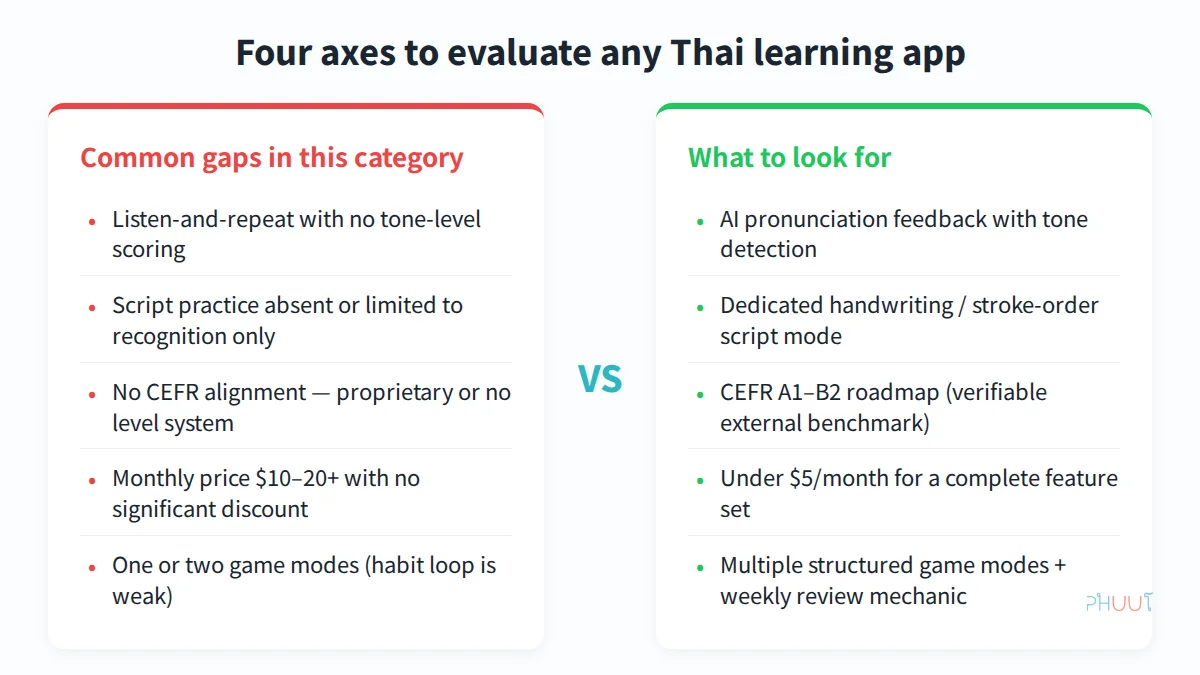
Before naming any app, here’s the evaluation framework. You can apply these four axes to any app you encounter — including ones not in this article.
Axis 1 — Gamification depth
The question isn’t whether an app is “fun.” It’s whether it creates a habit loop strong enough to survive real life: a busy week, a bad mood, the temptation to open Twitter instead. Apps vary enormously here. Some have a single quiz format and a streak counter. Others rotate across multiple game modes with weekly review mechanics that test accumulated vocabulary under pressure.
Ask: does this app give me a reason to open it tomorrow, or does it rely entirely on my willpower?
For context: most apps in this category have two or three active drill formats. The apps that sustain daily habit loops past week three tend to have five or more, including at least one weekly review mechanic that creates real consequence for skipping a day.
Axis 2 — Script coverage
Thai script has 44 consonants, 32 vowel forms, and tone marks that carry direct phonetic meaning. Apps treat script completely differently. Some skip it entirely (audio-only). Some offer passive reading within lessons. Some have dedicated handwriting modes with stroke-order feedback.
Thai’s five tones change word meaning entirely — and in written Thai, those tones are encoded through a combination of consonant class, vowel length, and tone marks. According to a Chulalongkorn University script-acquisition study (2018), learners who tackled Thai script within the first three months learned 40% faster than those who relied on romanization only. Romanization is a crutch that creates pronunciation habits you’ll spend months unlearning.
Ask: does this app teach me to read Thai, or does it only transliterate?
Axis 3 — Pronunciation and tone feedback
This axis has the widest variation between apps. Thai is tonal — the syllable /maa/ means something completely different depending on which of the five tones you produce. Pronunciation feedback falls into three distinct tiers:
- Listen and repeat (no scoring): You hear a model, you try to copy it. Nothing assesses your attempt.
- Speech check (pass/fail): The app detects whether your utterance resembles the target word. Better, but tells you nothing about which tone you produced.
- AI-scored tone detection: The app scores your pronunciation at the tone level specifically. This is the highest tier — and since Talkpal added Thai in May 2026, real-time tonal feedback is now available at under $15/month.
Ask: does this app tell me what I did wrong, or only whether I passed?
Axis 4 — Price and free-tier scope
Specific numbers as of June 2026: Phuut $4.99/month, Talkpal approximately $10–15/month, Ling $15.99/month, Pimsleur $19.99/month. Annual plans discount these rates — but for comparison purposes, monthly rates are the clearest apples-to-apples figure. What the free tier covers matters too: some apps gate core features immediately, others give you a meaningful trial window.
The Best Duolingo Thai Alternatives in 2026 — Honest Comparison
Four apps. Each gets the same structure: one-line positioning, specific strengths, real weaknesses, best-fit learner. No app wins every axis. The right choice depends on which axis matters most to you.
Phuut — Best overall for gamification + script + AI pronunciation under $5/month
Positioning: The lowest-priced structured Thai app in this comparison with the most complete feature set — gamification, script, AI pronunciation feedback, and a CEFR roadmap in a single app.
Strengths:
- Gamification suite: 8 game modes + Boss Battle. Selection quiz, listening, pronunciation practice, Thai script, typing, matching, flashcard, and a weekly Boss Battle review. More distinct mechanics than any other app in this comparison — and the variety is what makes the Boss Battle feel genuinely high-stakes after seven days of drilling, rather than just another quiz.
- Script mode + CEFR roadmap. A dedicated handwriting mode with stroke-order feedback — unique at sub-$5/month pricing — sits inside a full A1 Tourist → A2 Explorer → B1 Resident → B2 Local progression. Four levels, 3,850 words, 1,240 lessons. CEFR alignment means your level is legible outside the app — to a tutor, an employer, a language exchange partner. The Thai script beginner reading path is built directly into the lesson flow.
- AI pronunciation feedback with tone detection + price. AI Talk scores your tone specifically — not just pass/fail — with topic and difficulty selection that reduces speaking anxiety. All of this at $4.99/month Pro, the most accessible pricing among structured Thai apps in this comparison.
In practice, Phuut’s Boss Battle mode is the most memorable moment in a daily session, because losing means you actually replay the hard tones rather than skipping them — a mechanic that other apps in this comparison simply don’t have.
Weaknesses:
- iOS only at time of writing. Android is in development; no release date announced.
- Content library is narrower than years-deep archives. Phuut’s 3,850 vocabulary items and 1,240 lessons cover A1–B2 comprehensively, but learners seeking an extensive native-audio archive of cultural content will find it smaller than some alternatives.
Best for: Learners who want gamification depth, script practice, and AI pronunciation feedback without paying $15–20/month for each feature separately. Also ideal for the Duolingo-trained learner who wants a familiar habit loop at a price that doesn’t require monthly justification.
Ling App — Best for Duolingo-style UX at higher price
Positioning: The most popular Duolingo-style Thai app; strongest for absolute beginners who want a familiar UX and don’t have a tight budget.
Strengths:
- Ling’s gamified lessons — matching exercises, fill-in-the-blank, short speech games — will feel immediately familiar if you’ve come from Duolingo. The UX holds up on older devices, and Thai script basics are woven into the beginner vocabulary sequence.
- Version 8.1.3 (May 2026) added enhanced speech recognition across supported languages and a well-designed audio recording feature for self-comparison against a native speaker.
Weaknesses:
- $15.99/month — three times Phuut’s price. Annual plans discount this, but the monthly-to-monthly comparison is stark.
- User reviews consistently flag lessons as repetitive at intermediate stages; the game mechanic variety is limited compared to apps with dedicated Boss Battle-style review modes.
- Pronunciation feedback is pass/fail, not tone-level specific.
- No CEFR alignment — progress lives within Ling’s proprietary level system.
- Script coverage is recognition-only, not handwriting or stroke-order practice.
Best for: Learners who want the closest UX analog to Duolingo and have the budget for it. Good fit for learning Thai alongside other Southeast Asian languages in a single account.
Talkpal — Best for AI conversation practice (no curriculum)
Positioning: An AI conversation platform that added Thai in May 2026. Strong as a speaking-practice supplement; not suited for learners starting from zero.
Strengths:
- Real-time tonal feedback in speech recognition — the strongest feedback on tone accuracy among the apps here.
- AI chatbot practice on topic-clustered conversations with a range of scenarios.
- Community features and both Android and iOS support.
Weaknesses:
- No structured vocabulary progression. There’s no A1–B2 roadmap, no gamified drill modes, no spaced-repetition system. You talk to an AI without any scaffolding around what vocabulary you’re building.
- No script coverage whatsoever.
- Pricing approximately $10–15/month for full access — verify on talkpal.com before subscribing, as pricing was actively changing at time of writing.
- Best used after you’ve built A2+ vocabulary elsewhere. Starting from zero here is frustrating.
Best for: Learners who already have intermediate vocabulary and want structured speaking reps with real-time tonal feedback. Not the right starting point for total beginners.
Pimsleur Thai — Best for audio-only commuters (zero script coverage)
Positioning: The gold standard for audio-based conversational Thai. The weakest option for anyone who needs to read Thai text — which, in practice, is most learners.
Strengths:
- 30-minute structured audio lessons that work entirely without a screen. Commute-friendly, gym-friendly, walk-friendly.
- Proven spaced audio repetition for listening comprehension and conversational retention.
- Pimsleur’s spaced audio recall method — developed by Dr. Paul Pimsleur in the 1960s — is backed by interval-listening research on retention spacing.
Weaknesses:
- Zero Thai script coverage. You can complete both levels without being able to read a single Thai character — which means menus, street signs, messages, and road signs remain opaque.
- $19.99/month — the most expensive app in this comparison.
- No gamification. No AI pronunciation feedback. No vocabulary progression system outside the audio sequence.
- The methodology hasn’t changed significantly in years; the experience feels dated compared to apps with interactive game modes.
Best for: Commuters and audio-first learners who explicitly won’t need to read Thai. This is a narrow use case — if you’re spending any real time in Thailand, you’ll hit the script wall faster than you expect.
Price Reframed — What You Actually Spend Over a Year in Thailand
Here is the 12-month spend at each app’s standard monthly rate:
- Phuut Pro: $59.88/year
- Talkpal: ~$120–180/year (estimated — verify on talkpal.com)
- Ling (monthly rate): $191.88/year (annual plan reportedly ~$79.99/year — confirm on ling-app.com)
- Pimsleur: $239.88/year
The cheapest app isn’t automatically the right choice. The right choice is the one you actually open every day. That said, when two apps are functionally similar, a $130 annual gap matters — especially to digital nomads and expats who are already managing extended-stay costs.
The ROI argument for Thai language skills
Cost-of-living research for digital nomads in Southeast Asia suggests Thai-speaking expats pay 35–50% less than English-only peers in Thailand. The same nomad survey data records 3× higher lifestyle satisfaction scores for Thai-speaking expats vs. English-only peers — a second-order ROI that price comparisons alone don’t capture. Speaking Thai changes your relationship with landlords, markets, local transport, and neighborhood vendors. The price gap between apps is noise compared to the ROI of actually acquiring conversational Thai.
That framing matters when you’re looking at $59.88 versus $239.88. The question isn’t “is this app worth the money?” The question is “which app gets me to conversational Thai most efficiently?” A $180 annual difference spent on an app you use daily is well spent. The same amount spent on an app you abandon after six weeks is wasted regardless of how good the app is.
The CEFR roadmap as a navigation tool
One reason CEFR alignment matters: your level is portable. Proprietary level systems (“Level 7,” “Beginner 3”) don’t translate to a tutor, an employer, or a language exchange partner. CEFR A2 does. Knowing you’re at B1 Resident tells your Thai teacher exactly where to start without a placement test.
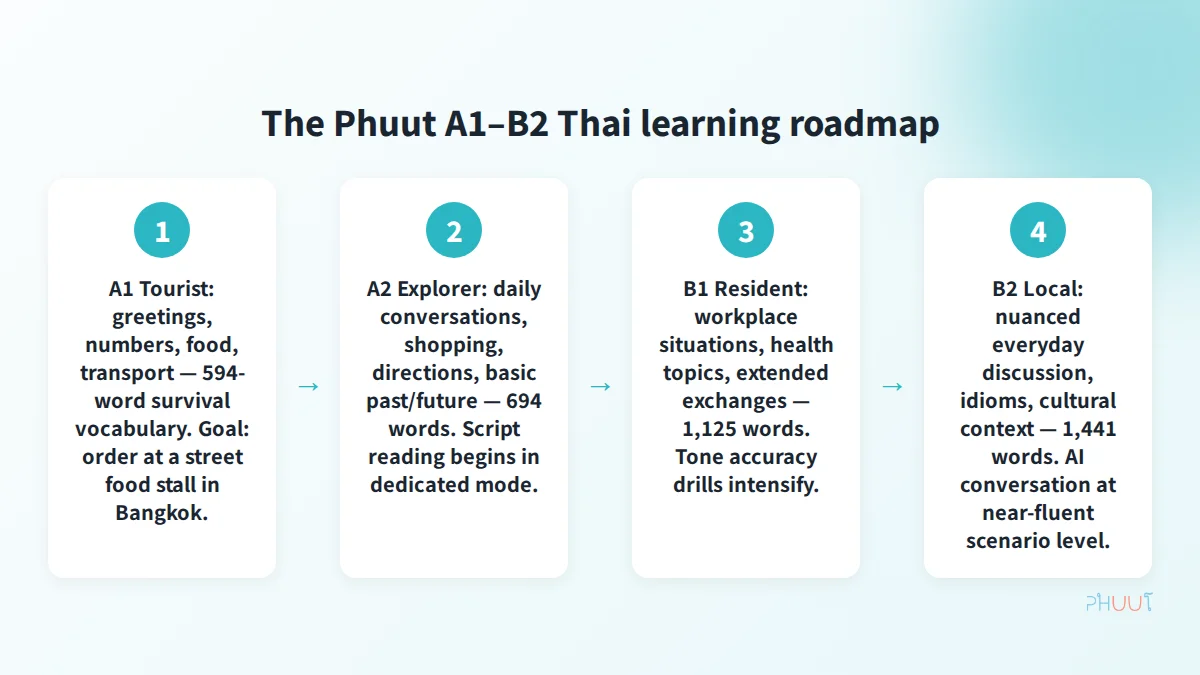
Phuut’s four levels in concrete terms:
- A1 Tourist: Greetings, numbers, food, transport — 594-word survival vocabulary. Clear goal: order at a street food stall in Bangkok without pointing.
- A2 Explorer: Daily conversations, shopping, directions, basic past/future — 694 words. Script reading begins in the dedicated mode at this level.
- B1 Resident: Workplace situations, health topics, extended exchanges — 1,125 words. Tone accuracy drills intensify; aspiration is the second pronunciation layer after tones, and Thai aspirated consonants are a core focus here.
- B2 Local: Nuanced everyday discussion, idioms, cultural context — 1,441 words. AI conversation at near-fluent scenario level.
The Boss Battle weekly review simulates cumulative vocabulary pressure — the mechanic that builds retention for real-world conversation rather than in-app quiz performance. Handwriting mode with stroke-order feedback is unique at sub-$5/month pricing. AI conversation follows your CEFR level, so the vocabulary in your speaking practice is appropriate to where you actually are.
The practical recommendation
Start with any app’s free tier. Apply the four-axis framework after one week of daily use: gamification, script, pronunciation feedback, price. Subscribe to the app you actually opened every day. The wrong choice is the one you open twice and abandon — regardless of star ratings.
If your priority is the complete package at the lowest price, Phuut is the only app here that covers gamification, script handwriting, AI pronunciation feedback, and a CEFR roadmap for under $5/month. If you commute two hours a day and your phone will stay in your pocket, Pimsleur is the better fit. If you already have working vocabulary and want conversation reps with tonal feedback, Talkpal is worth a trial.
Try Phuut for Thai — Free on iOS
Free to start. Eight game modes, AI conversation, and Thai script from day one.

Learn Thai that actually leaves your mouth
Free on iOS
Memorizing phrase lists doesn't help when you freeze at a food stall. Phuut runs lessons through real scenes — ordering, taxis, shopping — so the words come out when you need them.
- Scene-based lessons: street food, shopping, taxis, sightseeing
- AI role-play so you stop sounding like a phrasebook
- Native audio + Paiboon transliteration locks pronunciation in
- 5-minute sessions — preview just the scene you need today