
How to Count in Thai: Numbers 1-100 Explained
Affiliate disclosure: This article contains affiliate links. We may earn a small commission at no extra cost to you. As an Amazon Associate, we earn from qualifying purchases.
About the reviewer

Taishi Hirano
Phuut Founder
Founder of Phuut. Has observed how Japanese and English speakers stumble on Thai and built learning products around those patterns.
Follow Phuut on X →You’re at a Bangkok market stall. The vendor holds up three fingers, says something that sounds like “sǎam rôi” - and you want to count back, confirm the price, negotiate a little. But you can’t recall how to count in Thai. The words evaporate.
Whether you’re a tourist haggling at Chatuchak, an expat reading utility bills, or a culture learner watching Thai TV at home - the barrier is the same.
Learning how to count in Thai is the fastest entry point to real interaction in Thailand. By the end of this article, you’ll know every number from 1 to 100, recognise Thai script numerals when you see them, and understand the two rules that make the entire system click into place. That’s a realistic goal - not a promise of fluency, but a genuinely useful set of skills.
In this article:
- The Thai Number System: Two Scripts, One Logic
- Thai Numbers 1-100: The Core Table with Tones
- Two Rules That Break the Pattern
- Thai Script Numerals in the Wild: Where to Spot Them
- How to Actually Practice Thai Numbers Until They Stick
- Key Takeaways
- FAQ
The Thai Number System: Two Scripts, One Logic
Here’s the first thing to get straight: Thai numbers work on exactly the same base-10 place-value logic as English numbers. There’s no unfamiliar mathematical structure to absorb. Five is five, twenty is twenty, a hundred is a hundred.
What is different is that Thai has two written forms for the same numerals - and knowing which form turns up where is genuinely useful knowledge.
The two written forms in practice
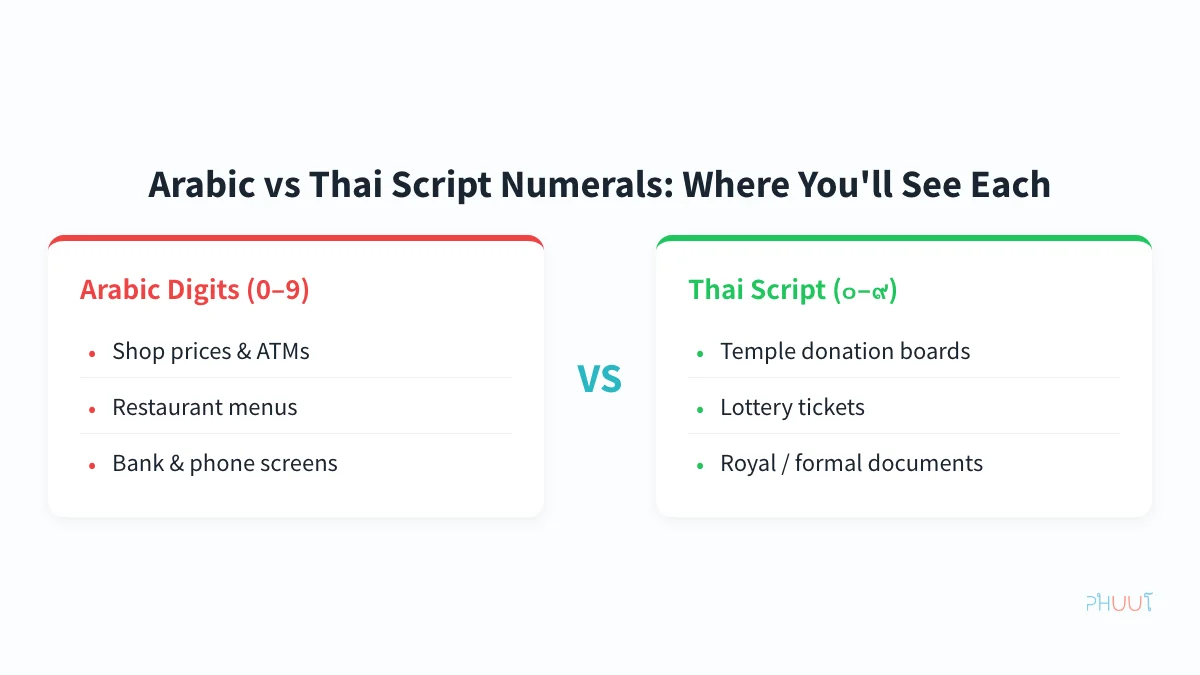
Most of the time in modern Thailand, you’ll see Arabic digits: 1, 2, 3. Shop signs, restaurant menus, ATM screens, taxi meters, online prices on Shopee or Lazada - all Arabic digits. They became the commercial standard decades ago and nobody is going back.
Thai script numerals - ๐ ๑ ๒ ๓ ๔ ๕ ๖ ๗ ๘ ๙ - still exist, and they still appear. But the contexts are specific. Walk into Wat Pho in Bangkok and look at the donation board - the amounts listed will often be in Thai script numerals. Find a lottery ticket in a convenience store and the numbers printed on the ticket face will mix both systems. Open a formal royal announcement and you’ll see Thai script numerals throughout.
The table below maps exactly where each system shows up. It’s not an abstract breakdown - it’s a practical encounter map so you know what to prepare for.
The Thai script numeral shapes
Here are the ten Thai script digits alongside their Arabic equivalents:
| Thai script | Arabic | Romanisation |
|---|---|---|
| ๐ | 0 | sǔun |
| ๑ | 1 | nùeng |
| ๒ | 2 | sǒong |
| ๓ | 3 | sǎam |
| ๔ | 4 | sìi |
| ๕ | 5 | hâa |
| ๖ | 6 | hòk |
| ๗ | 7 | jèt |
| ๘ | 8 | pàet |
| ๙ | 9 | gâao |
The shapes look unlike anything in the Latin alphabet, but they have a consistent internal logic. ๑ is simple; ๙ has a loop. A few of them - ๔ and ๗ - have distinctive visual hooks that make them easy to remember once you’ve seen them a few times.
You don’t need to write Thai script numerals. Recognising them when they appear - on a temple board, a lottery ticket, a formal document - is the practical skill. Spend five minutes with the table above and you’ll already be ahead of most visitors who have been in Thailand for months.
Thai Numbers 1-100: The Core Table with Tones
Numbers 1-10 are everything. Once you have them, the numbers 11 through 99 follow a pattern so consistent that you’ll only ever need to memorise two exceptions. This section gives you the full foundation.
Numbers 1-10 with tones
Most resources give you Thai script and romanisation and stop there. This table adds a tone column - because the tone on a number is not optional decoration. It’s part of the word.
| # | Thai script | Romanisation | Tone | Tone direction | Minimal pair (same sound, different tone) |
|---|---|---|---|---|---|
| 1 | หนึ่ง | nùeng | Low | Low-falling | - |
| 2 | สอง | sǒong | Rising | Low-to-high | - |
| 3 | สาม | sǎam | Rising | Low-to-high | - |
| 4 | สี่ | sìi | Low | Low-level | สี (sii, mid) = colour |
| 5 | ห้า | hâa | Falling | High-to-low | หา (haa, mid) = to search |
| 6 | หก | hòk | Low | Low-level | - |
| 7 | เจ็ด | jèt | Low | Low-falling | - |
| 8 | แปด | pàet | Low | Low-falling | - |
| 9 | เก้า | gâao | Falling | High-to-low | เกา (gao, mid) = to scratch |
| 10 | สิบ | sìp | Low | Low-falling | - |
Notice how ห้า and เก้า are falling tone - they land with weight. สี่ is different: it is low tone, holding flat and low rather than dropping from high. สี่ (low, holds flat and low) vs. สี (mid, flat at neutral pitch) - the low sits below the neutral pitch, which is why flattening สี่ upward makes it sound like “colour.” If you say ห้า (five) without the fall, it becomes หา (to search). In a crowded market these distinctions usually resolve with context. On the phone, or confirming a bank transfer amount, they matter more than you’d expect.
If you’re new to Thai tones entirely, Thai Tones for Beginners covers the full five-tone system - worth reading before or alongside this article.
The 555 / ห้าห้าห้า cultural hook
Before moving to 11-99, here’s a fact that makes ห้า (five) particularly memorable. In Thai digital culture, 555 - ห้าห้าห้า - is the equivalent of LOL. The syllable “hâa” sounds like the Thai expression of laughter, so Thais type 555 in text messages and social media comments the way English speakers type “haha” or “lol.”
You’ll see this in Thai chat groups, on Instagram comments under Thai content, in LINE messages. Once you know it, you’ll spot it constantly - and you’ll feel a small but real shift from outsider to someone who gets the culture. That’s what learning even one number well can do.
Numbers 11-19
The pattern is: สิบ (ten) + the digit.
| # | Thai script | Romanisation |
|---|---|---|
| 11 | สิบเอ็ด | sìp èt |
| 12 | สิบสอง | sìp sǒong |
| 13 | สิบสาม | sìp sǎam |
| 14 | สิบสี่ | sìp sìi |
| 15 | สิบห้า | sìp hâa |
| 16 | สิบหก | sìp hòk |
| 17 | สิบเจ็ด | sìp jèt |
| 18 | สิบแปด | sìp pàet |
| 19 | สิบเก้า | sìp gâao |
One exception already: 11 is สิบเอ็ด, not สิบหนึ่ง. The digit 1 in the ones position becomes เอ็ด (èt). You’ll see this pattern again throughout 21-99.
Numbers 20-99
Here’s the structure: [tens digit word] + สิบ + [ones digit word].
The tens are:
- 20 = ยี่สิบ (yîi sìp) - exception
- 30 = สามสิบ (sǎam sìp)
- 40 = สี่สิบ (sìi sìp)
- 50 = ห้าสิบ (hâa sìp)
- 60 = หกสิบ (hòk sìp)
- 70 = เจ็ดสิบ (jèt sìp)
- 80 = แปดสิบ (pàet sìp)
- 90 = เก้าสิบ (gâao sìp)
To build any number from 21-99, combine the tens word with the ones digit. The ones position uses the standard digit words - except when the ones digit is 1, in which case it’s เอ็ด.
Examples:
- 21 = ยี่สิบเอ็ด (yîi sìp èt) - เอ็ด rule applies
- 25 = ยี่สิบห้า (yîi sìp hâa)
- 37 = สามสิบเจ็ด (sǎam sìp jèt)
- 41 = สี่สิบเอ็ด (sìi sìp èt) - เอ็ด rule applies again
- 99 = เก้าสิบเก้า (gâao sìp gâao)
The system is completely regular from 22 onward - with the two exceptions already named. Two rules. That’s it.
Two Rules That Break the Thai Number Pattern (And How to Remember Them)
The Thai number system has exactly two points where the pattern breaks. Every top-10 article about Thai numbers teaches these in separate sections, which makes them feel like two unrelated facts to memorise. They’re not - they’re the only two exceptions to an otherwise perfect rule, and framing them together makes them easier to hold.
Exception 1: ยี่สิบ (yîi sìp) - twenty
Twenty in Thai is ยี่สิบ, not สองสิบ. The word ยี่ is an archaic form of two that survives only in this one compound. For every other multiple of ten - 30, 40, 50 all the way to 90 - the regular digit word is used (สาม, สี่, ห้า). Only twenty breaks this.
A practical mnemonic: think of ยี่สิบ as a proper noun, a name, not a derived form. The same way “eleven” and “twelve” in English don’t follow the “-teen” pattern of 13-19, ยี่สิบ stands apart from the rest. Memorise it as its own word and stop trying to derive it.
Exception 2: เอ็ด (èt) - the ones-position 1
The word for one is หนึ่ง (nùeng). But when 1 appears in the ones position of any two-digit number, it becomes เอ็ด (èt).
- 11 = สิบเอ็ด (not สิบหนึ่ง)
- 21 = ยี่สิบเอ็ด (not ยี่สิบหนึ่ง)
- 51 = ห้าสิบเอ็ด (not ห้าสิบหนึ่ง)
When does หนึ่ง stay หนึ่ง? When 1 is in any position other than the ones: 100 = หนึ่งร้อย, 1,000 = หนึ่งพัน. หนึ่ง handles hundreds and thousands; เอ็ด handles ones.
Together, they’re the complete exception set. If you know ยี่สิบ and เอ็ด, you know every rule that could trip you up in 1-99. Nothing else is irregular.
Large numbers - a practical preview
Thai currency amounts come up fast in real life, so it’s worth knowing the structure beyond 99 before you need it:
| Amount | Thai script | Romanisation |
|---|---|---|
| 100 | หนึ่งร้อย | nùeng rôi |
| 1,000 | หนึ่งพัน | nùeng phan |
| 10,000 | หนึ่งหมื่น | nùeng mùen |
| 100,000 | หนึ่งแสน | nùeng sǎen |
| 1,000,000 | หนึ่งล้าน | nùeng láan |
A taxi fare of ฿350 is สามร้อยห้าสิบ (sǎam rôi hâa sìp). A market item at ฿85 is แปดสิบห้า (pàet sìp hâa). Thai has a dedicated word for every power of ten up to ten million - which means large currency figures are more compact in Thai than in English.
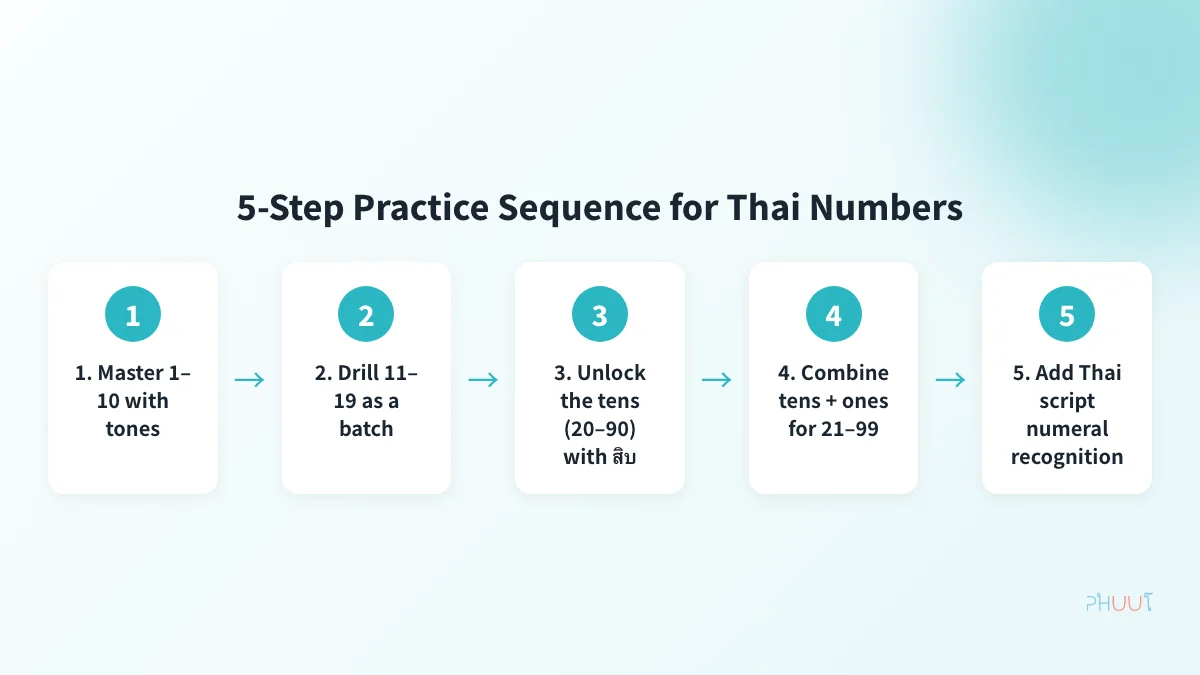
The 5-step practice sequence
Work through this sequence in order. Each step builds on the last.
Thai Script Numerals in the Wild: Where to Spot Them
Most visitors to Thailand never learn to recognise Thai script numerals because they’re told - correctly - that Arabic digits dominate commerce. That’s true. But “rarely used in commerce” is not the same as “irrelevant,” and the contexts where Thai script numerals appear are precisely the ones where you want to feel less lost.
Here are six specific encounter points:
1. Temple donation boards Walk into any major Buddhist temple in Thailand and look for the donation record boards - the lists of donors and amounts. These boards consistently use Thai script numerals. When you want to read how much the last donation was, you’ll need ๑ through ๙.
2. Lottery tickets The Thai national lottery is a significant social institution. Lottery tickets sold at corner shops across the country display the ticket numbers in Thai script numerals on the ticket face. The winning draw numbers are announced in Arabic digits - so both forms appear on the same piece of paper.
3. Royal and formal proclamations Any document originating from the royal household, government ministry announcements, and certain formal legal documents prefer Thai script numerals. If you ever receive a formal invitation to a Thai ceremony - an ordination (บวช), a wedding invitation from a traditional family - the date will likely be written in Thai script numerals using the Buddhist Era calendar.
4. Monks’ calendars and ordination records Thai Buddhist temples maintain ordination records and lunar-calendar schedules in Thai script numerals. If you study at a temple, attend a retreat, or simply spend time in monastic settings, these numerals are the default.
5. Historical and archaeological contexts Museum exhibits, temple murals, and historical inscriptions in Thailand use Thai script numerals as a matter of course. Recognising them transforms a confusing display into something you can partially read.
6. Certain traditional restaurant specials and menus In Bangkok this is rare - but in provincial towns and traditional restaurants that lean into Thai cultural identity, menus occasionally list dish numbers in Thai script. It’s not common, but it happens.
The historical origin, briefly Thai script numerals descend from ancient Indian Brahmi numerals through Khmer script, which heavily influenced the Thai writing system. They are cousins of the numerals used across South and Southeast Asia - Burmese, Khmer, and Balinese digits all share the same ancestry. Recognising this lineage makes the shapes feel less arbitrary. The same writing system roots explain the shapes you’ll see in Thai consonant classes.
Practical advice: when you encounter Thai script numerals in the wild - on a temple board, a lottery ticket, a sign in a market - take a photo. Use it to quiz yourself later. Five minutes of recognition practice with real images is more effective than five minutes of staring at a table.
How to Actually Practice Thai Numbers Until They Stick
Most Thai learners hit the same wall: passive listening lists don’t build real-time recall. You play a number audio track, hear the numbers, feel like you’ve learned them - and then a taxi driver quotes you a fare and the number disappears from your brain.
Passive exposure rarely produces fast recall under pressure. What builds it is active production: the act of generating the number yourself, not just recognising it.
Concrete active practice techniques
Count steps as you walk. When you’re walking up stairs in Bangkok or climbing up to a viewpoint in Chiang Mai, count the steps aloud in Thai. สิบเจ็ด. สิบแปด. สิบเก้า. It’s repetitive, it’s physical, and it’s free.
Read prices aloud from Thai shopping apps. Open Lazada TH or Shopee TH - both are available internationally - and read prices aloud in Thai before converting them mentally. ห้าพัน (5,000 baht). สองพันสามร้อยห้าสิบ (2,350 baht). You’ll encounter every number pattern in the 1-99 range within a few minutes.
Use a taxi meter as a live drill. If you’re in Thailand, watch the meter and say the fare aloud in Thai each time it ticks up. This works particularly well for numbers in the สามร้อย-หกร้อย range that appear constantly in short Bangkok taxi rides.
Spaced repetition for number vocabulary
Numbers are vocabulary. That sounds obvious, but it has a practical implication: treating numbers the same way you treat vocabulary flashcards - with spaced repetition - dramatically improves retention compared to a single intensive study session.
The reason is simple: spaced repetition brings a word back to you just before you’d naturally forget it. A card you study on Monday comes back on Wednesday - right before you’d forget it. One-session memorisation of all numbers 1-100 in an evening might feel productive, but most of those numbers won’t survive to next week without reinforcement.
How Phuut approaches number learning
Phuut’s A1 Tourist level introduces number-adjacent vocabulary - prices, quantities, dates, ordering food - in context rather than in isolation. That matters because numbers without a context are abstract; numbers attached to a street food price or a bus departure time have a hook to hang on. In Phuut’s A1 Tourist unit, number vocabulary appears in context - prices, quantities, and dates - so learners encounter สี่สิบห้า (45 baht) in a street-food ordering scenario before it ever shows up as an isolated flashcard.
Both the matching game and flashcard modes in Phuut reinforce number recognition with immediate feedback. Boss Battle at the end of each unit tests everything covered under mild time pressure - a reasonable simulation of real market recall. Spaced repetition in the review system brings numbers back before they fade, not after.
If you want to build a personal vocabulary list that goes beyond what any single app covers - custom example sentences, notes on tones, personal mnemonics - a note-taking system alongside your app practice makes the combination significantly more effective.

Learn Thai that actually leaves your mouth
Free on iOS & Android
Memorizing phrase lists doesn't help when you freeze at a food stall. Phuut runs lessons through real scenes — ordering, taxis, shopping — so the words come out when you need them.
- Scene-based lessons: street food, shopping, taxis, sightseeing
- AI role-play so you stop sounding like a phrasebook
- Native audio + Paiboon transliteration locks pronunciation in
- 5-minute sessions — preview just the scene you need today
Frequently Asked Questions
Ready to Hear the Numbers, Not Just Read Them?
Get the free Thai Numbers Quick-Reference Card: all numbers 1-100 with tones, Thai script, and the two irregular rules on one page. Enter your email below and it arrives immediately.
The first time a vendor confirms a price and you repeat it back correctly in Thai - สามสิบห้า - the look on their face is worth the fifteen minutes of practice it took to get there.
Learn Thai that actually leaves your mouth
Free on iOS & Android
Memorizing phrase lists doesn't help when you freeze at a food stall. Phuut runs lessons through real scenes — ordering, taxis, shopping — so the words come out when you need them.
- Scene-based lessons: street food, shopping, taxis, sightseeing
- AI role-play so you stop sounding like a phrasebook
- Native audio + Paiboon transliteration locks pronunciation in
- 5-minute sessions — preview just the scene you need today