
Why Self-Study Can't Fix Your Thai Tones (and What Does)
Affiliate disclosure: This article contains affiliate links. We may earn a small commission at no extra cost to you. As an Amazon Associate, we earn from qualifying purchases.
About the reviewer

Taishi Hirano
Phuut Founder
Founder of Phuut. Has observed how Japanese and English speakers stumble on Thai and built learning products around those patterns.
Follow Phuut on X →A widely-read note essay titled “1,264 Hours of Despair” documented 500 days of studying Thai for two to three hours every day. Its conclusion was blunt: tones can’t be fixed by self-study alone.
A lot of people saw themselves in it. That’s because it wasn’t one person’s bad luck — it described, accurately, the wall that most self-studiers run into.
Search around in English and you’ll find the same dead end. “Tones are hard.” “Listen more.” “Get a tutor.” None of it answers the real question: why don’t your tones improve, and what actually fixes them?
Tones don’t get stuck because you’re lazy, untalented, or under-practiced. They get stuck because of structure. And a structural problem has a structural fix.
This article breaks down the three structural reasons you can’t fix your Thai tones in self-study, then shows how AI feedback resolves all three at once — plus a 5-step route you can start today.
Affiliate disclosure: This article may contain affiliate links. We may earn a commission at no extra cost to you.
In this article:
- Why self-study can’t fix your Thai tones — three structural reasons
- Why the usual self-study methods don’t fix tones
- How AI feedback solves all three at once
- A 5-step route to fix your tones, starting today
- A weekly routine that makes it a habit
Why self-study can’t fix your Thai tones — three structural reasons
Blaming “not enough practice” for stuck tones is wrong. The person who logged 1,264 hours and still couldn’t fix them is the proof. The problem isn’t how much you practice. It’s how the practice is built. Three structural flaws stack on top of each other.
Problem 1: The feedback loop never closes
Pronunciation learning needs a three-step cycle: speak → feedback comes back → correct. Only when that cycle turns does pronunciation improve.
In self-study, “speak” works fine. What breaks is “feedback comes back.”
When a child acquires their native language, the people around them react constantly. Say it right and the conversation flows; say it wrong and you get a puzzled face. That everyday “understood / not understood” signal quietly corrects pronunciation over time.
Self-study Thai has none of it. You play an audio lesson, you repeat after it, and the lesson never tells you “your tone was right” or “your tone was wrong.” No feedback, no turning cycle.
Problem 2: Wrong pronunciation fossilizes
So what happens when you keep practicing with no feedback? The wrong sound gets recorded as the “correct” feeling. Second-language acquisition research calls this fossilization.
Take คน (kon, “person”). It’s a mid tone. But if you say it slightly high “because it kind of feels right” a few hundred times, that becomes your kon. Eventually you can hear a correctly-spoken mid-tone คน and think it sounds oddly flat.
Here’s the counterintuitive part: with no feedback, more practice makes the error stronger. The 1,264 hours probably didn’t fail to fix the tones — they made the wrong pronunciation more solid.
Problem 3: No internal benchmark for the correct sound
Knowing the five tones and having an ear-level benchmark for each are two completely different abilities.
Thai has five tones — mid, low, falling, high, and rising. Plenty of learners can recite that list. Whether “mid sits here, high sits there” actually exists as a reference in your head is a separate question.
English has no lexical tone, so that benchmark doesn’t form on its own. The result: you record yourself, play it back, and still can’t tell whether it’s right. Without a reference, no amount of replaying sets a direction for correction.
These three problems — an open feedback loop, fossilization, and no internal benchmark — overlap to make tone correction structurally hard in self-study.
| Problem | What it feels like |
|---|---|
| Open feedback loop | You speak, but nothing tells you “right / wrong” |
| Fossilization | Practice hardens the wrong tone into “your correct sound” |
| No internal benchmark | You replay a recording but can’t judge it yourself |
None of this yields to effort. If the structure doesn’t change, you keep hitting the same wall no matter how many hours you add.
For the five tones themselves and how each one sounds, how Thai’s five tones actually work walks through the system. To dig into the “is my tone even correct?” problem on its own, how to self-check whether your Thai tone is right covers it in depth.
Why the usual self-study methods don’t fix tones
Once you see the three structural problems, it gets clear why the standard self-study moves fall short — and exactly where each one fails.
I studied Thai on my own for close to two years before anyone in Bangkok could reliably understand me. Every day I listened to audio lessons and recorded myself to play back, yet I still got “huh?” at the food stall over and over. The first time I used Phuut’s pronunciation mode, the reason finally landed. I said ข้าวผัด (khao phat, fried rice), aiming for a falling tone, and the AI returned “heard as mid tone.” That was the first time I saw, objectively, that my output was a different tone entirely.
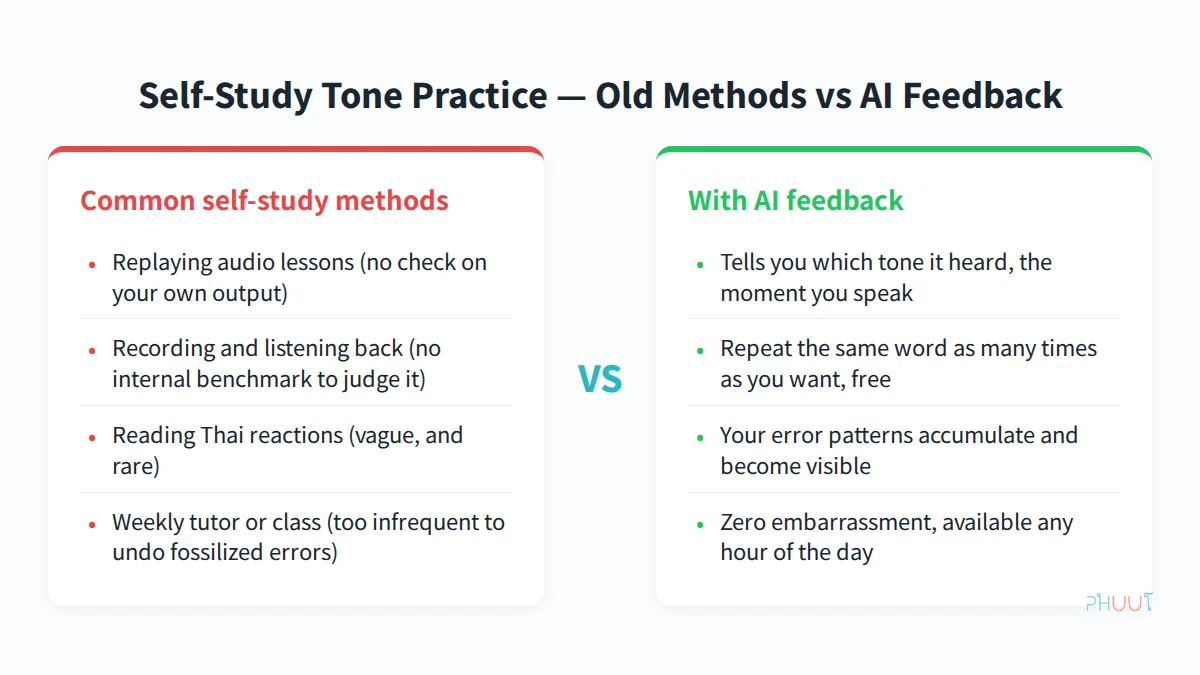
Replaying audio lessons. Feeding yourself correct Thai input is the right instinct. But it never checks whether what you say is right. The verification step between input and output is simply missing, so Problem 1 (open loop) and Problem 3 (no benchmark to compare your output against) both stay unsolved.
Recording and listening back. This is the most-recommended method, and it has a fundamental gap. Without the internal benchmark, playing back your own voice can’t tell you “is that a correct high tone?” The best you get is “hmm, a bit off” — vague, with no direction to fix. Problem 3 stays in place, which limits how much recording can do for you.
Native checks or a language class. This is the most effective feedback there is. A teacher can tell you, specifically, “that came out as a low tone.” But it can’t be anytime, unlimited, or the same word drilled dozens of times. A weekly lesson simply can’t out-rep fossilization — the frequency isn’t there.
For feedback to actually fix tones, three conditions have to be true at once:
- Immediacy — it comes back right after you speak. Wait too long and the link to correction weakens.
- Specificity — not “wrong” but “heard as falling tone.” A tone name sets the direction; without it, you can’t correct.
- Repeatability — the same word, dozens of times, at no extra cost. Undoing fossilization takes high-frequency correct reps.
None of the standard self-study methods deliver all three together. That’s why the tones don’t move.
If the problem runs broader than tone alone, why your Thai pronunciation isn’t getting understood frames the other sounds that trip learners up.
How AI feedback solves all three at once
AI works for tone correction because it maps one-to-one onto the three structural problems from earlier. This isn’t “you can practice with AI now.” It’s that the shape of the solution finally matches the shape of the problem.
| Structural problem | What AI feedback does |
|---|---|
| Open feedback loop | Names “which tone it heard” the instant you speak |
| Fossilization | Instant judgment lets you stop before reinforcing the error |
| No internal benchmark | Repetition internalizes the AI’s judgment as your own ear |
How it solves Problem 1. In Phuut’s pronunciation mode, you say a word and the AI puts the tone it recognized on screen. That single exchange closes the loop self-study left open. “Speak → a tone name comes back → correct” turns for the first time. Practicing ม้า (ma, “horse,” rising) but landing closer to a falling tone? You get “heard as falling tone” right away. That tells you exactly what to adjust: you’re not raising enough.
How it solves Problem 2. Fossilization happens because you repeat the error without noticing it. When the AI immediately returns “that’s a different tone,” you can stop before the wrong rep hardens. The fix window opens before the mistake sets as your “correct feeling.” And the crucial detail: it returns a tone name, not pass/fail. “Wrong” gives you no direction. “Aimed high, came out low” tells you to push higher or change how you use your breath.
How it solves Problem 3. After dozens of judgments, something shifts. “I said this as a high tone → the AI confirmed high → so that’s my high-tone benchmark.” Across reps, the AI’s judgment grows into your own ear’s reference. Replaying a recording can’t do that, because an internal benchmark only forms when there’s an external reference point to grow from.
Listening mode and pronunciation mode together. Listening mode trains reception — “which tone did I just hear?” Pronunciation mode diagnoses production — “which tone did I sound like?” Run both and the loop is whole, on the receiving side and the producing side.
An honest caveat. AI recognition accuracy can shift with background noise and the speaker’s voice. Treat it as a self-check aid, not a full replacement for a professional tutor.
Once AI gives you a direction, the fastest setup is a hybrid: AI for frequency and instant feedback, a native tutor for precision and context. After the AI shows you “this is coming out as the wrong tone,” a human confirms whether you’ve actually fixed it in real conversation. If you want that human check, a native Thai tutor is the natural complement to your AI practice.

So the feedback mechanism is clear. The next question is order: what do you actually practice, and in what sequence?
A 5-step route to fix your tones, starting today
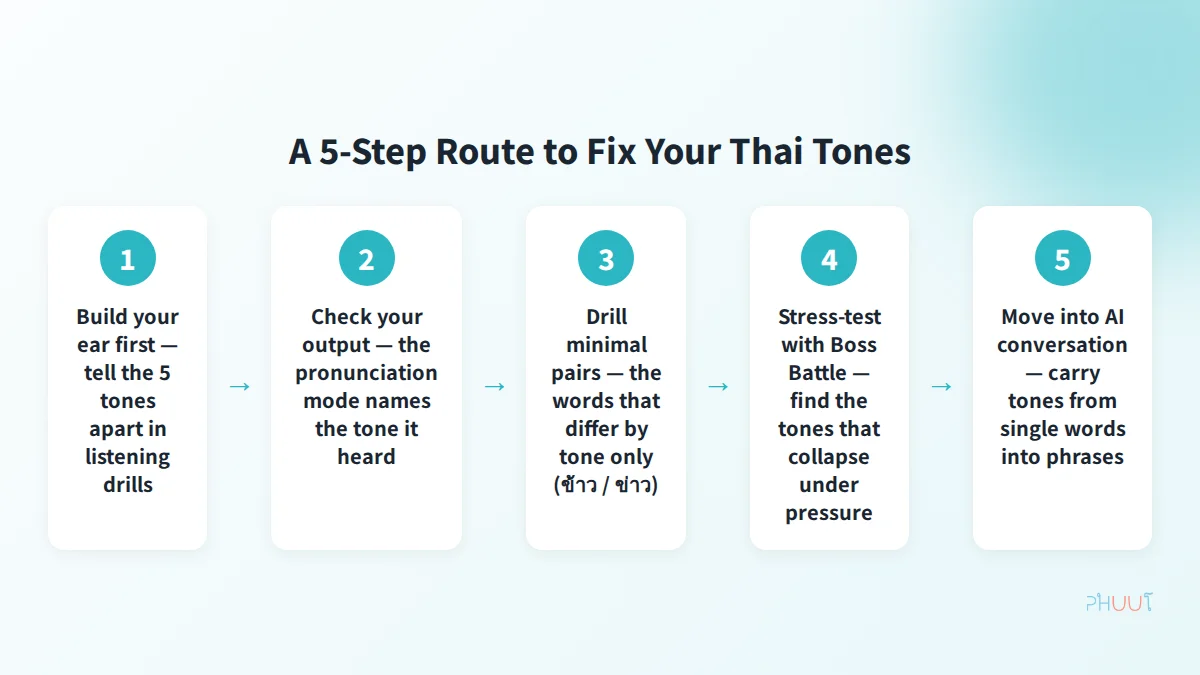
There’s a correct order to tone correction. The common self-study mistake is jumping straight into conversation or production drills. If your reception — your ear — isn’t sharp first, you can’t even detect your own errors. Ear before mouth.
-
Build your ear (quiz + listening modes). Reception before production: you can’t fix what you can’t hear. Use Phuut’s multiple-choice quiz and listening modes to tell the five tones apart — mid, low, falling, high, rising — under the game’s instant feedback. Checkpoint: reliably distinguish all five, around 70%+. Why first: the internal benchmark (Problem 3) starts with listening. Without an ear, the pronunciation-mode feedback in step 2 lands at half value.
-
Check your output (pronunciation mode). The goal here is diagnosis: which tone does the AI hear when you speak? Pronunciation mode is a self-diagnostic tool, not just a drill. Use the same words from step 1 to reinforce the link. The AI returns the tone it heard — “heard as falling tone” is the first concrete signal of which way to correct. Checkpoint: repeat until the AI returns the right tone name. Five to ten words drilled deeply beats many words drilled shallowly.
-
Drill minimal pairs (matching mode). The goal is precision on word pairs that differ by tone alone — which is exactly where meaning splits in real speech. Use Phuut’s matching mode on the pairs you confuse:
- ข้าว (khao, rice) vs ข่าว (khao, news) — falling vs low
- มา (ma, come) vs ม้า (ma, horse) — mid vs rising
- ใกล้ (klai, near) vs ไกล (klai, far) — low vs mid
Same sounds, tone the only difference. There’s no better material for feeling that the tone is the meaning. Checkpoint: 80%+ within the time limit, then move on.
-
Stress-test with Boss Battle. The goal is to surface the tones that collapse under pressure — the ones you can’t see in calm practice. Tones break down under time pressure and fast speech. That’s the “fine when I go slow, falls apart in conversation” effect. Phuut’s Boss Battle is a timed mixed round where stacking mistakes ends the run, which builds the kind of tension real conversation has. Checkpoint: the tone you keep failing here is the tone you focus on next week.
-
Move into AI conversation. The goal is carrying single-word tones into phrase context, where the rhythm of connected sounds can break them. Use Phuut’s AI conversation for short back-and-forth dialogue. When the AI flags a phrase where your tone slipped, note it, and loop back to step 2 at the word level. That loop is what lifts tone correction up to the conversation level.
How the tone games work, step by step goes deeper on the quiz, listening, matching, and Boss Battle modes from steps 1, 3, and 4. For step 5, getting started with AI Thai speaking practice covers the setup.
A weekly routine that makes it a habit
What tone correction needs isn’t a long weekend session. It’s short, dense, daily practice. Learning science calls this distributed practice — for the same total amount of study, spacing reps out beats cramming them for long-term retention.
A 10–15 minute daily template. Start with five minutes of listening or quiz to warm up your ear — it’s an easy way in. Move straight into five minutes of pronunciation mode to diagnose the day’s words. Three times a week, add five minutes of matching mode on the pairs you mix up. Run this loop daily and the feel shifts within a week.
Weekly Boss Battle. Play it once a week to find the tone you were weakest on. “The tone I lost to in Boss Battle” becomes next week’s focus. That simple PDCA keeps the correction cycle turning.
A realistic one-month expectation. Not “perfect tones.” The honest target is “five to ten specific words come out reliably correct.” That’s what gives you the first real sense of “I fixed a tone.” It starts with one word, and perfect tones come later, off the back of that.
Where AI ends and a human starts. AI covers daily frequency and instant feedback. Where you have access to native conversation, confirm there too. AI is the main practice; a human is the check. That split is the most efficient setup.

Build a Thai habit that actually sticks
Free on iOS
Willpower isn't a strategy. Phuut bakes proven learning science into the app so you just need to tap for 5 minutes a day.
- Spaced repetition (SRS) tuned to forgetting curves
- CEFR A1–B2 and Thai proficiency-test vocabulary only
- Paiboon transliteration fixes the read-but-can't-speak gap
- Free on iOS — the structure handles the discipline for you
The short version
Your tones aren’t stuck because you’re lazy or untalented. Three structural problems overlap: the feedback loop never closes, wrong pronunciation fossilizes, and no internal benchmark forms for the correct sound.
Recording and replaying can’t set a direction without that benchmark. Native checks are the strongest feedback but can’t hit the daily frequency fossilization demands.
AI that names “which tone it heard” the instant you speak resolves all three at once. The loop closes, you get a chance to stop the error before it hardens, and the benchmark grows across reps.
Run the five-layer loop — ear → output → minimal pairs → Boss Battle → AI conversation — about 15 minutes a day. The first real step is one word, checked in Phuut’s pronunciation mode.
Build a Thai habit that actually sticks
Free on iOS
Willpower isn't a strategy. Phuut bakes proven learning science into the app so you just need to tap for 5 minutes a day.
- Spaced repetition (SRS) tuned to forgetting curves
- CEFR A1–B2 and Thai proficiency-test vocabulary only
- Paiboon transliteration fixes the read-but-can't-speak gap
- Free on iOS — the structure handles the discipline for you