
How to Correct Your Thai Tones Without Romanization
Affiliate disclosure: This article contains affiliate links. We may earn a small commission at no extra cost to you. As an Amazon Associate, we earn from qualifying purchases.
About the reviewer

Ramy Hirano
Phuut Founder
Founder of Phuut. Has observed how Japanese and English speakers stumble on Thai and built learning products around those patterns.
Follow Phuut on X →You have been drilling romanized Thai for weeks. You know what the 5 tones are supposed to sound like. But every Thai speaker you talk to still needs a beat to understand you - or politely looks confused. The problem is not your effort. It is that romanization was never designed to carry tone information, so every practice session gives you no way to know if the tone you produced was right or wrong. This guide explains why romanization blocks self-correction, how Thai script unlocks the feedback loop, and what a practical self-correction sequence looks like for learners who study without a tutor.
In this article:
- Why Romanization Blocks Thai Tone Self-Correction
- What Thai Script Gives You That Romanization Cannot
- A Self-Correction Sequence for Thai Tones Without a Tutor
- How AI Pronunciation Feedback Closes the Self-Correction Loop
- FAQ
Why Romanization Blocks Thai Tone Self-Correction
If you have been learning Thai with romanization and your tones are still not landing, you are not failing to practice hard enough. You are practicing without an error signal.
The first time I heard a native speaker correct my สวัสดี, I realized my romanized pronunciation had been wrong for months without my knowing it. I had been drilling the right letters and the wrong pitch - and nothing in my study materials had flagged it.
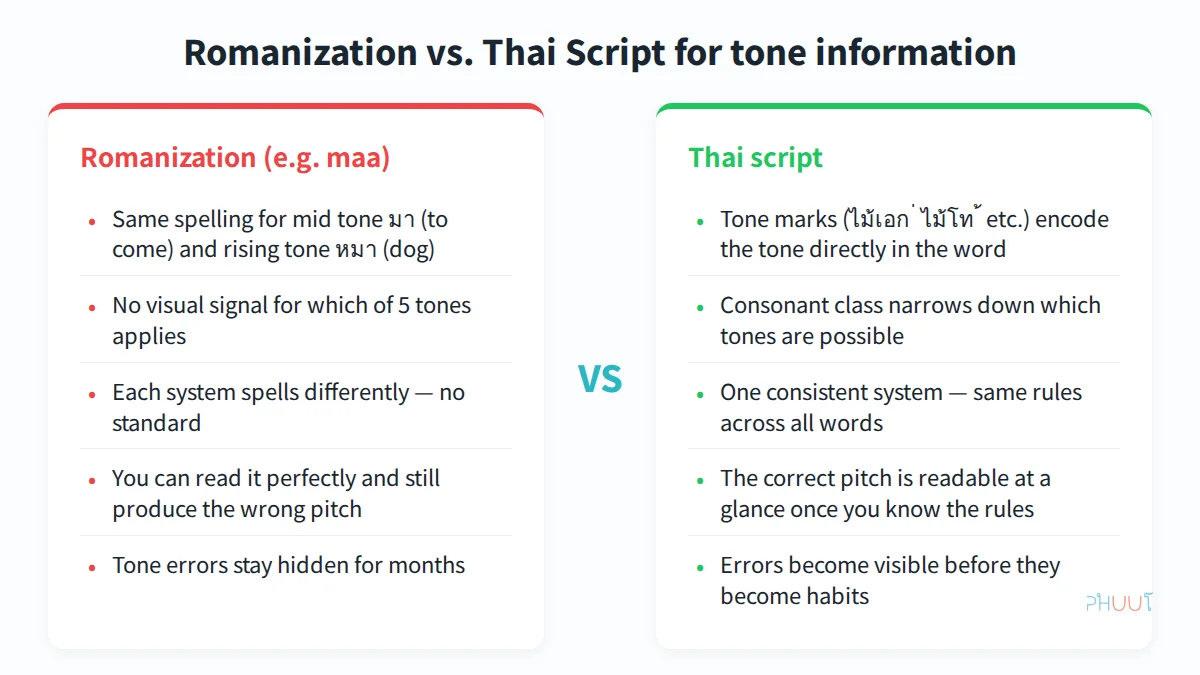
Here is the core mechanism. Thai has 5 tones - mid, low, falling, high, and rising - and each tone on the same syllable produces a different word with a different meaning. The syllable “maa” is the standard textbook example: มา (mid tone, to come), หมา (rising tone, dog), and ม้า (falling tone, horse) all romanize to the same four letters. No romanization system on the market - not RTGS, not Paiboon, not the ad-hoc spellings in most phrasebooks - can distinguish the three words on the page. You read “maa” and you have no way to know which pitch to use.
This is not a design flaw that a better romanization system could fix. The Latin alphabet has no notation for 5 distinct pitch contours on the same syllable. There is no superscript for “start high and drop” or “dip then curve up.” The information simply cannot be encoded in the Latin script.
The result is what I call the error-signal gap. When you practice a romanized word and produce the wrong tone, nothing in your study materials changes. The romanization looks the same whether your pitch was correct or wrong. You can repeat “maa” for months, produce the rising tone every time when the word needs the mid tone, and see zero signal that you have made an error. The error does not just stay uncorrected - it becomes a habit, because uncorrected production is repeated production.
Competitors will tell you that romanization is inconsistent between systems, which is true. But the deeper problem is not inconsistency - it is invisibility. Even a consistent romanization system cannot tell you which tone you produced, because it has no mechanism for encoding tone feedback into the written form. The learner who switches to Thai script is not just gaining a reading skill; they are gaining the only tool that makes their tone errors detectable before the errors become permanent.
Thai script encodes tone in two places: the consonant class (high, mid, or low) and the tone mark above the vowel. Once you can read both, you can predict the correct tone before you speak - and you can look at a word after you speak and ask yourself: did I produce what this word requires? That two-way check is the self-correction loop. Romanization has no equivalent.
For a deep look at how Thai tone marks encode the pitch directly in the word, see how Thai script encodes tone in consonant class and tone marks.
What Thai Script Gives You That Romanization Cannot
The common advice is “learn the Thai script.” The intimidating version is “you need to memorize all 44 consonants before you can do anything with tones.” Both framings overstate the prerequisite.
The minimum viable knowledge for tone self-correction is smaller than that: consonant class recognition plus the four tone marks. That is it. You do not need to read fluently. You do not need to know every consonant’s name or sound. You need to be able to look at a Thai word and identify two things:
-
Which class is the initial consonant? Thai consonants are divided into three classes - high, mid, and low. Each class has a default tone for syllables with no tone mark. A mid-class consonant with no mark produces a mid tone. A low-class consonant with no mark produces a mid tone in a different register. A high-class consonant with no mark produces a rising tone. The class tells you the baseline.
-
Is there a tone mark, and if so, which one? Thai has four tone marks: ไม้เอก (่), ไม้โท (้), ไม้ตรี (๊), and ไม้จัตวา (๋). Each mark shifts the tone from the class default in a predictable way. ไม้เอก on a mid-class consonant produces a low tone. ไม้โท on a mid-class consonant produces a falling tone. The mark plus the class together tell you the exact tone.
This combination - class plus mark - is enough to predict the tone of most Thai syllables from the written form before you open your mouth. That is the self-correction mechanism that romanization cannot provide. You look at the word, predict the tone, speak the word, and then check: did my production match what the script predicts? If you have a feedback source (a recording, a tutor, or an AI scorer), the loop closes.
Research at Chulalongkorn University suggests that learners who study Thai script from the start progress approximately 40% faster than those who rely on romanization throughout their study. The proposed mechanism is not reading fluency - it is earlier error detection. Script learners can identify their own tone mistakes by looking at the word. Romanization learners cannot. The difference in progress rate tracks the difference in how quickly errors are caught and corrected.
The minimum viable threshold - consonant class plus tone marks - is achievable in 2 to 4 weeks of focused study. You are not committing to years of reading practice. You are acquiring a specific lookup skill that unlocks the error-detection mechanism. That is a different task, and a much shorter one.
For learners who want a structured path into reading the Thai script, Thai script for beginners covers the consonant classes and vowel patterns in the sequence that matters most for tone reading.
A Self-Correction Sequence for Thai Tones Without a Tutor
Knowing that tones are self-correctable does not tell you which tone to start with. The order matters, because some tones are perceptually distinct and others are subtle near-copies that learners conflate even after months of practice.
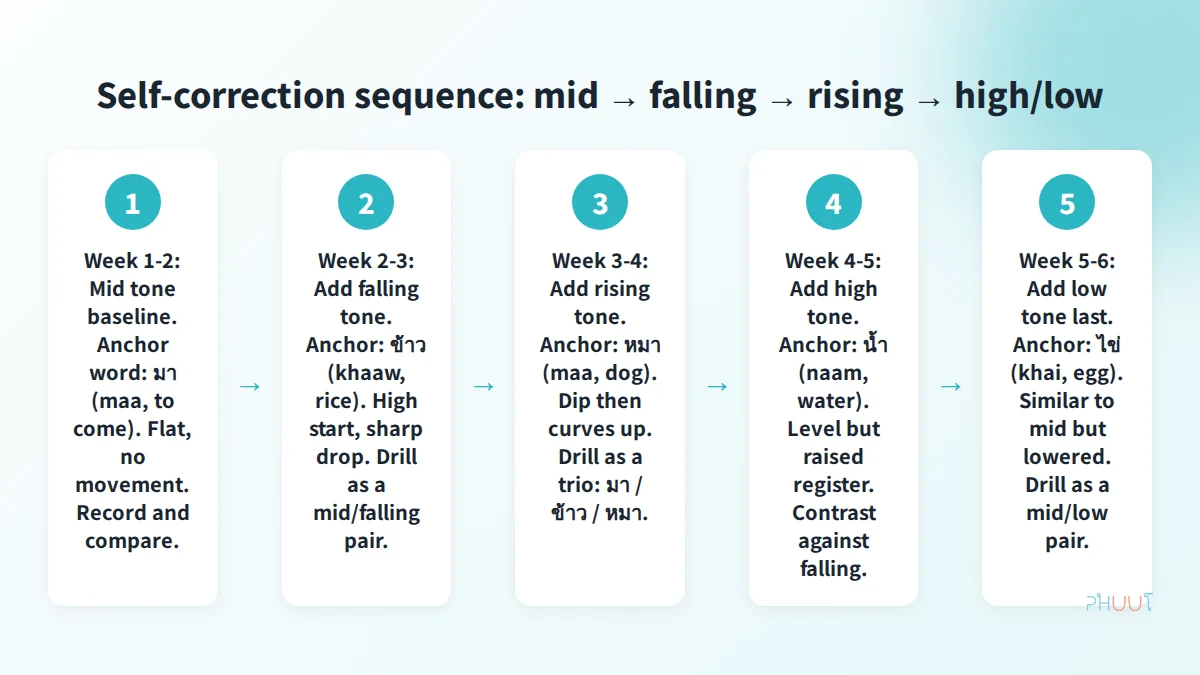
The sequence that works: mid first, then falling, then rising, then high and low last. Here is why that order.
Mid tone is the unmarked baseline. A mid-class consonant with no tone mark produces a mid tone. No pitch movement, no contour - it is the flat, neutral pitch that English speakers produce when they are not expressing emphasis or emotion. Because it requires the least contour of the five tones, it is the most forgiving starting point. Anchor word: มา (maa, to come).
Falling tone is the most commonly encountered tone-marked form and is perceptually easy to identify - you start high and drop sharply. The contrast between mid (flat) and falling (drop) is large enough that even a self-recording can catch the difference. Anchor word: ข้าว (khaaw, rice).
Rising tone dips before curving up. Paired against mid, the contrast is clear. Paired against falling, the direction reversal makes the distinction physically obvious. Anchor word: หมา (maa, dog). The mid/falling/rising trio - มา / ข้าว / หมา - gives you three tones with large perceptual gaps between them. This is your stable foundation.
High tone is level but pitched higher than mid. The contrast against mid is register, not contour - harder to catch by ear without a reference. Anchor word: น้ำ (naam, water).
Low tone is the subtlest: similar to mid but lowered. This one requires the most patience. Anchor word: ไข่ (khai, egg). Drill it as a mid/low pair after you have the first four tones stable.
The drill design that matters: commit before you hear.
The single most important instruction in this entire sequence is this: produce your spoken output before you hear the reference audio. This is not a small procedural detail - it is the difference between a self-correction drill and a rehearsal drill.
When you listen to the correct tone first and then repeat it, you are rehearsing. Your brain is matching a recently heard model. The memory of the model is still active. You have not checked your own phonological intention - you have just imitated a sound you heard half a second ago. That is useful for building listening accuracy, but it tells you nothing about what your autonomous production sounds like.
When you commit first - you look at the Thai script, predict the tone from consonant class and tone mark, and produce it before hearing the reference - you are running a true self-check. You are testing what your default production is, under the normal cognitive conditions of speaking. Then you check the reference. The gap between what you produced and what the script requires is the information you need to self-correct.
This “commit before you hear” principle is absent from the listen-then-repeat methodology used in most tone-learning resources. It is the design distinction that makes a self-correction drill function as a self-correction drill rather than an audio-matching exercise.
Minimal-pair drill: same syllable, alternating tones, back-to-back.
Run the drill as follows: choose a single syllable that appears in two different tones, such as มา (mid, to come) and หมา (rising, dog). Say มา - pause - say หมา. Repeat the pair five times in a row, committing to each tone before you hear any reference audio. The goal is not to hear the difference between the two words; it is to feel the difference in your own voice. Back-to-back production under the same breath forces your articulatory system to switch contours, which is the motor learning the isolated drilling approach never triggers. Once the มา / หมา pair feels physically distinct, add ม้า (falling, horse) as the third in the rotation.
For readers who want a detailed protocol for building a self-check habit into daily study, how to build a Thai tone self-check habit covers the production-check method in full, including self-recording techniques and comparison tools.

If your self-correction ceiling using recordings and script is not sufficient - and for many learners, it is not - a session with a Thai tutor on italki closes the gap that AI and self-recording cannot. A tutor hears your production in real time, can contrast your wrong tone against the correct one in the same breath, and catches social errors (tonal politeness cues, register shifts) that no written reference covers. Self-study tools build the habit; a skilled human listener catches what the habit has missed.
How AI Pronunciation Feedback Closes the Self-Correction Loop
Every self-correction loop has the same three steps. First, you produce a spoken tone - not listen to one, not imitate one, but produce one aimed at the pitch target you’re aiming for. Second, you receive feedback on what tone you actually produced. Third, you compare that feedback to the target (which Thai script now makes readable) and adjust.
Thai script solves step three. You can read the word, identify the consonant class and tone mark, and know what pitch the word requires. The gap that remains - the gap that kept you stuck in romanization for months - is step two. If nobody tells you what tone you actually produced, the loop does not close. You corrected your intention; you did not correct your output.
This is exactly where AI pronunciation feedback enters.
Phuut’s pronunciation game mode works as follows: you see a Thai word on screen, you speak it, and the AI scores whether your tone was correct. This is production feedback - information about your actual output, not just a playback of the reference audio. The game uses spaced repetition, so words you mispronounced in an earlier round resurface in later rounds. The session is self-contained and available at any hour without a tutor present.
Phuut also has an AI conversation practice mode, available on the Pro plan, where you speak in a conversational context - casual and formal topics at adjustable difficulty - and receive feedback on your pronunciation in real time. The difference from isolated drill sessions is cognitive load - the mental effort required to process two things at once: when you are managing vocabulary, grammar, and social register simultaneously, your tone production is under the same mild pressure it faces in real speech. Errors that disappear in calm practice sessions reappear here.
The Boss Battle feature in Phuut runs a weekly cumulative review of all vocabulary from the past seven days under that same mild pressure. For self-learners without a tutor, this is the closest home approximation of a real-world speaking test: you cannot cherry-pick easy words, and the session resumes the week’s full range, not just the items you already handle well.
Phuut covers approximately 3,850 words and 1,240 lessons across A1 to B2 levels. The Pro plan is $4.99 per month. Phuut is available on iOS; Android is planned.
For a deeper look at how the game modes work session by session, how Phuut’s pronunciation game modes work in practice covers the full game-loop rationale and pacing.
The three-step loop, closed: Thai script shows you the target tone. AI feedback tells you what you produced. The gap between the two is your correction target. Romanization had no equivalent for any of these three steps.

Stop guessing — hear if your tone is right
Free on iOS & Android
Even if you can recognize tones, producing them accurately is a different skill. Phuut gives you AI feedback so you can self-correct.
- Speak into the app, AI flags exactly which tone is off
- Sequenced from mid → falling → rising → high/low
- Paiboon transliteration shows nuance kana/romanization miss
- 5 minutes a day; most learners flip in about 3 weeks
Practice Thai tone self-correction with AI feedback - try Phuut free on iOS.
Fix the Loop, Not the Effort
The learners who get stuck on Thai tones are not practicing carelessly. They are practicing without an error signal. Romanization keeps the errors invisible, the corrections never come, and the habits calcify. The fix is not more repetition - it is closing the loop.
The path is specific: build the minimum viable script reading (consonant class plus four tone marks, two to four weeks), run your practice sessions in commit-first order so you are checking production rather than rehearsing audio, and add a feedback source that can tell you what tone you actually produced. That feedback source is a tutor, a self-recording reviewed against reference audio, or an AI scorer.
You do not need to be fluent in Thai to self-correct Thai tones. You need the mechanism that makes errors visible. Thai script is that mechanism.
Start with the mid and falling tone pair. Drill มา and ข้าว back-to-back, commit-first, five repetitions each. Add the rising tone (หมา) when the pair feels stable. The loop is open. Now close it.
If you want AI to score your spoken tone rather than relying on your own ear alone, try Phuut free on iOS.
Stop guessing — hear if your tone is right
Free on iOS & Android
Even if you can recognize tones, producing them accurately is a different skill. Phuut gives you AI feedback so you can self-correct.
- Speak into the app, AI flags exactly which tone is off
- Sequenced from mid → falling → rising → high/low
- Paiboon transliteration shows nuance kana/romanization miss
- 5 minutes a day; most learners flip in about 3 weeks