
Is Thai Hard for English Speakers? Honest Answer + Real Timelines
Affiliate disclosure: This article contains affiliate links. We may earn a small commission at no extra cost to you. As an Amazon Associate, we earn from qualifying purchases.
About the reviewer

Taishi Hirano
Phuut Founder | Bangkok-based
Bangkok-based for 7 years. Founder of Phuut. Has observed how Japanese and English speakers stumble on Thai and built learning products around those patterns.
Follow Phuut on X →2,200 hours. That’s the US Foreign Service Institute’s estimate for an English speaker to reach professional proficiency in Thai. At one hour per day, that’s six years.
Before you close this tab — that number needs context. The 2,200-hour figure is for diplomatic-level fluency: negotiating contracts in Thai, navigating nuanced bureaucratic language, presenting at a conference. Survival tourist Thai is around 150 hours. Real working conversation — discussing your week, your job, your health — sits in the middle at roughly 600 hours. Is Thai hard for English speakers? Yes, in specific ways. But the difficulty is concentrated in three areas, and the rest is more manageable than most “hardest languages” articles admit.
In this article:
- The FSI Number — What It Actually Means
- The 3 Hard Walls and 5 Grammar Gifts
- Realistic Timelines by CEFR Level
- The 90-Day Starting Plan That Avoids the Two Biggest Mistakes
The FSI Number — What It Actually Means
The Foreign Service Institute classifies languages into four categories of difficulty for native English speakers. Category I — Spanish, French, Italian, Portuguese — takes roughly 600 classroom hours. Category II (German, Indonesian) is around 900 hours. Category III covers languages like Russian, Hebrew, and Hindi at around 1,100 hours.
Category IV is the hardest tier. It includes Arabic, Mandarin Chinese, Japanese, Korean — and Thai.
The FSI’s ~2,200 hours for Category IV represents ILR Level 3, the equivalent of CEFR B2–C1 professional working proficiency. That’s the level a diplomat needs to conduct sensitive negotiations in Thai. Most learners have a very different goal.
If you’re planning a trip to Thailand and want to order food, ask for directions, and handle basic transactions — that’s A1–A2, roughly 150–350 hours. If you’re moving to Bangkok and want to navigate daily life, talk to neighbors, and handle health appointments — that’s B1, roughly 600 hours. At 1 hour per day, B1 is about 20 months, not six years.
The 2,200-hour figure is accurate. It’s also irrelevant to 95% of learners’ actual goals.
How Thai compares to the other Category IV languages
This is where most “is Thai hard” articles stop: state Category IV, move on. Here’s what the comparison actually looks like.
Thai vs. Mandarin: Both are tonal. Thai has 5 tones; Mandarin has 4. Mandarin, however, has absorbed thousands of loanwords from Western languages (think: 咖啡 for “coffee,” 沙发 for “sofa”). Thai has almost none — every new word is genuinely new. On the grammar side, Thai is arguably simpler than Mandarin, which has a more complex aspect marker system.
Thai vs. Japanese: Japanese has three writing systems (hiragana, katakana, kanji) and a deeply stratified honorific system where verb forms change entirely based on social relationship. Thai has one script and no grammatical honorific conjugation. Japanese also has significant syntactic differences from English (SOV word order vs. Thai’s SVO). By grammar complexity, Thai is easier than Japanese.
Thai vs. Korean: Korean has a completely different syntactic structure (SOV, heavy use of postpositions, complex honorific levels) and a writing system that, while phonetically logical, requires learning a new alphabet. Thai’s script is harder to read initially, but Korean grammar is more structurally foreign to English speakers.
Thai is squarely in the hardest tier. It isn’t uniquely terrifying compared to its Category IV peers — it has genuine advantages in grammar that the raw FSI number obscures.
The 3 Hard Walls and 5 Grammar Gifts
This is the most useful frame for answering “is Thai hard.” Most guides give a binary answer. The accurate answer is directional: Thai is hard in specific, predictable places, and surprisingly manageable in others. Knowing which is which lets you allocate study time rather than dreading an amorphous difficulty.
The 3 Hard Walls
Wall 1: Tones
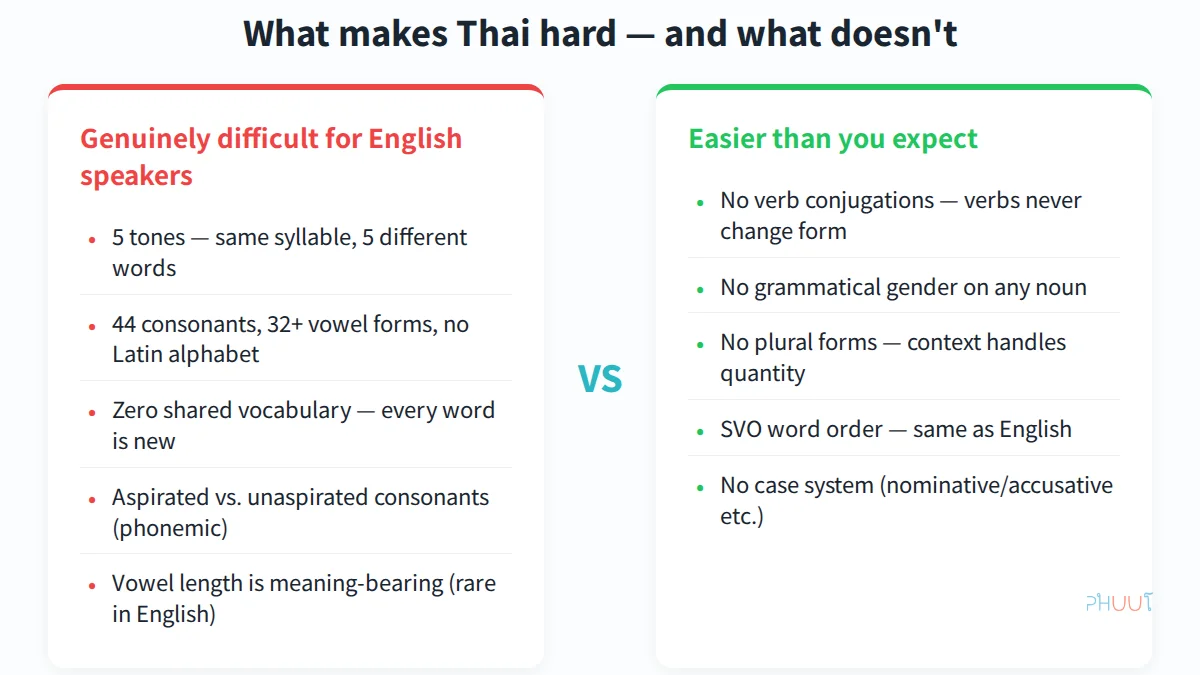
Thai has 5 tones — mid, low, falling, high, and rising — that change word meaning completely. The syllable “maa” means “come” (mid tone), “horse” (falling tone), or “dog” (rising tone) depending on how you say it. Saying the wrong tone doesn’t make you sound like you have an accent — it means you said a completely different word.
The difficulty for English speakers isn’t physical. You can produce the sounds. The difficulty is cognitive: English uses pitch to signal emotion and grammar (rising intonation for questions, falling for statements). Thai requires overriding that automatic reflex and treating pitch as a vocabulary carrier instead. This isn’t a quick adjustment. It’s a genuine rewiring that takes deliberate, sustained practice to build.
The moment this hits home is usually the first time you hear คา / ข้า / ค่า / ค้า played back to back. They sounded like slight variations of the same syllable to me — not four distinct words. They are four distinct words. A Thai speaker hears them as clearly as an English speaker hears “bat,” “cat,” “hat,” and “mat.” Getting your ear to the same place takes weeks of deliberate minimal-pair work, not casual listening.
Wall 2: Script
Thai script has 44 consonants organized into three tone classes, plus 32+ vowel forms that can appear above, below, before, or after the consonant they belong to. There is no Latin alphabet, no borrowed letters, no visual anchor for an English eye.
The good news: once you know the rules, Thai script is phonetically consistent. Unlike English, where “through,” “tough,” “cough,” and “dough” all end differently despite sharing “-ough,” Thai spelling maps predictably to sound. The initial learning curve is steep; the long-term behavior of the system is reliable.
Wall 3: Vocabulary
Spanish gives you “hospital,” “hotel,” “animal,” “natural” from day one — words that look and sound like English because both languages share Latin roots. Thai gives you ไป (bpai — “go”), มา (maa — “come”), กิน (gin — “eat”). Every word is a new arbitrary sound-meaning pairing. There are no cognates, no shortcuts, no partial recognition. Learning vocabulary in Thai takes more hours per word than in any European language.
The 5 Grammar Gifts
Here’s what most difficulty articles bury in a footnote, if they mention it at all: Thai grammar is structurally simpler than Spanish, French, or German.
No verb conjugations. The word ไป (bpai) means “go” regardless of who is doing it or when. “I go,” “she went,” “they will go,” “we have gone” — all use the same form. Tense is indicated by time words (yesterday, tomorrow, already) rather than verb changes.
No grammatical gender. In French, a table (la table) is feminine. In German, a girl (das Mädchen) is technically neuter. In Thai, nouns have no gender. None.
No plural forms. You don’t change the word for “cat” to make it “cats.” You say the number, or context handles it.
SVO word order. Subject-Verb-Object — the same structure as English. “I eat rice” in Thai follows the same sequence: ฉันกินข้าว (chăn gin khâaw — literally “I eat rice”). No verb-at-the-end rule, no SOV restructuring.
No case system. English vestigially has this (I/me/my, he/him/his). Latin, German, Russian have full case systems where word endings change based on grammatical function. Thai has none of this.
This isn’t spin. Thai grammar is objectively less complex than most European languages that English speakers learn in school. The difficulty is phonological (tones) and lexical (vocabulary), not grammatical. That distinction matters for how you study.
Realistic Timelines by CEFR Level
Many online guides promise “conversational Thai in 3 months.” That claim needs a definition. Conversational at what level?
A1 “conversational” means: ordering food, asking prices, saying hello and goodbye. You can do A1 in 3 months at 2 hours per day. That’s real progress and worth celebrating.
B1 “conversational” means: discussing your weekend plans in Thai, explaining a health problem to a doctor, asking your landlord to fix the water heater. That requires 600+ hours — about 20 months at 1 hour per day. The online guides aren’t lying; they’re just not specifying which kind of “conversational” they mean.
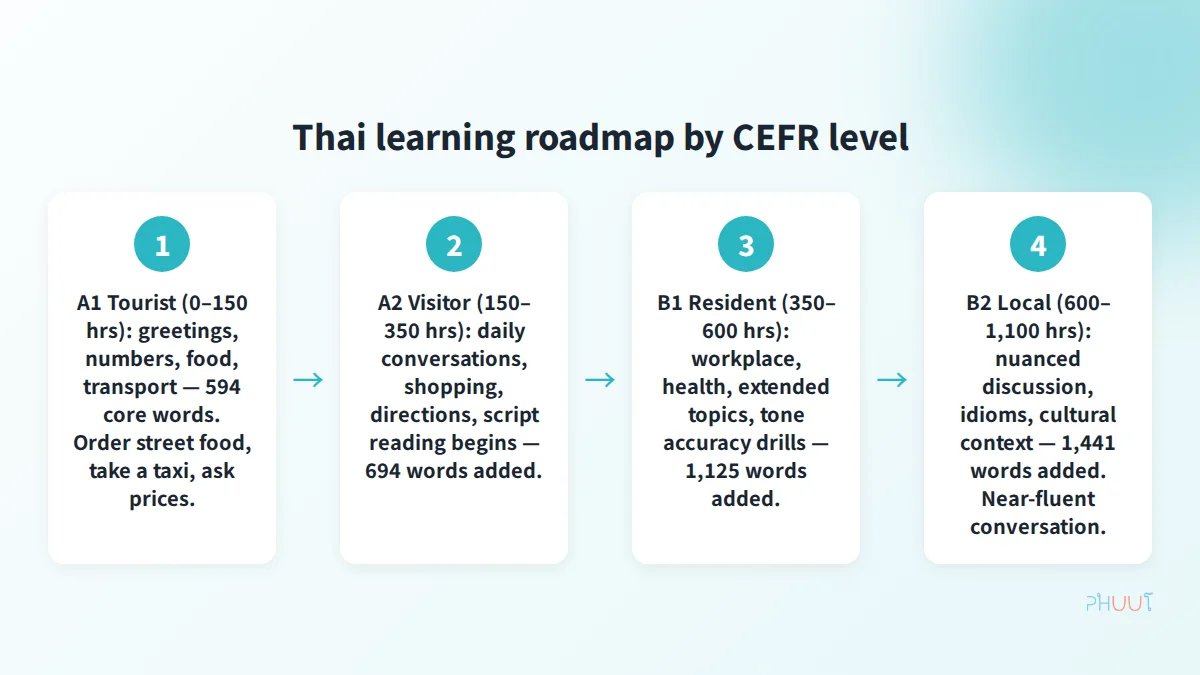
Here’s an honest breakdown of what each CEFR level looks like in Thai, and how long it takes at different study intensities.
If you’re ready to compare tools for each stage, our Thai app comparison breaks down which apps work best at A1 vs. B1.
How the hour estimates were calculated
The cumulative hour figures (A1: ~150, A2: ~350, B1: ~600, B2: ~1,100) are derived from FSI’s total working-proficiency benchmark of ~2,200 hours, distributed proportionally across CEFR levels based on vocabulary complexity and linguistic milestone data. They’re estimated ranges, not official FSI per-level figures — FSI reports only the total for professional working proficiency. Cross-referencing with independent language school data (Jam Kham, Weaver School) produces broadly consistent estimates.
What “1 hour per day” actually means
The table assumes focused, structured study — not background listening while cooking or passively watching Thai TV. One hour of active study (new vocabulary with feedback, tone drilling, script practice) is not the same as one hour of ambient exposure. If your current practice is mostly passive, the timeline extends proportionally.
The Phuut curriculum maps directly to these stages. A1 Tourist covers 594 core words. A2 Explorer adds 694 more. B1 Resident covers 1,125 words, and B2 Local adds 1,441. Each level has 1,240 lessons total (248 units × 5 lessons each). A learner can see exactly where they sit on the map and what the next concrete step looks like.
The 90-Day Starting Plan That Avoids the Two Biggest Mistakes
Most Thai learners make one of two mistakes in the first three months. Both feel like the safe choice. Both create problems that compound later.
Mistake 1: Starting with romanization
Romanization (writing Thai sounds using Latin letters) feels safer because it looks familiar. The problem: there is no single standard. Paiboon romanization writes the word for “go” as “bpai.” The Royal Thai General System (RTGS) writes it as “pai.” When you look up the same word in two different sources, it may not look like the same word.
Romanization also locks you out of reading anything in Thailand: menus, signs, apps, messages from Thai friends. And the pronunciation habits it builds — mapping Thai sounds onto English phoneme categories — are genuinely hard to unlearn. The Thai script has an initial learning curve. But it’s internally consistent in a way romanization never will be.
Mistake 2: Deferring tones
“I’ll get the vocabulary first, then worry about tones” is the Thai-learning equivalent of learning to type with two fingers: it feels efficient at first and costs you heavily later. Tones in Thai aren’t pronunciation polish — they’re part of the word. Learning กา (kaa) without its mid tone isn’t learning half the word. It’s learning the wrong word, because กา with a falling tone means something different.
Every hour you spend learning vocabulary without tones is an hour you’ll later spend relearning those words with correct tones. Integrate tone awareness from lesson one. You don’t need to produce perfect tones — you need to notice them and try.
The 3-Month Structure
Month 1 (Days 1–30): Script + Core Vocabulary Together
Don’t wait until you “know the script” to start vocabulary. Learn them simultaneously. Start with the 10 most frequent consonants (ก, ข, ค, ง, น, ม, ย, ร, ล, ว appear in the majority of common words). Pair each consonant with words that use it. Target: recognize and write the core consonant set; learn 50–80 words with their tones. Every word you learn, learn it with its Thai script form.
Month 2 (Days 31–60): Vowel Forms + Tone Class Rules
Thai has three consonant classes (high, mid, low) that interact with tone marks to produce the 5 tones. This system looks complicated; it becomes mechanical once you know the pattern. Month 2 is when the script starts clicking. Begin minimal pair drilling — words that differ only by tone — to train your ear to catch tonal distinctions. Target: 150 words, ability to read short syllables in Thai script without romanization.
Month 3 (Days 61–90): Speaking + Full A1 Set
Complete the A1 vocabulary set (594 words). Add daily speaking practice — AI conversation, recorded shadowing, or ideally conversations with a Thai speaker. The goal isn’t perfect pronunciation. The goal is hearing yourself say the words aloud and noticing where your tones drift. Confidence at ordering food, asking prices, and giving basic information about yourself.
This framework works regardless of which tools you use. What makes it work isn’t the specific app — it’s the sequencing: script and vocabulary in parallel, tones from day one, speaking before you feel ready.
Phuut’s A1 Tourist curriculum is built around this structure. What you actually get: the tone game modes give you active feedback — not just listen-and-repeat, but a closed loop where you know whether you produced the right tone before moving on. Script mode pairs stroke order with reading so you’re never just memorizing shapes in isolation. Boss Battle at the end of each week tests cumulative retention, not just last session’s words, so the “am I actually holding onto this?” question has a real answer rather than a hope.

Start Learning Thai
Phuut maps A1 Tourist to B2 Local. Know where you are, know what’s next. Free to start.

Build a Thai habit that actually sticks
Free on iOS
Willpower isn't a strategy. Phuut bakes proven learning science into the app so you just need to tap for 5 minutes a day.
- Spaced repetition (SRS) tuned to forgetting curves
- CEFR A1–B2 and Thai proficiency-test vocabulary only
- Paiboon transliteration fixes the read-but-can't-speak gap
- Free on iOS — the structure handles the discipline for you