
Duolingo Doesn't Have Thai - Here's What to Use Instead
Affiliate disclosure: This article contains affiliate links. We may earn a small commission at no extra cost to you. As an Amazon Associate, we earn from qualifying purchases.

About the reviewer

Ramy Hirano
Phuut Founder
Founder of Phuut. Has observed how Japanese and English speakers stumble on Thai and built learning products around those patterns.
Follow Phuut on X →You searched “Duolingo Thai.” Nothing came up. Not a beta, not a limited release - just absence. Duolingo is one of the world’s most downloaded language apps, and as of 2026-05-30 it does not offer a Thai course. We can only describe what exists today; we don’t speculate about future roadmaps. What we can do is help you compare the structured Thai apps that are available right now: our own app Phuut, plus Ling App, ThaiPod101, and Pimsleur.
This article walks through a four-axis evaluation framework (gamification, script coverage, pronunciation feedback, price), then describes where each app tends to be stronger. No app wins on every axis - the right choice depends on your use case.
In this article:
- Why Duolingo doesn’t currently offer Thai
- How to evaluate a Thai learning app: the four axes
- The four structured Thai apps: where each tends to be stronger
- Pricing context and a suggested learning path
- Sources & disclaimers
- Key takeaways
- FAQ
Why Duolingo Doesn’t Currently Offer Thai
A common assumption is that Thai must be hidden somewhere in Duolingo, or coming soon. As of 2026-05-30, neither is the case based on the courses Duolingo publicly lists.
What we can confirm
Duolingo’s public course catalog as of 2026-05-30 does not include Thai. That is the verifiable fact - and it is the only fact you need in order to plan your learning today.
Historical context
Historically, Duolingo built new language courses through a programme called the Incubator, where volunteer teams of native speakers built courses through Alpha, Beta, and graduated stages. Thai was submitted to the Incubator but did not reach a published course. We don’t claim insider knowledge of why; what is documented publicly is simply that the course never launched.
We don’t make predictions about Duolingo’s future roadmap. Companies change product strategies, and any forecast we offered would be speculation. The practical implication, however, is concrete: if you want to learn Thai today, you need to choose among apps that do currently offer Thai.
What you’re actually looking for
It’s worth naming what made Duolingo attractive in the first place. The habit loop is well-designed: daily streaks, short sessions, immediate feedback, and a free entry tier. Those design patterns are not exclusive to Duolingo - they have been adopted across the language app market, including in the Thai-specific apps below. The features that drew you to Duolingo are reproducible. They just live elsewhere for Thai.
How to Evaluate a Thai Learning App: The Four Axes
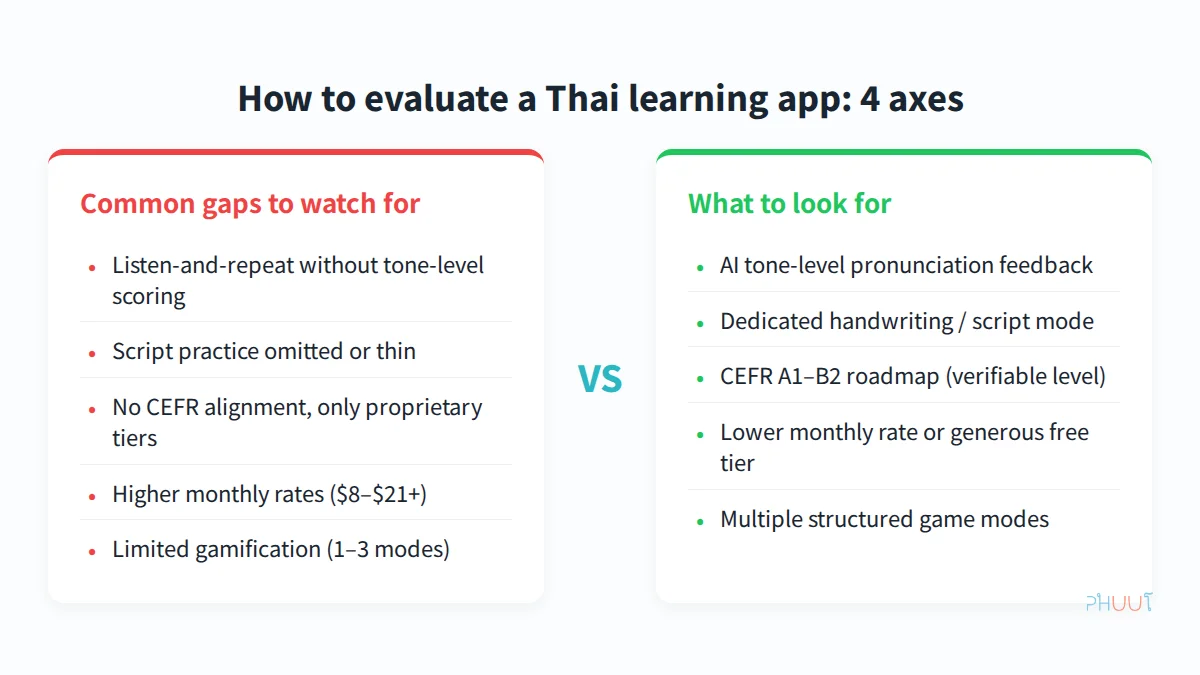
Before naming specific apps, here is the framework we use internally when comparing Thai learning tools. You can apply these four axes to any app, now or in the future.
Axis 1 - Gamification depth
The habit-loop design Duolingo popularised - streaks, short sessions, varied interactions - is what keeps many learners opening the app the next day. Thai apps vary widely: some have a single quiz format plus a streak counter, others rotate across multiple game modes with weekly review mechanics.
Ask: does this app have a mechanism that makes me want to open it tomorrow, or does it rely entirely on my willpower?
Axis 2 - Thai script coverage
Thai script has 44 consonants, 32 vowel forms, and tone marks that carry meaning. Apps treat script very differently - some skip it entirely (audio-only), some include passive reading, and some have dedicated handwriting or stroke-order modes.
Thai’s five tones change word meaning entirely, and in written Thai those tones are encoded through a combination of consonant class, vowel length, and tone marks. Skipping script means missing a layer of pronunciation information that romanisation cannot fully convey.
Ask: does this app teach me to read Thai, or does it only transliterate?
Axis 3 - Pronunciation and tone feedback
This is the axis with the widest variation between apps. Thai is tonal - the syllable /maa/ can mean “come,” “horse,” or “dog,” depending only on the tone. Pronunciation feedback approaches typically fall into three categories:
- Listen and repeat (no scoring): You hear a model, you repeat. Nothing assesses your attempt.
- Speech check (pass/fail): The app detects whether your utterance resembles the target word.
- AI-scored tone detection: The app scores your pronunciation at the tone level, identifying which of the five tones you produced.
Ask: does this app tell me what I did wrong with my pronunciation, or only whether I passed?
Axis 4 - Price
Approximate monthly pricing for the four apps below (as of 2026-05-30): Phuut ~$4.99 (¥600 in Japan), Ling ~$14.99 on the monthly plan, ThaiPod101 ~$8-47 depending on tier, Pimsleur ~$14.95 on the 90-day plan. Annual or longer plans typically discount these rates significantly. Always confirm current pricing on the provider’s official site before subscribing.
The Four Structured Thai Apps: Where Each Tends to Be Stronger
The structure below is the same for each app: a short summary, the areas where the app tends to be stronger, the trade-offs, and the learner type we’d recommend it for. None of these apps is universally “the best” - each has a clear domain of strength.
Phuut
Summary: Phuut is our app - a Thai-specialised learning app focused on AI tone feedback, dedicated script practice, and a gamified daily loop at a low monthly price.
We have an obvious bias here, so we’ll keep this section to specific, verifiable features rather than superlatives.
Where Phuut tends to be stronger:
- AI tone detection. Phuut scores pronunciation at the tone level rather than as pass/fail, which is a more granular approach than the listen-and-repeat or pass/fail patterns common in other Thai apps.
- Thai script mode. A dedicated handwriting practice mode with stroke-order feedback. The Thai script beginner reading path is integrated into the lesson flow rather than offered as an add-on.
- Gamified loop. Eight rotating game modes (multiple-choice, listening, pronunciation, Thai script, typing, matching, flashcards, and a weekly Boss Battle review).
- Price. Approximately $4.99/month in the US and ¥600/month in Japan as of 2026-05-30 - the lowest monthly price among the four structured apps in this comparison.
- CEFR A1-B2 roadmap. Four levels (Tourist, Explorer, Resident, Local) tied to international CEFR benchmarks, so you can describe your level outside the app.
Trade-offs:
- iOS only at the time of writing; Android is in development, with no public launch date.
- Content library: Phuut covers ~3,850 vocabulary items across 1,240 lessons. For learners seeking the broadest archive of native-audio content, ThaiPod101’s library is deeper.
- We’re the publisher of this article - please verify our claims against your own trial of the free tier before deciding.
We recommend Phuut for: learners on iOS who want AI tone feedback and a dedicated Thai script mode at the lowest monthly price.

Build a Thai habit that actually sticks
Free on iOS & Android
Willpower isn't a strategy. Phuut bakes proven learning science into the app so you just need to tap for 5 minutes a day.
- Spaced repetition (SRS) tuned to forgetting curves
- CEFR A1–B2 and Thai proficiency-test vocabulary only
- Paiboon transliteration fixes the read-but-can't-speak gap
- Free on iOS & Android — the structure handles the discipline for you
Ling App
Summary: A multi-language app covering more than 60 languages, including Thai, with a Duolingo-like UX. The following points are based on publicly documented features as of 2026-05-30.
Where Ling tends to be stronger:
- Multi-language ecosystem. Ling publicly documents more than 60 supported languages, so learners studying Thai alongside Vietnamese, Indonesian, or other regional languages can keep them in one account.
- Familiar UX. Based on publicly documented features, the lesson flow includes matching exercises, fill-in-the-blank, and short speech checks - a format that will feel familiar to anyone who has used a Duolingo-style app.
- Community scale. As a multi-language platform, Ling has a wider general user base than Thai-specialised apps, which is reflected in its public community presence.
Trade-offs:
- Pricing is approximately $14.99/month on the monthly plan, as of 2026-05-30 per Ling’s official site. Annual plans offer significant discounts - please confirm the current rate on Ling’s official site before subscribing.
- Pronunciation feedback follows a different approach than Phuut’s tone-level AI scoring; based on publicly documented features, Ling’s pronunciation check is not described as tone-specific.
- Script coverage exists as part of the Thai course based on publicly documented features, but the depth differs from Phuut’s dedicated handwriting mode.
We recommend Ling for: learners who want a single account across multiple Southeast Asian (and other) languages.
ThaiPod101
Summary: A Thai-specialised platform built around native-audio lessons with cultural context. Points below are based on publicly documented features as of 2026-05-30.
Where ThaiPod101 tends to be stronger:
- Native audio depth. ThaiPod101’s archive of native-speaker lessons across beginner-to-advanced levels is one of the larger publicly available libraries for Thai.
- Cultural context. Grammar and vocabulary lessons frequently include cultural background notes alongside direct translation, based on publicly documented lesson formats.
- Listening practice. Native-audio dialogues across the catalogue offer listening practice that is harder to replicate in gamified apps.
- Flexibility. Learners can dip into specific topics rather than being locked into a linear path.
Trade-offs:
- Pricing varies by tier - approximately $8/month at the Basic level and up to ~$47/month at the highest tier as of 2026-05-30 per ThaiPod101’s official site. Confirm current rates before subscribing.
- The UI is less gamified than the other apps in this comparison.
- Based on publicly documented features, ThaiPod101 does not include active script writing practice or AI pronunciation scoring.
We recommend ThaiPod101 for: learners who prefer lecture-style audio content and value cultural depth alongside vocabulary.
Pimsleur Thai
Summary: An audio-first course series (Thai Levels 1-2) built on spaced audio repetition. Points below are based on publicly documented features as of 2026-05-30.
Where Pimsleur tends to be stronger:
- Audio-only learning. Fully usable without a screen - a fit for commutes, walks, or driving.
- Research-backed methodology. The Pimsleur method has decades of pedagogical research behind its spaced-audio approach for listening comprehension and conversational retention.
- Disciplined session structure. 30-minute lessons that build cumulatively, with minimal interaction beyond listening and speaking.
Trade-offs:
- No Thai script coverage. If you want to read Thai, you’d need to combine Pimsleur with another tool.
- Pricing is approximately $14.95/month on the 90-day plan as of 2026-05-30 per Pimsleur’s official site - confirm current rates before subscribing.
- No gamification or AI tone scoring, based on publicly documented features.
We recommend Pimsleur for: commuters and audio-first learners who don’t need to read Thai script in the near term.
Pricing Context and a Suggested Learning Path
A rough 12-month spend comparison at monthly rates (as of 2026-05-30 per each provider’s official site, before any annual discount; please verify on each provider’s site):
- Phuut: ~$59.88
- ThaiPod101 (Basic): ~$96
- Pimsleur (90-day plan): ~$179.40
- Ling (monthly plan): ~$179.88
- ThaiPod101 (Premium Plus): ~$564
These are list-price estimates, not promotional rates. Annual plans, regional pricing, and trial periods all change the effective cost - Ling’s annual plan in particular is documented to be considerably cheaper than the monthly rate. We are not claiming any single number is definitive - we are providing a rough order-of-magnitude reference so you can compare against your own budget.
The CEFR roadmap as a navigation tool
One reason CEFR alignment matters in any app is portability of your level. Proprietary level systems (“Beginner 3,” “Level 7”) don’t translate to a tutor, an employer, or a language exchange partner. CEFR does.
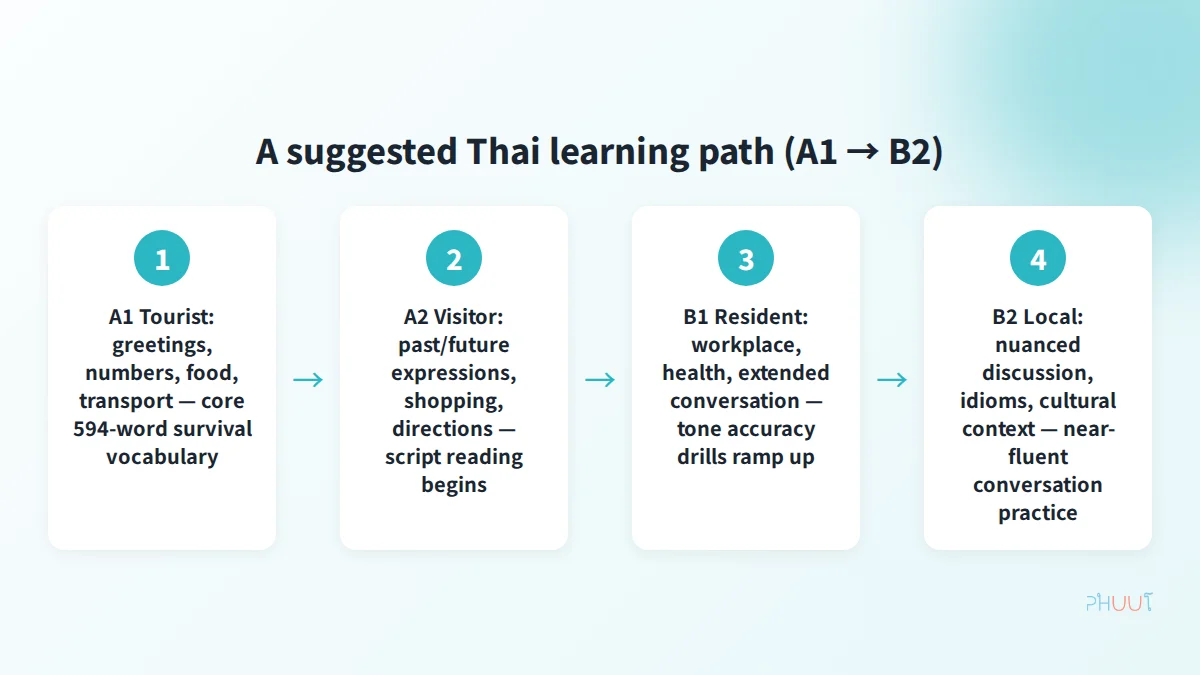
- A1 Tourist: Basic survival phrases - ordering food, navigating transport, exchanging greetings. Roughly the first 594 vocabulary items in Phuut’s curriculum.
- A2 Explorer: Past and future tense, shopping, directions. Thai script reading typically begins in earnest at this level.
- B1 Resident: Workplace and health vocabulary, extended conversation on familiar topics.
- B2 Local: Nuanced discussion, idioms, and cultural context.
A practical recommendation
Try the free tier of any app on this list. Use the four-axis framework - gamification, script, pronunciation feedback, price - to assess fit after a week of daily use. Subscribe to the app you actually opened every day. The wrong choice is the one you open twice and abandon.
If your priority is AI tone feedback and dedicated Thai script practice at the lowest monthly rate, we recommend trying Phuut. If you want a multi-language ecosystem covering more than 60 languages in one account, Ling is worth a look. If you want a large native-audio Thai library and cultural depth, ThaiPod101’s archive is among the larger options publicly available. If you’ll only ever learn through audio while commuting, Pimsleur tends to be the better fit despite the higher monthly cost.
Build a Thai habit that actually sticks
Free on iOS & Android
Willpower isn't a strategy. Phuut bakes proven learning science into the app so you just need to tap for 5 minutes a day.
- Spaced repetition (SRS) tuned to forgetting curves
- CEFR A1–B2 and Thai proficiency-test vocabulary only
- Paiboon transliteration fixes the read-but-can't-speak gap
- Free on iOS & Android — the structure handles the discipline for you
Sources & Disclaimers
- Pricing data verified as of 2026-05-30. Visit each provider’s official site for current pricing.
- Feature comparisons reflect product specifications publicly documented at the time of writing. Capabilities evolve; we encourage readers to verify the current state of each app.
- All competitor names are trademarks of their respective owners:
- Duolingo® is a trademark of Duolingo, Inc.
- Ling App is a product of Simya Solutions Ltd.
- ThaiPod101 is a product of Innovative Language Learning, LLC.
- Pimsleur® is a trademark of Simon & Schuster, Inc.
- This article reflects the editorial perspective of Phuut. Affiliate disclosure: we may receive commissions if you sign up through links in this article.
Try Phuut for Thai - Free on iOS
Free on iOS. Practice conversation, 5 minutes a day.
Build a Thai habit that actually sticks
Free on iOS & Android
Willpower isn't a strategy. Phuut bakes proven learning science into the app so you just need to tap for 5 minutes a day.
- Spaced repetition (SRS) tuned to forgetting curves
- CEFR A1–B2 and Thai proficiency-test vocabulary only
- Paiboon transliteration fixes the read-but-can't-speak gap
- Free on iOS & Android — the structure handles the discipline for you
Build a Thai habit that actually sticks
Free on iOS & Android
Willpower isn't a strategy. Phuut bakes proven learning science into the app so you just need to tap for 5 minutes a day.
- Spaced repetition (SRS) tuned to forgetting curves
- CEFR A1–B2 and Thai proficiency-test vocabulary only
- Paiboon transliteration fixes the read-but-can't-speak gap
- Free on iOS & Android — the structure handles the discipline for you