
You Maniac Thai Phrases: Learn Thai Before the Premiere
Affiliate disclosure: This article contains affiliate links. We may earn a small commission at no extra cost to you. As an Amazon Associate, we earn from qualifying purchases.
About the reviewer

Ramy Hirano
Phuut Founder
Founder of Phuut. Has observed how Japanese and English speakers stumble on Thai and built learning products around those patterns.
Follow Phuut on X →Peach and Me wraps on August 1. The next William Jakrapatr and Est Supha show is You Maniac - no confirmed premiere date as of July 27 2026. That window is yours. You Maniac Thai phrases are worth learning now, before episode one drops, so you catch words the moment they are spoken. This guide starts with บ้า (the Thai word the show title is built around), covers the vocabulary transferring from Peach and Me, and maps the emotional phrase cluster that appears in every GMMTV BL drama.
In this article:
- The title “You Maniac” - what บ้า teaches you about Thai slang
- The Peach and Me head start - vocabulary that carries over
- Thai BL emotional core - vocabulary every GMMTV drama uses
- Informal and youth Thai - what characters say when the drama is not dramatic
- Why Thai script plus tone marks works: the retention method
The Title “You Maniac” - What บ้า Teaches You About Thai Slang
Before the first episode of You Maniac airs, the show’s English title already gives you one of the most useful words in informal Thai. The word is บ้า (baa, falling tone). It means crazy, maniac, or irrational - and it doubles as affectionate slang between people who know each other well.
บ้า covers the affectionate-exasperation register - calling someone a maniac because you know them so well you can. คลั่ง (khlâng, falling tone) sits at the other end: obsessive infatuation, the kind of all-consuming feeling that makes a character act against their own best judgment. Both words live in You Maniac’s title - the show’s emotional arc covers both registers.
That isn’t coincidence for a drama with this name. It’s the vocabulary entry point.
บ้า is a mid-to-high frequency Thai word that operates across multiple registers. At its most literal, it describes genuinely irrational or out-of-control behavior - someone acting in a way that breaks social norms. But between close Thai friends, and consistently in Thai BL dialogue as characters move from formal interaction to real intimacy, บ้า shifts from accusation to affection.
In GMMTV dramas, the moment a character calls another character บ้า without any particle or apology attached is often the moment you know the distance between them has closed. The show title is named for exactly this shift.
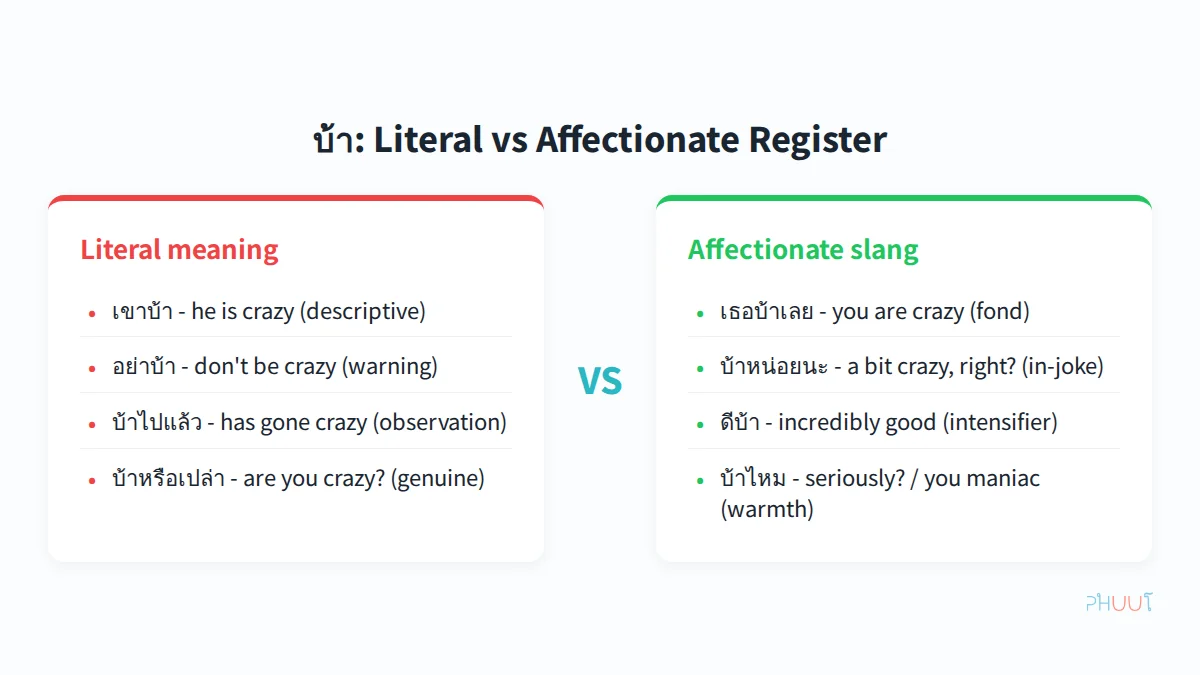
Here’s how the register works in practice. เธอบ้า (ter baa) means “you are crazy” or “you maniac” - the direct address form, warm and intimate when spoken softly between close people. บ้าหน่อยนะ (baa noi na) is “you are a bit crazy, you know?” - นะ converts the statement to an in-joke between people who know each other well, the register of maximum familiarity. Est Supha’s LYKN register also uses บ้า as a positive intensifier: ดีบ้า (dii baa) = incredibly good, สนุกบ้า (sa-nuk baa) = incredibly fun. A positive extreme with none of the literal craziness attached.
บ้า is one Thai word with at least five distinct functional registers. Every appearance in You Maniac is a register marker as much as a vocabulary item. Once you can hear it, you’ll catch it in every scene. It’ll tell you something about the relationship at that moment.
You Maniac is a GMMTV Q3 2026 BL production starring William Jakrapatr (วิลลี่ จักรภัทร) and Est Supha (เอสต์ ศุภ). No premiere date has been confirmed as of July 27 2026. For the vocabulary from their previous show together, see our Peach and Me Thai phrase guide. For the full 2026 GMMTV lineup that places You Maniac alongside Kiss Me Remember and Gunshot, see the 2026 GMMTV vocabulary guide.
บ้า and title vocabulary
| Thai | Romanization | Tone note | Meaning | Register |
|---|---|---|---|---|
| บ้า | baa | falling | crazy / maniac / irrational | Literal in description; affectionate in direct address between close people |
| เธอ | ter | mid | you (intimate / romantic pronoun) | BL romantic address; same pronoun pattern from Peach and Me |
| คนบ้า | khon baa | rising-falling | a crazy person / a maniac (noun phrase) | คน = person; บ้า = crazy; compounds into a noun |
| บ้าเลย | baa loei | falling-mid | so crazy / totally crazy | เลย intensifies; common in casual affectionate exasperation |
| บ้าหน่อย | baa noi | falling-low | a little crazy | หน่อย = a little; softened register |
| บ้าหน่อยนะ | baa noi na | falling-low-mid | a bit crazy, you know? (in-joke) | นะ converts statement to gentle observation between close speakers |
| อย่าบ้า | yàa baa | low-falling | don’t be crazy | Mild prohibition; อย่า = don’t; can be fond or genuine warning |
| บ้าไหม | baa mai | falling-rising | are you crazy? / seriously? | ไหม = question marker; register determined by context and delivery |
| ดีบ้า | dii baa | flat-falling | incredibly good (intensifier) | บ้า as positive extreme; contemporary youth Thai register (Est Supha) |
The Peach and Me Head Start - Vocabulary That Carries Over
If you watched Peach and Me, you already have a vocabulary head start for You Maniac.
The two shows share the same cast, the same polite particle system, and the same emotional expression register. All that Thai vocabulary you absorbed from Peach and Me doesn’t reset when a new show begins. This section maps what you already know to what you’ll hear when You Maniac premieres.
William Jakrapatr’s delivery patterns and Est Supha’s contemporary speech register don’t change between productions. ครับ (khrap, mid tone) at the end of William’s formal lines, the พี่/น้อง age-honorific address system, the emotional vocabulary cluster around ชอบ and รัก - all of these are embedded in the genre and in how these two actors speak. Fans of Peach and Me aren’t starting from zero. They’re building from a foundation that the first show gave them.
Map the specific transfers. ครับ after William’s lines: same function, same frequency, same social signal in any production. พี่/น้อง address: GMMTV BL consistently uses this honorific system regardless of character names or show. คิดถึง in separation scenes: the word is identical whether you heard it in Peach and Me or you’ll hear it in You Maniac Episode 1. The emotional vocabulary cluster transfers completely, with no adaptation needed.
Peach and Me wasn’t just entertainment. For vocabulary learners, it was the training set for You Maniac. Every phrase you caught from the show you just finished is one you’ll recognize in the next one without waiting for the subtitle.
The Peach and Me Thai phrase guide covers the full cast vocabulary from that drama in detail - the title vocabulary, polite particles, and emotional expressions that now give you a head start here.
Core transfer vocabulary from Peach and Me
| Thai | Romanization | Tone note | Meaning | Transfer note |
|---|---|---|---|---|
| ครับ | khrap | mid | Male polite particle; yes / understood | Direct transfer - William Jakrapatr uses this after every formal line in any production |
| ค่ะ | kha | falling | Female polite particle (statement) | Direct transfer - same function in any GMMTV production |
| พี่ | phi | falling | Older person / honorific prefix | Direct transfer - พี่ [name] is the standard address in GMMTV BL between characters with an age difference |
| น้อง | nong | high | Younger person / junior address | Direct transfer - same age-relative system as Peach and Me |
| สวัสดีครับ / สวัสดีค่ะ | sa-wat-dii khrap / kha | compound | Hello (male / female polite) | Universal; scene-opening greeting transfers to any Thai drama or real conversation |
| ขอบคุณครับ | khop khun khrap | compound | Thank you (male polite) | Direct transfer - gratitude phrase with same polite particle as Peach and Me |
| ไม่เป็นไร | mai pen rai | falling-mid-mid | Never mind / it’s okay | Direct transfer - the most universal Thai phrase; appears in every resolution scene |
| ชอบ | chop | falling | Like / fond of (precursor to love) | Direct transfer - the A1 approach to confessing feelings before the full รัก arc |
| นะ | na | mid | Plea / softener / seeking agreement | Direct transfer - works identically in every GMMTV BL; the load-bearing particle in confessions |
| ผม | phom | falling | I / me (formal male first person) | Direct transfer - William Jakrapatr uses ผม in formal and emotional registers |
| เธอ | ter | mid | You (intimate second person) | Direct transfer - the romantic address pronoun in BL confession language |
| แล้วเจอกัน | laew joe kan | high-flat-mid | See you later | Direct transfer - parting phrase from Peach and Me and every Thai drama |
Thai BL Emotional Core - Vocabulary Every GMMTV Drama Uses
Thai BL emotional vocabulary is remarkably consistent across GMMTV productions. The same cluster of words - คิดถึง, รัก, เจ็บ, ห่วง, เสียใจ - appears in every slow-burn BL drama regardless of plot or cast. Learning them now means they’ll be recognizable from the first emotional scene of You Maniac.
The consistency isn’t coincidence. GMMTV BL dramas share a genre grammar that assigns certain vocabulary to emotional peaks. Separation scenes reliably produce คิดถึง (miss you) and อย่าไป (don’t go). Conflict scenes produce เจ็บ (hurt) and เสียใจ (sad, heartbroken). Confession scenes produce รัก and ชอบ in that order, with ผมรักเธอ as the peak. This is genre vocabulary as much as it’s language - and it transfers from Peach and Me to You Maniac and to every Thai BL you’ll ever watch.
Walk through the emotional cluster with tone context. คิดถึง (khit thueng, low-rising) encodes urgency and longing in the rising second syllable. You can hear the word reaching upward. รัก (rak, falling) delivers its meaning with the same decisive finality as the emotion - the falling tone doesn’t waver. เจ็บ (jep, mid) sits in the middle register, stable and unavoidable, the way emotional pain is. ห่วง (huang, falling) shares รัก’s falling finality - worrying about someone in Thai is as committed an act as loving them.
Understanding the tones deepens recognition. The falling tone on รัก is decisive. The rising second syllable of คิดถึง encodes urgency. If you want the full tone system behind these words, the Thai tones explained guide covers how consonant classes and tone marks interact across the language.
When you catch คิดถึง before the subtitle loads, you are no longer watching a drama with subtitles. You are watching a Thai drama. That shift - from subtitle-dependent viewer to active listener - is what mastering this cluster before You Maniac premieres gives you.
Thai BL emotional vocabulary
| Thai | Romanization | Tone note | Meaning | Drama context |
|---|---|---|---|---|
| รัก | rak | falling | love (verb / noun) | Confession word; falling tone signals decisiveness; ผมรักเธอ = I love you |
| ชอบ | chop | falling | like / fond of (precursor to love) | ชอบเธอ = I like you; appears before full confession in slow-burn arc |
| คิดถึง | khit thueng | low-rising | miss someone / think of someone | คิดถึงเธอ = I miss you; rising tone encodes urgency and longing |
| เจ็บ | jep | mid | hurt (physical or emotional) | เจ็บใจ = emotionally hurt; appears in conflict and misunderstanding scenes |
| ห่วง | huang | falling | worried about / care for | ห่วงเธอ = I am worried about you; อย่าห่วง = don’t worry |
| เสียใจ | sia jai | falling-flat | sad / heartbroken | เสียใจมาก = very sad; เสีย (lose) + ใจ (heart) = literally lost heart |
| ใจ | jai | flat | heart / inner feelings | Compounds: ใจหาย (heart drops), เจ็บใจ (heartache), ดีใจ (glad) |
| อยู่ด้วยกันนะ | yuu duay kan na | mid-low-mid-mid | stay together, okay? | Commitment phrase; นะ converts statement to plea |
| อย่าไป | yàa pai | low-flat | don’t go | อย่า = don’t; ไป = go; universal parting-scene phrase across GMMTV BL |
| ที่รัก | thi rak | falling-falling | darling / dear (address form) | Term of address for established couple; appears in later-episode scenes |
| ดีใจ | dii jai | flat-flat | glad / happy | ดีใจมากเลย = I am so happy; reunion and positive emotional expression |
| นะ | na | mid | plea / softener / seeking agreement | In confessions = plea; in goodbyes = heartbreak; the most versatile drama particle |
| อยู่ที่นี่นะ | yuu thi ni na | mid-falling-high-mid | stay here, okay? | Comfort and closeness phrase; นะ makes it a plea not a command |
The falling tone on รัก is what makes the word feel decisive - and it’s also the tone that most English speakers drift off of without noticing. A native Thai tutor on italki can hear your production and tell you in real time whether your รัก has the same finality you’ll hear in You Maniac when it premieres. Getting that tone right before the premiere means you’ll already know how the word feels in your mouth when you hear it in the show.

Informal and Youth Thai - What Characters Say When the Drama Is Not Dramatic
Not every line in a Thai BL drama is a confession or an emotional revelation. Between the high-stakes moments, characters use daily informal Thai and contemporary youth speech. This is where Est Supha’s LYKN register creates vocabulary worth specifically learning before You Maniac.
Est Supha’s background in Thai idol group LYKN gives his speech a contemporary Bangkok youth quality. It’s faster, more casual, and includes register-markers you won’t find in a standard phrasebook. บ้า as a positive intensifier (ดีบ้า, สนุกบ้า) is one of them. The relaxed particle usage, the informal connectives, the pace - all of it is a different register from William Jakrapatr’s more measured delivery. Knowing both registers means you can parse the contrast between them when characters shift from formal to intimate speech, or from dramatic to everyday conversation.
This two-register dynamic is the same audio environment that made Peach and Me useful for vocabulary study. One speaker paced for comprehension, one paced for authentic contemporary speed. Fans of both actors from Peach and Me already know what each register sounds like. You know when William’s careful delivery gives you an extra beat before the subtitle loads. You also know when Est picks up the pace.
Walk through the daily and informal cluster. ทำอะไรอยู่ (what are you doing?) is the casual check-in that opens everyday scenes. ไปด้วยกัน (let’s go together) is two characters choosing to move jointly - one of the most common casual invitations in Thai. รอก่อนนะ (wait a moment, okay?) is the soft hold-on request, with นะ transforming a potential command into a considerate ask. เดี๋ยวนะ (just a moment, hold on) is the quick informal pause marker that appears constantly in casual Thai conversation - and between scenes in every Thai drama.
The informal vocabulary in You Maniac is the vocabulary you’ll use first in real Thai conversation. It’s lower-stakes than the confession language but higher-frequency. Mastering it before the premiere means you stop needing subtitles for the between-scenes dialogue, not just the dramatic peaks.
Informal and daily Thai vocabulary
| Thai | Romanization | Tone note | Meaning | Real-world use |
|---|---|---|---|---|
| ทำอะไรอยู่ | tham a-rai yuu | flat-rising-mid | what are you doing? | Casual check-in; อยู่ marks ongoing action; extremely high frequency |
| ไปด้วยกัน | pai duay kan | flat-low-mid | let’s go together | Invitation to move jointly; same phrase transfers to any Thai context |
| รอก่อนนะ | ro gon na | high-low-mid | wait a moment, okay? | นะ softens the command; polite informal hold-on request |
| เดี๋ยวนะ | diao na | low-mid | just a moment / hold on | Quick pause marker; เดี๋ยว = shortly; very high frequency in casual Thai |
| ไม่รู้ | mai ruu | falling-high | I don’t know | One of the most honest and frequent responses in Thai conversation |
| แล้วเจอกัน | laew joe kan | high-flat-mid | see you later | Parting phrase; แล้ว = then, เจอ = meet, กัน = each other |
| หิวข้าวไหม | hiu khao mai | flat-flat-rising | are you hungry? | Scene-transitional daily question; appears in every Thai drama |
| ขอหน่อยได้ไหม | kho noi dai mai | low-low-falling-rising | could I have a little / may I? | Polite request formula; หน่อย = a little bit |
| โอเค | o-ke | flat-flat | okay (loanword) | Contemporary Thai casual confirmation; extremely common in youth register |
| ก็ได้ | ko dai | low-falling | that works / fine by me | Casual agreement or acquiescence; natural in everyday Thai |
| แล้วกัน | laew kan | high-mid | then / that settles it | Conversational closer; marks agreement or resolution of a decision |
When You Maniac premieres on GMMTV, fans outside Thailand who want to watch alongside Thai audiences may find geo-restrictions in the way. NordVPN lets you connect through a Thai or regional server to reach the full episode library. Getting this sorted before the premiere date means you’ll be watching the first episode when it drops - not a week later waiting for a workaround.

Why Thai Script Plus Tone Marks Works: the Retention Method
Every vocabulary table in this article is structured with Thai script first, Paiboon romanization second, and a tone note third. This isn’t an arbitrary format choice. It’s a named retention method that produces meaningfully better vocabulary retention than romanization-only study.
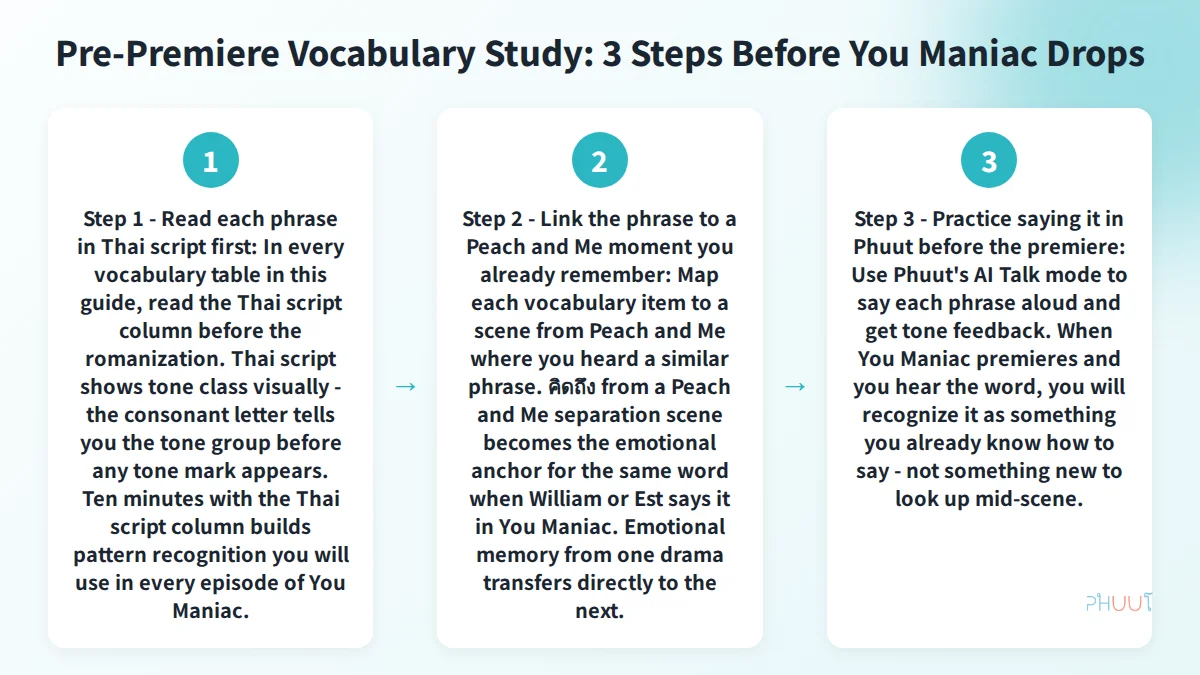
Romanization gives you approximate sounds. But it strips out the visual information that makes Thai vocabulary stick. When you read คิดถึง in Thai script, you’re reading a tone-bearing system: the consonant class of ค and ถ tells you their tone group before any tone mark appears. Reading it alongside a drama scene provides two distinct encoding pathways for the same vocabulary item - auditory-emotional (the scene itself) and visual-analytic (the Thai script).
Research on dual-encoding in language acquisition consistently shows that two distinct encoding pathways produce retention rates meaningfully higher than a single pathway, even when that single pathway involves repetition. The mechanism is the same across studies: two pathways reinforce different aspects of the same memory, making retrieval more robust. Applied to drama vocabulary, some dual-coding studies describe the improvement as substantial - though the exact figure varies by learner and material type.
Apply the method to คิดถึง specifically. In a drama scene, you hear it with rising intonation at a moment of separation. In the vocabulary table, you see คิดถึง - the script for a word you now associate with that emotional moment. Reading the Thai script activates the visual pathway. Hearing the word in the scene activates the auditory-emotional pathway. In Phuut’s flashcard mode, you see both simultaneously, and in AI Talk mode you produce the word with tone feedback. Each vocabulary entry gives you four things to lock on to: the Thai script, the Paiboon romanization, the tone name, and the meaning. Four separate mental hooks per word.
The pre-premiere window for You Maniac is a rare opportunity to build vocabulary through reading before the auditory drama input arrives. By the time the first episode airs, you’ll have two encoding pathways for every word in this guide. That means the drama itself becomes a retrieval practice session rather than a first exposure. You aren’t reading along with the subtitles. You’re testing what you already know.
For a structured approach to turning every episode of a Thai drama into a vocabulary study session - not just You Maniac but any show you watch - see how to study Thai from every episode.
Phuut’s flashcard mode covers every vocabulary item in this guide at A1-A2 level - with Thai script display so you see the tone pattern, not just hear the word. A1 holds 594 words; A2 holds 694 words. Eight game modes include flashcard review and AI Talk conversation practice. AI Talk is where you close the gap between recognizing a phrase and producing it: say บ้า, say คิดถึง, say รักนะ - and the tone checker tells you whether your production matched what you’ll hear in You Maniac. Build the vocabulary now, in the window before the premiere. Free to start on iOS and Android.
Download Phuut on the App Store

The Thai you'll actually need in Thailand
Free on iOS & Android
Tourist phrases don't get rent paid or a doctor's appointment. Phuut, designed by long-term residents, covers banking, housing, healthcare — the daily reality of living in Thailand.
- Lessons for visa, rental, hospital, banking scenes
- AI conversations simulate clerks, landlords, civil servants
- Native audio + Paiboon transliteration keeps pronunciation crisp
- 5 minutes a day to preview what your week actually needs
Related reading:
- Peach and Me Thai Phrase Guide - William Jakrapatr and Est Supha in Peach and Me (มีสติแล้วลูกพีช), which concluded August 1 2026 on GMM 25 and iQIYI; the companion vocabulary guide for the show that sends traffic here
- 2026 GMMTV Drama Vocabulary Guide - the full 2026 GMMTV lineup, covering You Maniac alongside Kiss Me Remember and Gunshot
- BL Drama Vocabulary Guide - confession phrases, particles, and the phi/nong system across Thai BL dramas, not anchored to a single show
- How to Study Thai from Every Episode - turn every episode of You Maniac into a structured vocabulary study session
The Thai you'll actually need in Thailand
Free on iOS & Android
Tourist phrases don't get rent paid or a doctor's appointment. Phuut, designed by long-term residents, covers banking, housing, healthcare — the daily reality of living in Thailand.
- Lessons for visa, rental, hospital, banking scenes
- AI conversations simulate clerks, landlords, civil servants
- Native audio + Paiboon transliteration keeps pronunciation crisp
- 5 minutes a day to preview what your week actually needs