
Free Thai Language App: What Phuut's Free Tier Covers
Affiliate disclosure: This article contains affiliate links. We may earn a small commission at no extra cost to you. As an Amazon Associate, we earn from qualifying purchases.
About the reviewer

Ramy Hirano
Phuut Founder
Founder of Phuut. Has observed how Japanese and English speakers stumble on Thai and built learning products around those patterns.
Follow Phuut on X →You searched “thai language app free.” Duolingo has no Thai course - that search ended before it started. So you’re here, wondering whether a free tier on an app you’ve never heard of is worth your time, or whether you’ll hit a paywall in five minutes. This article gives you a specific, honest answer: here’s exactly what Phuut’s free thai language app covers, here’s where it stops, and here’s a decision framework at the end so you know whether $4.99/mo is worth it for you - without a sales pitch pushing you either way.
In this article:
- What the free tier actually covers
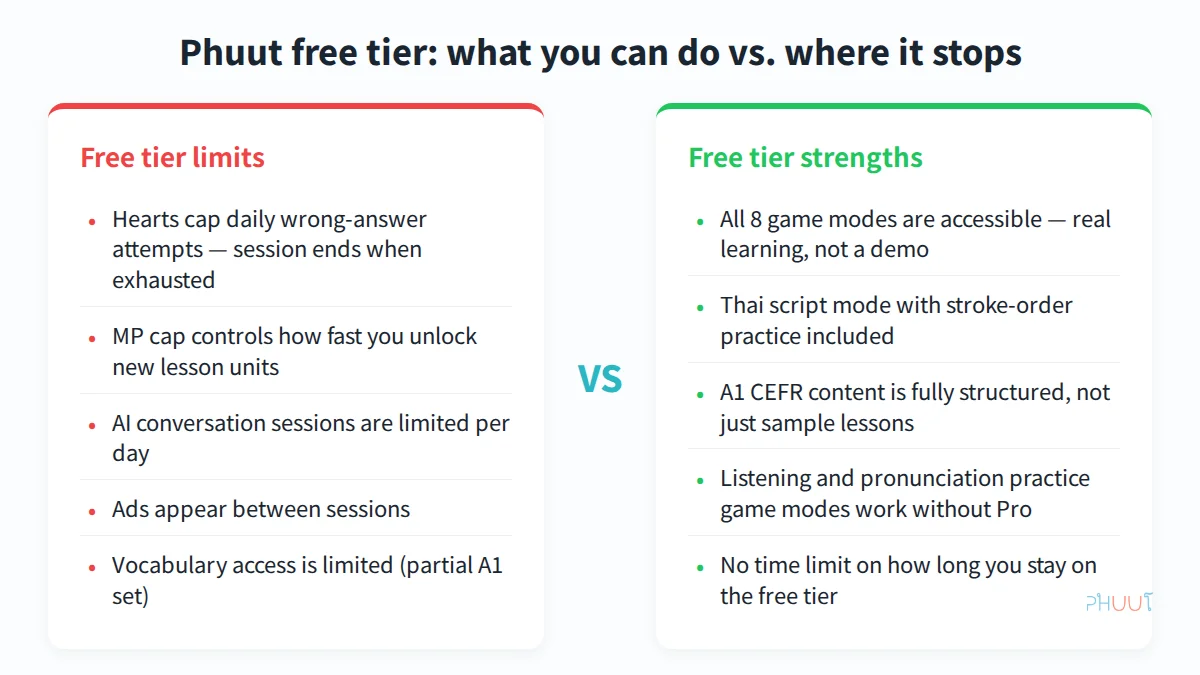
- Where the free tier stops: hearts, MP, and AI talk limits
- What Pro unlocks - and what stays the same
- Should you upgrade? A decision framework
- Key takeaways
- FAQ
What the Free Tier Actually Covers (More Than You Think)
The honest answer: Phuut’s free tier is a real learning foundation - fully functional, with no countdown clock. You can use it for weeks or months without paying anything. Phuut is free to download on the App Store for iPhone and iPad.
Here is what that means specifically.
All 8 game modes - free from day one
Phuut has eight distinct game modes, and all eight are accessible on the free tier. They are: selection quiz, listening, pronunciation practice, Thai script, typing, matching, flashcards, and Boss Battle. All eight are the actual modes with real A1 vocabulary content - fully playable from day one.
This matters because game mode variety is the mechanism that builds a daily habit. A single quiz format wears thin after a week. Eight rotating modes - including a weekly Boss Battle that tests everything you have drilled that week - create a meaningful reason to open the app tomorrow. The Boss Battle is the mode most users describe as the most memorable: you face accumulated vocabulary under pressure, and losing has a real consequence (replaying the hard words). That mechanic exists on the free tier.
Thai script mode - included, not paywalled
Thai has its own alphabet: 44 consonants, 32 vowel forms, and tone marks that carry direct phonetic meaning. Most apps either skip script entirely or limit it to passive reading within lessons. Phuut has a dedicated Thai script mode with stroke-order tracing and reading recognition practice - and it’s available on the free tier.
This inclusion matters more than it might seem. Script literacy is where most Thai learners’ pronunciation problems originate. Thai has five tones, and in written Thai, tones are encoded through a combination of consonant class, vowel length, and tone marks. A learner who can read Thai has tonal cues in the text; a learner who can only use romanization is missing those cues entirely. Getting script access on the free tier means you can start building that foundation without a subscription.
A1 CEFR content - the full structure, pace-controlled
Phuut’s curriculum covers four CEFR levels: A1 Tourist, A2 Explorer, B1 Resident, and B2 Local. The free tier gives you access to the A1 level content within a structure of 248 units, each containing five lessons - 1,240 lessons in total across the full app. The free tier’s pace is controlled by the MP system (explained in the next section), but the content is there. You are working toward a genuine milestone, just at a paced rate rather than at sprint speed.
For example, A1 vocabulary includes everyday Thai words like สวัสดี (sà-wàt-dee, “hello”) and ขอบคุณ (khàawp-khun, “thank you”) - words where tone marks the difference between a greeting and confusion. The free tier gives you full access to all 594 A1 vocabulary items across every game mode, including script tracing, listening, and pronunciation practice for each one.
Listening and pronunciation practice game modes - both functional
The listening mode and pronunciation practice game mode both work on the free tier. Listening mode trains your ear to distinguish Thai sounds before you are expected to produce them. Pronunciation practice gives you structured output reps with the same vocabulary you are drilling in other modes. Both are fully functional learning tools - the same modes you use throughout the app, applied to real A1 vocabulary.
For learners who want to explore how Phuut compares to other apps before committing, the full multi-app breakdown is in the Thai language app comparison.
The honest scope of the free tier
It is a real entry point into structured Thai learning. You can reach genuine A1 milestones - reading basic Thai characters, recognizing vocabulary in listening exercises, practicing pronunciation - without spending money.
The free tier works best for learners who practice casually (every two to three days) or who are early in their learning and want to evaluate the app before subscribing. The limits become noticeable when you start practicing daily and want to move fast. That is the subject of the next section.
Where the Free Tier Stops: Hearts, MP, and AI Talk Limits
The free tier has three friction points. They are intentional design choices that pace progression and keep the freemium model financially sustainable - and this section treats them as such. Understanding them clearly is more useful than either dismissing them or dramatizing them.
Friction point 1: Hearts
Hearts are your attempt budget within a practice session. Each incorrect answer costs one heart. When your hearts run out, the session ends - you need to wait for them to refill before continuing.
For a casual learner who practices every two or three days and gets most answers right, hearts rarely become a problem. The refill happens between sessions and you start fresh the next time you open the app.
For a daily practitioner - someone who opens the app every morning and genuinely wrestles with the hard words - hearts become a daily ceiling. Making mistakes is how you learn. If every wrong answer costs a resource that takes time to recover, you’ll eventually stop attempting the things you don’t yet know. That’s the opposite of what good learning looks like.
Friction point 2: MP (Magic Points)
MP is the currency used to unlock new vocabulary units and progress through the lesson structure. The free tier gives you MP at a rate that matches casual progression. A learner who wants to power through multiple units in a single sitting will hit the MP cap and have to wait before unlocking the next unit.
This is the limit that affects motivated learners most. If you are excited about Thai and want to move fast - a reasonable and healthy instinct - the MP cap is the thing that stops you. Specifically, it stops you from deciding for yourself when to move to the next unit.
Friction point 3: AI conversation cap
Phuut’s AI conversation practice feature lets you hold structured conversations on casual and formal topics with adjustable difficulty. On the free tier, these sessions are limited. You can try the feature, but if you want to practice speaking output as a regular part of your daily session, you’ll exhaust the free allotment quickly.
This is the limit that matters most as your learning matures. Passive drilling - recognizing vocabulary, completing listening exercises - is necessary but not sufficient. Productive output - actually forming sentences, choosing words under pressure, correcting your own pronunciation in real time - is where retention accelerates. The AI conversation feature is the gateway to that stage of learning, and the free-tier cap limits how long you spend there.
The design logic behind these limits
All three limits serve the same function: they pace the free tier for casual use and create a natural conversion point when a learner’s practice intensity outgrows casual use. The limits are calibrated to stay invisible to a learner who practices occasionally, and to become apparent only for a learner who is actively building a daily habit. The second type of learner is the one for whom Pro is designed.
What Pro Unlocks - and What Stays the Same
Phuut Pro is the same app - with every free-tier cap lifted.
What Pro unlocks
- Unlimited hearts. Your practice sessions are no longer capped by wrong answers. You can attempt difficult vocabulary as many times as you need without waiting for a refill.
- Unlimited MP. You control your own pace through the curriculum. If you want to unlock three units in a morning, nothing stops you. The A1-B2 progression becomes a timeline you set, not one the app sets.
- Unlimited AI conversation practice. This is the most impactful unlock. On Pro, you can use AI conversation practice as a daily habit - not as an occasional feature you save up for. Structured sessions on casual and formal topics, with adjustable difficulty, at whatever frequency your schedule allows. This is the shift from passive drilling to active output, and it’s the feature that most meaningfully differentiates Pro from free.
- Full vocabulary access - 3,850 words across A1-B2. Free vocabulary access is limited. Pro unlocks the full scope: 594 words at A1 Tourist, 694 at A2 Explorer, 1,125 at B1 Resident, 1,441 at B2 Local.
- No ads. Sessions are uninterrupted.
What stays the same between free and Pro
This is as important as what changes. The 8 game modes, curriculum structure, and lesson format are identical between free and Pro. Pro gives you the same experience - with all pacing limits removed.
Every mode, every lesson, every Boss Battle - it’s all the same content you’ve already been using. If the free-tier experience works for you, Pro is exactly that, minus the limits.
The practical implication: evaluate the free tier on its own merits before upgrading. If you do not enjoy the game modes, script mode, or lesson structure on the free tier, Pro will only give you more of the same. The free tier is a genuine preview of the full app - the real thing, just paced for casual use.

Learn Thai that actually leaves your mouth
Free on iOS & Android
Memorizing phrase lists doesn't help when you freeze at a food stall. Phuut runs lessons through real scenes — ordering, taxis, shopping — so the words come out when you need them.
- Scene-based lessons: street food, shopping, taxis, sightseeing
- AI role-play so you stop sounding like a phrasebook
- Native audio + Paiboon transliteration locks pronunciation in
- 5-minute sessions — preview just the scene you need today
Should You Upgrade? A Decision Framework
The free tier is genuinely capable for casual learning. The question of whether to upgrade is not “is Pro better?” - it obviously removes limits, so yes. The question is: “have I reached the point where the limits are interrupting my learning?”
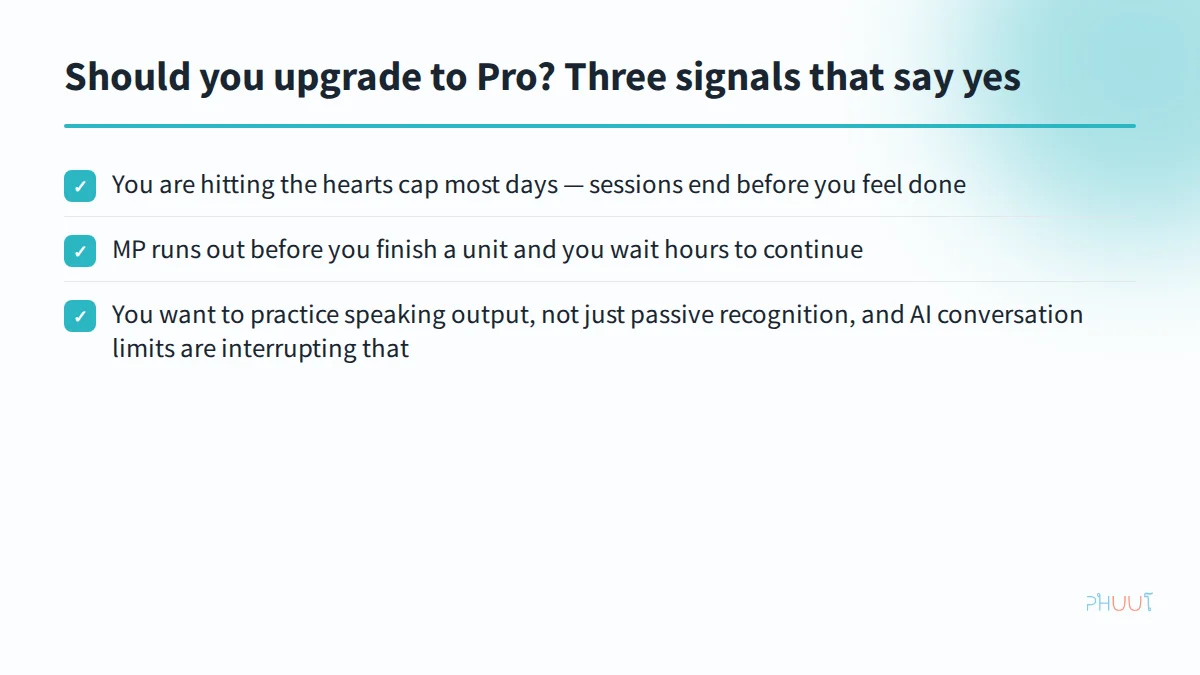
Here is the three-signal test. If two or more of these are true for you, the upgrade is worth it.
Signal 1: You hit the hearts cap most days
Your sessions end not because you finished the content, but because you ran out of hearts. You are making mistakes - which means you are genuinely challenged by the material, which is exactly right - and the cap is stopping you before you have worked through those mistakes. You find yourself waiting to come back and try again rather than resolving the difficulty in the same session.
Signal 2: MP runs out before you finish a unit
You are progressing fast enough that the MP refill rate cannot keep up. You have finished the current unit, you want to unlock the next one, and you are waiting rather than learning. This is a signal that your motivation and pace have outgrown the free tier’s design envelope.
Signal 3: AI conversation limits are interrupting your output practice
You have tried the AI conversation feature and found it useful - structured, specific, genuinely harder than passive recognition. But the session cap means you exhaust your free allocation before your practice session feels complete. You want to spend more time on output, not less.
The honest case for staying free
If you’re in your first two weeks of learning Thai, practice every two to three days, and haven’t yet hit any of the three signals above - stay free. There’s no reason to pay before you’ve tested whether the app fits your learning style. The free tier is real enough to find out.
The upgrade decision should come from your own practice data, not from a sales pitch. The three-signal test above is designed to give you that data. Check it after two weeks of regular use.
The price context
If the three signals are present and you decide to upgrade, here is the price reality.
$4.99/mo is less than the cost of one cup of coffee in most cities in North America or Europe. More usefully: it is less than the cost of a single 30-minute session with a community tutor on italki or Preply, which runs $30-70. A 60-minute session with a professional tutor on either platform runs $60-140. Pro at $4.99/mo does not replace a human tutor - but for daily drilling volume, it costs a fraction of what one tutoring session costs.
Among Thai learning apps with a full CEFR curriculum and gamification, Phuut Pro is the lowest-priced subscription in the market as of June 2026.
Human tutors provide something apps cannot: personalized correction, cultural context, and spontaneous conversation that responds to you specifically. Most committed learners use both - Phuut for daily drilling volume, a tutor for monthly or quarterly milestone sessions. At $4.99/mo, the upgrade is a minor financial decision relative to the alternatives. If the three signals are present, move forward.
A note on the Ling App comparison
The cost-comparison table includes Ling App at $15.99/mo (or approximately $6.67/mo on annual billing). Ling is the closest functional competitor in the gamified Thai app category. The monthly rate is three times Phuut’s. Annual billing closes part of the gap. Both figures are in the table so the comparison is complete and you are not reading a cherry-picked number.
The summary recommendation
Start free. Use the three-signal test after two weeks of daily practice. Upgrade when at least two signals are present. If you’re not hitting those signals, free is enough - and there’s no expiration date on the free tier. You can stay free as long as it’s working.
Learn Thai that actually leaves your mouth
Free on iOS & Android
Memorizing phrase lists doesn't help when you freeze at a food stall. Phuut runs lessons through real scenes — ordering, taxis, shopping — so the words come out when you need them.
- Scene-based lessons: street food, shopping, taxis, sightseeing
- AI role-play so you stop sounding like a phrasebook
- Native audio + Paiboon transliteration locks pronunciation in
- 5-minute sessions — preview just the scene you need today
Start Learning Thai Free - Upgrade Only When You Need To
Thai is easier to start than you think - and it costs nothing to find out.
All 8 game modes, Thai script, and real A1 lesson content - no payment required. Upgrade to Pro at $4.99/mo when the free-tier limits start interrupting your daily practice.
Learn Thai that actually leaves your mouth
Free on iOS & Android
Memorizing phrase lists doesn't help when you freeze at a food stall. Phuut runs lessons through real scenes — ordering, taxis, shopping — so the words come out when you need them.
- Scene-based lessons: street food, shopping, taxis, sightseeing
- AI role-play so you stop sounding like a phrasebook
- Native audio + Paiboon transliteration locks pronunciation in
- 5-minute sessions — preview just the scene you need today
Learn Thai that actually leaves your mouth
Free on iOS & Android
Memorizing phrase lists doesn't help when you freeze at a food stall. Phuut runs lessons through real scenes — ordering, taxis, shopping — so the words come out when you need them.
- Scene-based lessons: street food, shopping, taxis, sightseeing
- AI role-play so you stop sounding like a phrasebook
- Native audio + Paiboon transliteration locks pronunciation in
- 5-minute sessions — preview just the scene you need today