
No Thai on Duolingo? 4 Best Alternative Apps (2026)
Affiliate disclosure: This article contains affiliate links. We may earn a small commission at no extra cost to you. As an Amazon Associate, we earn from qualifying purchases.
About the reviewer

Ramy Hirano
Phuut Founder
Founder of Phuut. Has observed how Japanese and English speakers stumble on Thai and built learning products around those patterns.
Follow Phuut on X →You opened Duolingo to learn Thai, searched “Thai,” and found nothing. You’re not missing it. As of June 2026, there is no Thai course on Duolingo - and this isn’t a temporary gap. The bus isn’t late; the route was shut down.
This article does two things. First, it explains why Duolingo has no Thai - a structural reason, not a coincidence. Then it compares four apps you can actually use instead, rated on the three things that matter for Thai: tone support, how well the games keep you coming back, and price.
Why Duolingo Has No Thai - And Why It’s Not Coming
The question is fair: Duolingo teaches Mandarin and Vietnamese, both tonal. Why not Thai?
The answer is in how Duolingo built its non-flagship courses. For years, smaller-language courses came through the Incubator - volunteer teams who built and submitted a course for review. Thai was submitted. It never graduated. The course didn’t clear the quality bar needed for public beta, and then, in 2021-2022, Duolingo wound the Incubator down. The channel that Thai would have entered no longer operates.
That leaves Duolingo’s core product team. Their roadmap targets the largest markets - European languages, Hindi, Arabic, Korean. Thai is a Category IV FSI language, the hardest tier for English speakers, with a smaller global learner base than Spanish or Mandarin. From a pure product-economics view, the resources go elsewhere.
Why Duolingo has no Thai course - Duolingo’s Incubator let volunteer teams build non-flagship courses. Thai was submitted but never reached the quality bar to graduate to public beta, and the Incubator was wound down in 2021-2022. Duolingo’s current expansion focuses on its largest addressable markets - European languages, Hindi, Arabic, Korean. Thai is a Category IV FSI language (one of the hardest for English speakers) with a comparatively small learner market. It is not on Duolingo’s public roadmap as of June 2026. The gap is structural.
So when does Thai arrive? On the public evidence, not soon. There’s no roadmap entry and no announcement as of June 2026. If you want to start now, waiting isn’t a plan - a different app is.
Here’s the useful part: what made Duolingo work for you isn’t exclusive to Duolingo. The daily streak, the short sessions, the immediate feedback, the free entry tier - those habit-loop mechanics are reproducible. The Thai apps below have them. What a Thai replacement needs to add is the part Duolingo could never deliver for Thai: script, and real tone feedback. That’s the bar.
4 Best Duolingo Alternatives for Thai - Compared on 3 Axes
If you’re used to Duolingo, judge any Thai app on three things, in this order.
1. Tone support. Thai’s biggest wall isn’t vocabulary - it’s tone. The real test isn’t whether an app has a “speech check.” It’s whether the app tells you which of the five tones you actually produced. Those are different features, and the gap between them decides how fast you improve.
2. Gamification quality. Will the app survive a busy week and a bad mood, or does it lean entirely on your willpower? A streak counter and one quiz format isn’t the same as a rotation of game modes that gives you a reason to open it tomorrow.
3. Price. Thai isn’t a two-week project. The monthly cost compounds, so it’s worth knowing up front.
Why tones make a Thai app’s feedback decisive - Thai has 5 tones: mid, low, falling, high, and rising. The same syllable means different things depending on tone - “maa” can mean come, dog, or horse. Generic speech recognition built for European languages doesn’t distinguish these tones; it only checks whether a word was recognized. A Thai app with useful pronunciation feedback needs tone-specific detection in its speech model - not just a pass/fail “you were understood.” The first question to ask of any Thai app is: does it tell you which tone you produced, or only whether you were understood?
Line the four apps up against those axes and the trade-offs get clear (June 2026, based on each company’s public information).
| Axis | Phuut | Ling | ThaiPod101 | uTalk |
|---|---|---|---|---|
| Thai focus | Thai-only | 1 of 60+ languages | Thai-only | Multi-language |
| Game modes | 8 (tone-specific design) | Yes (no tone-specific game) | Few | Some game feel |
| Tone feedback | AI, by tone category | Pronunciation pass/fail | Audio playback only | Audio playback only |
| Thai script | Dedicated mode (handwriting) | Yes | Yes | Limited |
| AI conversation | Yes (topic + level) | Chatbot | Limited | No |
| CEFR roadmap | A1-B2 aligned | Own levels | Own levels | Own levels |
| Price / mo | $4.99 | ~$14-15 (est.) | ~$13+ (est.) | ~$10+ (est.) |
| Free tier | All 8 games + AI tone feedback (limited) | Some lessons | Some content | Some lessons |
Competitor prices are estimates based on what was publicly visible in June 2026 and may vary by region and plan. Phuut’s $4.99/month is from its official pricing.
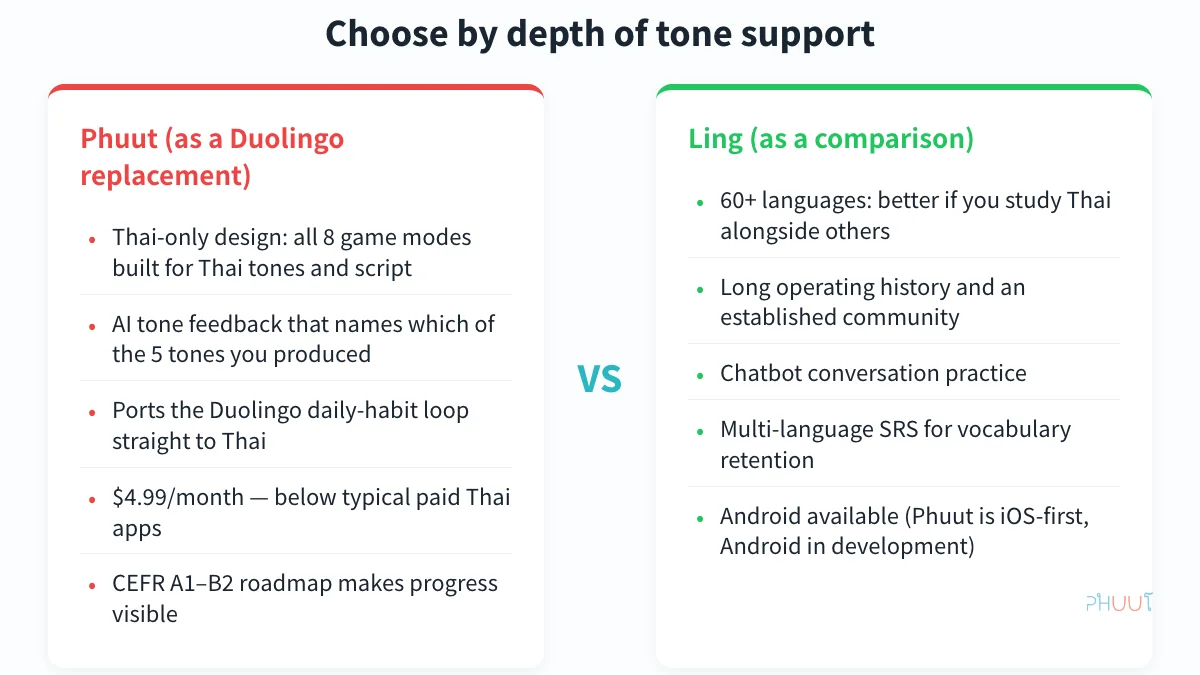
Phuut is built as a Thai-only app, and its 8 game modes - selection quiz, listening, pronunciation, Thai script, typing, matching, flashcards, and Boss Battle - are all designed around Thai’s specifics, tones and script especially. Its AI feedback names which tone category it heard, so you can see which of your tones is drifting. At $4.99/month it’s the lowest-priced option here. The weakness: it’s iOS-first, with Android still in development.
Ling has a real strength Phuut doesn’t - 60+ languages in one app, which matters if you’re studying Thai alongside others. Its Thai course is solid and it runs on both iOS and Android. The trade-offs: tone feedback is pass/fail rather than tone-by-tone, and the price (~$14-15/month, est.) is well above Phuut.
ThaiPod101 has a deep library of Thai audio and video, with careful grammar and culture explanations. If you learn best by listening, it fits. The weakness for a Duolingo refugee: the game feel is thin compared with Phuut or Ling, so it’s a poor pick if the streak-and-play loop is what kept you going.
uTalk is phrase-first and good for short pre-trip prep - it has some game feel. But it has no real tone feedback, which is exactly the part that matters most for Thai. Treat it as a phrasebook with a quiz, not a tone trainer.
Now the direct Duolingo-vs-Phuut view, since that’s the swap you’re actually making.
| Feature | Duolingo (reference) | Phuut (replacement) |
|---|---|---|
| Thai course | None (as of June 2026) | Thai-only |
| Learn by games | Game-first format | 8 game modes |
| Tone practice | - (no Thai) | Tone game + AI feedback |
| Thai script | - (no Thai) | Handwriting mode |
| Free trial | Much is free | All 8 games + AI tone feedback (limited) |
| Paid / mo | ~$7+ (Super, est.) | $4.99 |
If you want the AI side compared in depth - the different types of AI Thai tutor and how to pick one - read the types of AI Thai tutor and how to choose, and for spoken practice specifically, AI conversation practice for Thai, in depth. For a broader, non-Duolingo roundup that also covers Talkpal, see how Phuut, Ling, and Talkpal compare on games, AI, and price. And if you want to understand the wall itself first, why Thai’s 5 tones are the real difficulty is the place to start.
Why Phuut Fits Duolingo Users Best
Full disclosure: I build Phuut. I started it because I kept wanting a Thai app that felt like the Duolingo habit - short daily sessions, games, instant feedback - but that could actually train tones by ear and voice. Text and video never closed that gap for me.
The reason Phuut is an easy switch for Duolingo users is that most of the Duolingo loop is already here. You don’t have to relearn how to study.
What carries over from Duolingo:
- Selection-quiz questions
- Listening exercises
- Matching games
- A hearts system (mistakes have a limit)
- A daily-habit streak design
That overlap is the point. Less “learn a whole new app,” more “same loop, now for Thai.”
What Duolingo couldn’t do for Thai - and Phuut does:
A tone-specific game plus AI tone-category feedback. In pronunciation mode, your attempt comes back as “leaning toward rising” or “that read as falling - the target was low,” so a tone you keep missing finally becomes visible instead of just wrong. There’s a dedicated Thai script mode where you don’t only type - you practice handwriting, the way Duolingo lets you trace kana for Japanese. And there’s AI Talk: pick a topic (travel, daily life, food) and a difficulty, then speak Thai in a setting where mistakes don’t cost you anything. That speak-plus-feedback loop is the piece Duolingo’s format never had for Thai.
Your first week, concretely:
- Step 1: Install Phuut free → spend 5 minutes on the tone-ID game to start tuning your ear to the 5 Thai tones.
- Step 2: Play A1 (Tourist level) for 7 days → lock in street-food, greeting, and number phrases through games.
- Step 3: Move to AI Talk → speak real Thai in a no-embarrassment setting - the speak-plus-feedback loop Duolingo never had.
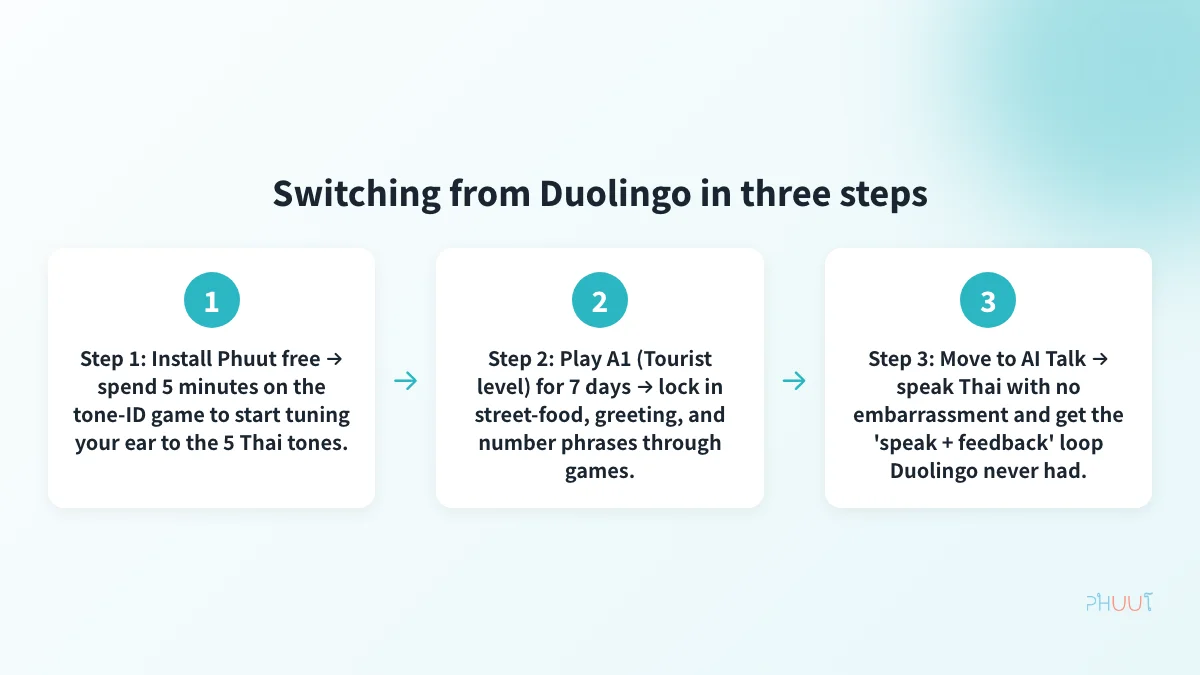
The free tier opens all 8 game modes and AI tone feedback, so you can run that whole week before paying anything. The “start free, then decide” entry is the same instinct Duolingo trained into you.

Build a Thai habit that actually sticks
Free on iOS & Android
Willpower isn't a strategy. Phuut bakes proven learning science into the app so you just need to tap for 5 minutes a day.
- Spaced repetition (SRS) tuned to forgetting curves
- CEFR A1–B2 and Thai proficiency-test vocabulary only
- Paiboon transliteration fixes the read-but-can't-speak gap
- Free on iOS & Android — the structure handles the discipline for you

Once an app has built your base - tones and phrases - the fastest next step is talking to a real person. On italki you can find native Thai tutors for 1-on-1 lessons and get human feedback on your pronunciation. The app builds the foundation; a tutor adds output practice. They complement each other, and learners who do both tend to move faster than those who do either alone.
Pick by Goal - Trip Prep, Drama, or Serious Self-Study
The right app depends on why you’re learning. Here’s how the choice shifts by goal.
Prepping for a trip, short timeline. Go with Phuut’s A1 (Tourist level). Ordering at a street stall, greetings, telling a taxi where to go - the core travel phrases are designed to land in about 7-14 days of play. At $4.99/month, paying for just the weeks around your trip is cheap.
Understanding Thai dramas. Start with tone listening - that’s the base. As your ear sorts the five tones, drama lines stop being a blur of sound. By A2 (Explorer level) your vocabulary reaches around 1,288 words, which covers a lot of everyday drama dialogue, and using AI Talk to actually say the phrases you’ve heard makes them stick faster.
Serious self-study. Run Phuut’s A1-B2 roadmap (about 3,850 words across 1,240 lessons) for structured input, and pair it with a native tutor for output. App for the system, tutor for the conversation - that two-track setup pushes past what self-study alone tops out at. If you want to weigh apps purely on features first, how to choose the best Thai learning app lays out the criteria.
Studying several languages at once. This is where Ling earns its place - a 60+ language ecosystem in one app is genuinely convenient if you’re juggling Thai with others. Its tone feedback doesn’t go as deep as Phuut’s, but if unified management is your priority, that’s a fair trade.
Your first step - three moves:
- Install Phuut free (iOS).
- Spend 5 minutes on the tone-ID game.
- See if it fits your style before considering Pro at $4.99/month.
One note for Android users: Phuut is iOS-first, with Android in development. Until it ships, starting on Ling or ThaiPod101 and switching to Phuut when its Android version arrives is a reasonable order.
The Short Version
There’s no Thai course on Duolingo as of June 2026, no announcement, and no roadmap entry - so the realistic move is to pick a replacement and start now.
For the closest “Duolingo feel” applied to Thai, Phuut is the strongest match: 8 game modes, AI tone-category feedback, a CEFR A1-B2 roadmap, and $4.99/month - built so a Duolingo user doesn’t have to relearn how to study. The first step is small: install it free and spend five minutes on the tone-ID game. That alone shows you what comes next.
Will Duolingo add Thai? Almost certainly not in the near term. The Incubator - through which volunteer teams built non-flagship courses - was wound down in 2021-2022, and Thai never graduated. Thai is not on any Duolingo roadmap or announcement as of June 2026. If you want to start now, an alternative app is the realistic choice.
Which Thai app feels most like Duolingo? Phuut is the closest. It has 8 game modes - selection quiz, listening, matching, flashcards, Boss Battle, and more - built around the same “short daily session” loop. It adds a tone-specific game and AI tone feedback that Duolingo never had for Thai, so for Thai it does more than Duolingo’s format could.
Phuut or Ling - how do I choose? Choose Phuut if you want to focus on Thai (Thai-only, 8 tone-aware games, $4.99/month). Choose Ling if you also study other languages or want its multi-language ecosystem. Tone feedback is deeper on Phuut (by tone category vs pass/fail), based on public information as of June 2026.
Can I start for free? Yes. Phuut’s free tier opens all 8 game modes and AI tone feedback (with daily heart limits; AI conversation is turn-limited). Try it for a week before deciding on Pro at $4.99/month.
Build a Thai habit that actually sticks
Free on iOS & Android
Willpower isn't a strategy. Phuut bakes proven learning science into the app so you just need to tap for 5 minutes a day.
- Spaced repetition (SRS) tuned to forgetting curves
- CEFR A1–B2 and Thai proficiency-test vocabulary only
- Paiboon transliteration fixes the read-but-can't-speak gap
- Free on iOS & Android — the structure handles the discipline for you
Build a Thai habit that actually sticks
Free on iOS & Android
Willpower isn't a strategy. Phuut bakes proven learning science into the app so you just need to tap for 5 minutes a day.
- Spaced repetition (SRS) tuned to forgetting curves
- CEFR A1–B2 and Thai proficiency-test vocabulary only
- Paiboon transliteration fixes the read-but-can't-speak gap
- Free on iOS & Android — the structure handles the discipline for you