
Thai Travel Phrases: Your Last 3 Days Before the Flight
Affiliate disclosure: This article contains affiliate links. We may earn a small commission at no extra cost to you. As an Amazon Associate, we earn from qualifying purchases.
About the reviewer

Ramy Hirano
Phuut Founder
Founder of Phuut. Has observed how Japanese and English speakers stumble on Thai and built learning products around those patterns.
Follow Phuut on X →Your flight to Thailand is in three days. You haven’t learned a word of Thai. The question isn’t whether to learn it - it’s whether you can learn anything useful in the time you actually have.
You can. With one constraint: 15 Thai travel phrases to learn before your trip, studied in the right order across three 15-minute evening sessions. Not 50 phrases. Not 7 days. Just 15, in priority order, with a method that actually works at this timescale.
This article gives you the 15 phrases and the 3-evening plan to lock them in before you board.
In this article:
- Why 15 phrases and not 50 - the 3-day constraint
- The 15 Thai travel phrases, in priority order
- Your 3-evening study plan before departure
- How Phuut makes 15-20 minutes actually work
- When a phrase doesn’t land
Why 15 Phrases and Not 50: The 3-Day Constraint
Three days is a specific problem, and most travel-Thai articles make it worse.
Browse any “Thai phrases for tourists” list and you’ll find 50 entries, sometimes more. Reading through them feels productive. Then close the tab and ask yourself which phrase comes first - and usually nothing surfaces. The list looked comprehensive and disappeared anyway.
The problem isn’t memory. It’s the method. 50 unfamiliar phrases in 72 hours is a memorization sprint, and sprints without a built-in review structure don’t hold. The last 30 phrases wash out before you land. You arrive with a foggy half-memory of a list, which is exactly as useful as arriving with no list at all.
The constraint makes the method work. 15 phrases at 15-20 minutes over 3 evenings is the threshold at which spaced repetition functions properly. Your brain encounters each phrase at the interval it needs to convert short-term recognition into accessible production - the kind that comes out when you’re jet-lagged and standing at a food stall with a queue behind you. Expand the list to 50 and neither the schedule nor the method holds together.
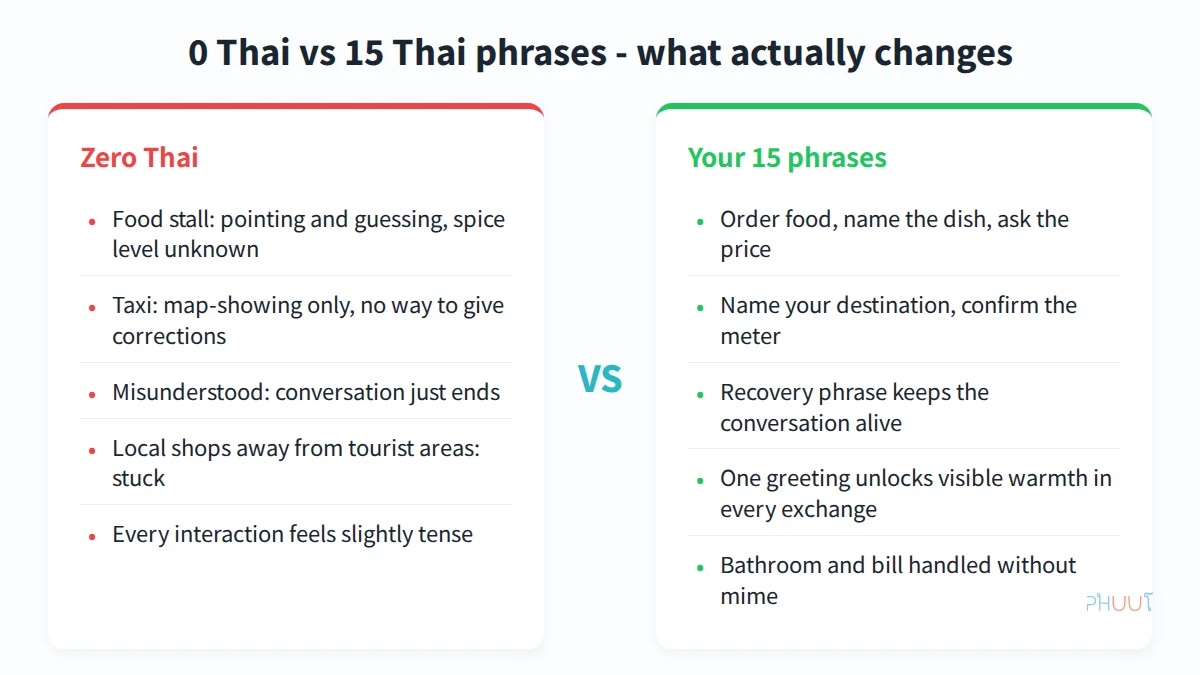
What 15 phrases actually covers: five scenarios that account for most of the moments where Thai would help on a short trip.
- Greetings: three phrases that open every interaction
- Recovery lifelines: three phrases for when a tone goes wrong and you need to stay in the conversation
- Food and street stalls: the workhorse phrases for ordering, spice level, complimenting, and price
- Getting around: destination, stop, and the meter check
- Situational saves: bathroom and the bill
That’s not everything Thailand might ask of you. It’s the minimum viable set - the phrases that cover the most frequent, highest-stakes moments with the lowest total time investment before your flight.
Set the expectation now: this is not fluency prep. It’s “get your first line out by reflex” prep. That’s a meaningfully different goal, and it’s achievable in 3 days.
If you have a full week before your trip, you can go further with the 7-day Thai prep plan.
The 15 Thai Travel Phrases, in Priority Order
These 15 phrases are organized by scenario. The order is not alphabetical or by difficulty - it’s by the sequence you’ll actually need them. Recovery phrases appear before food and transport because the first interaction in Thailand is often the hardest, and that’s when recovery matters most.
Group 1: Greetings (phrases 1-3)
สวัสดีครับ/ค่ะ (sawatdii khrâp/khâ) opens every exchange in Thailand. It works as both hello and goodbye. Use it at the start of every interaction - every shop, every taxi, every hotel desk, every food stall. No exceptions.
ขอบคุณครับ/ค่ะ (khàawp-khun khrâp/khâ) is your second-most-used phrase. After any food delivery, any help, any service. Say it even when nothing significant happened. The habit costs nothing and builds consistent goodwill across every interaction.
ไม่เป็นไร (mâi pen rai) means “no problem” or “you’re welcome.” It also doubles as a mood-setter. When someone bumps into you, when service takes longer than expected, when any small thing goes wrong - this phrase signals that you’re a relaxed visitor, not a demanding one. Thai people use it constantly. When a foreigner uses it back, the effect is immediate and warm.
Group 2: Recovery lifelines (phrases 4-6)
These come second in the list - before food, before transport. The reasoning is tactical: tone errors happen in the first conversation, not after you’ve warmed up. Without recovery phrases, one failed interaction ends the attempt. With them, you stay in the conversation.
พูดช้าๆ ได้ไหมครับ/ค่ะ (phûut cháa cháa dâi mǎi khrâp/khâ) means “could you speak slowly?” Use it when a response comes too fast to follow. Thai people almost always slow down when asked this. The phrase signals effort and buys a second attempt.
พูดอีกทีได้ไหมครับ/ค่ะ (phûut ìik thii dâi mǎi khrâp/khâ) is “could you say that again?” For the moments when you caught the first word but lost the rest. Often that’s enough to reconstruct the meaning on the second pass.
ไม่เข้าใจครับ/ค่ะ (mâi khâo jai khrâp/khâ) means “I don’t understand.” It’s an honest signal, not a defeat. In many situations, it prompts the other person to switch to English - which is a perfectly acceptable outcome. Saying this phrase is a strategy, not a failure.
Group 3: Food and street stalls (phrases 7-10)
อันนี้ครับ/ค่ะ (an-nii khrâp/khâ) - “this one” - is the workhorse of any Thailand trip. Point at the dish or item as you say it. This single phrase plus a gesture handles most street stall ordering without requiring any further Thai.
ไม่เผ็ดครับ/ค่ะ (mâi phèt khrâp/khâ) means “not spicy.” If you have any spice limit at all, this phrase is non-negotiable. Say it before you finish ordering, not after the bowl arrives.
อร่อยมากครับ/ค่ะ (a-ròi mâak khrâp/khâ) means “very delicious.” Use it after eating. This is perhaps the highest-return phrase per syllable on the entire list - the reaction from street food vendors when a foreign visitor says this with something close to the right tones is immediate and genuine. It costs nothing and often changes the entire atmosphere of the interaction. The first time I said it at a night market stall - pointing at an empty bowl of pad kra pao - the vendor called her daughter over to listen to the foreigner say it again. Both of them grinned. That’s not an exaggeration of what this phrase does; it’s just what happens.
เท่าไหร่ครับ/ค่ะ (thâo-rài khrâp/khâ) is “how much?” Works at markets, stalls, and anywhere a price isn’t displayed. Holds the phrase open for any purchase context.
Group 4: Getting around (phrases 11-13)
ไป (place name) ครับ/ค่ะ (pai (place name) khrâp/khâ) - “(destination), please” - works for any taxi or tuk-tuk. Say the destination name or show it on your phone. The frame phrase tells the driver you want to go somewhere; the name fills in the where. Short, clear, complete.
จอดตรงนี้ครับ/ค่ะ (jòt trong-nii khrâp/khâ) is “stop here.” Use it when you’re close and need to fine-tune the drop-off point. More precise than pointing and hoping.
เปิดมิเตอร์ไหมครับ/ค่ะ (pèrt mí-dtəə mǎi khrâp/khâ) means “use the meter?” Say it before you get in. Drivers who plan to quote a flat rate will usually switch to the meter when politely asked. This is the most financially important phrase in this group.
Group 5: Situational saves (phrases 14-15)
ห้องน้ำอยู่ที่ไหนครับ/ค่ะ (hông-náam yùu thîi-nǎi khrâp/khâ) - “where is the bathroom?” - has high frequency and no reliable mime workaround. The phrase is longer than most in this list, but you’ll be grateful you drilled it.
เก็บตังค์ด้วยครับ/ค่ะ (kèp dtang dûai khrâp/khâ) means “check, please.” Snapping your fingers or miming writing works in tourist-area restaurants. At local spots, this phrase is faster and more polite.
For a deeper breakdown of vocabulary thresholds beyond these 15, see the survival 50 and beyond.
Your 3-Evening Study Plan Before Departure
The plan is built around evenings, not days. You’re studying in the three evenings before your flight, at 15-20 minutes per session. No airport cramming, no inflight study. Just three calm evening sessions that follow a specific order.
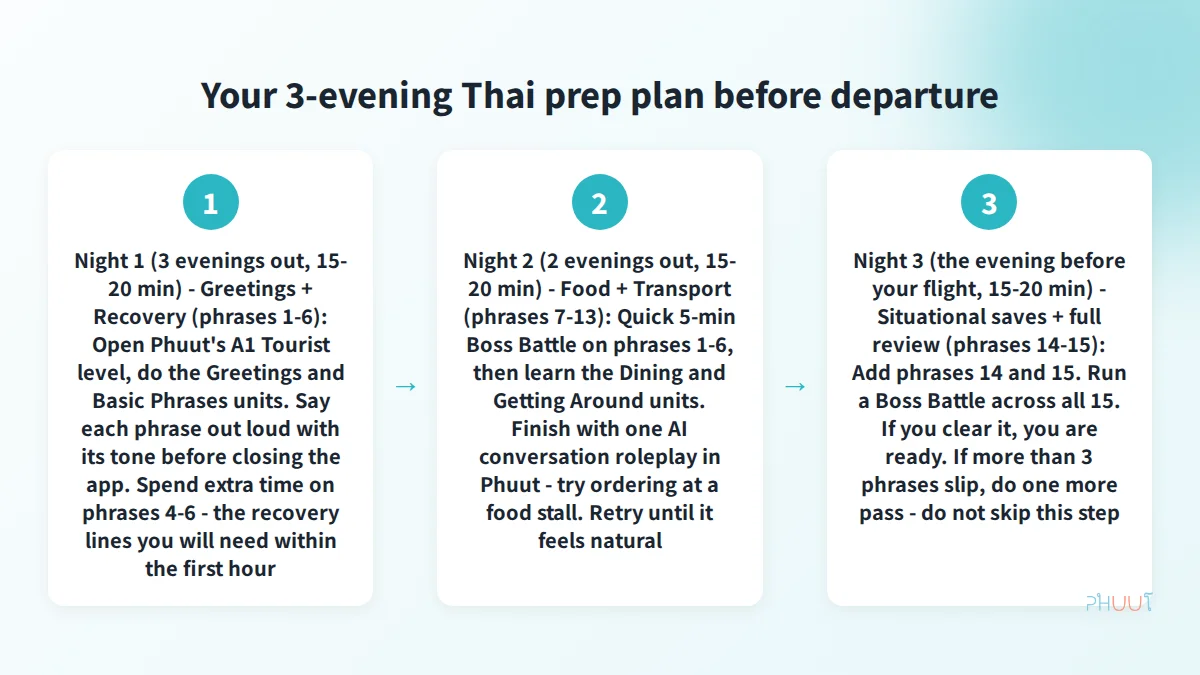
Night 1: Greetings + Recovery (phrases 1-6)
Open Phuut’s A1 Tourist level and run the Greetings and Basic Phrases units. Say each phrase out loud - not silently, but spoken. Your mouth needs to practice the shape, not just your eyes.
Spend extra time on phrases 4-6. These are the recovery lines you’ll reach for in the first hour on the ground. Getting misunderstood in a taxi at the airport is almost guaranteed when you’re jet-lagged and arriving in a new country. Phrases 4-6 are what keeps you in the conversation when that happens.
Before you close the app, run through all 6 from memory. If any slip, do one more pass.
Night 2: Food + Transport (phrases 7-13)
Start with a 5-minute Boss Battle on phrases 1-6. Boss Battle is Phuut’s built-in full-deck review mode - it decides which phrases to test and in what order. If you clear it in under 5 minutes, phrases 1-6 are solid.
Then open the Dining and Getting Around units and work through phrases 7-13. End the session with one AI conversation roleplay. Choose the food stall scene and try a full order using the phrases from Group 3. Retry until the sequence feels natural before you close the app for the night.
Night 3: Situational saves + full review (phrases 14-15)
Add phrases 14 and 15 first. Spend 5 minutes drilling just those two. Then run a Boss Battle across all 15.
If you clear it, you’re ready to fly.
If more than 3 phrases slip, do one more pass through the weak ones. Don’t skip this. It’s the difference between phrases you recognize when prompted and phrases that come out when a vendor is looking at you and there’s noise everywhere.
How Phuut Makes 15-20 Minutes Actually Work
The 3-evening plan works because the tool matches the method. Three specific things in Phuut make 15-20 minute sessions effective rather than frustrating.
Spaced repetition is built in. Phuut surfaces each phrase at the interval where your brain is about to forget it - the core mechanism of spaced repetition learning (SRS). Across 3 sessions at 15-20 minutes each, your 15 phrases get reviewed approximately 5-7 times total, spaced at increasing intervals. You’re not relying on willpower or a random self-quiz. The app’s schedule is the study plan. Follow it.
8 game modes keep the same 15 phrases fresh. Multiple choice, listening, pronunciation, Thai script, typing, matching, flashcard, and Boss Battle. Each mode drills the same phrases in a different cognitive format. Listening mode exposes a specific gap that the other modes won’t show you: you can recognize a phrase when it appears on screen and still miss it when it plays as audio first - and audio-first is exactly the format you’re facing at a noisy Bangkok street stall. The variety keeps the same 15 phrases feeling like a different task each session. The game format stops the session from feeling like homework, which matters when you’ve had a full day and you’re studying Thai at 10pm.
The A1 Tourist level already sets the priority list. Phuut’s A1 Tourist level covers 594 words built around travel scenarios. Open it and the Greetings, Basic Phrases, Dining, and Getting Around units come up first. You don’t decide what to study on Night 2 - the app already has the right answer. Follow the unit order and you’re following the 3-evening plan.
Total curriculum: 1,240 lessons across 3,850 words at four levels (A1 to B2). For this sprint, A1 Tourist is all you need. The free plan covers all 15 phrases in this guide and includes the Boss Battle review. Unlimited AI conversation practice is a Pro feature at $4.99/month - worth trying if you want more roleplay rounds before departure, but the 3-day sprint is fully achievable without it.
Duolingo does not offer a Thai course as of July 2026. For a side-by-side breakdown of what’s actually available, see what to use instead of Duolingo for Thai.

Learn Thai that actually leaves your mouth
Free on iOS & Android
Memorizing phrase lists doesn't help when you freeze at a food stall. Phuut runs lessons through real scenes — ordering, taxis, shopping — so the words come out when you need them.
- Scene-based lessons: street food, shopping, taxis, sightseeing
- AI role-play so you stop sounding like a phrasebook
- Native audio + Paiboon transliteration locks pronunciation in
- 5-minute sessions — preview just the scene you need today
When a Phrase Doesn’t Land
It will happen. You say the phrase. The vendor’s expression doesn’t match what you expected. You try again. Nothing connects.
Phrases 4-6 are already in your 15 for exactly this reason. Recovery phrases aren’t a backup plan - they’re part of the plan from the first evening. When something doesn’t land, you don’t restart from zero. You stay in the conversation with the tool you prepared.
The two most common failure modes in 3 days of prep:
Tone on mâi goes wrong. The negative marker mâi appears in three of your 15 phrases: mâi phèt (not spicy), mâi pen rai (no problem), and mâi khâo jai (I don’t understand). mâi uses a falling tone - your pitch drops from mid to low across the syllable. If it rises or stays flat instead, a different syllable comes out. Drill the falling tone on mâi during Night 1 specifically. When one of these phrases fails, this is the most likely reason.
The listener is in a noisy environment and didn’t catch you. Market stalls and street kitchens are loud. The fix is simple: say the phrase once more, slightly louder, and point at the same time. The combination of a recognizable word shape and a clear gesture usually lands on the second attempt.
The posture that makes both scenarios manageable: you’re a traveler who made an effort, not a linguist defending a grade. The effort is visible in every attempt, even the mispronounced ones. Thai people read the effort as respect, and that changes how they respond - often more than whether the phrase itself was perfect.
If you want a native speaker to confirm which tones are landing before you fly, a single 30-minute session with a Thai tutor catches the specific errors that self-study can’t calibrate the same way. It’s a focused use case: you have your 15 phrases rehearsed and you want human feedback on tone accuracy before departure.

For the complete phrase set for Bangkok taxis beyond these 15, see Thai taxi phrases for Bangkok.
After your trip, if you want to build beyond 15 phrases, 40 essential Thai phrases for daily conversation is the natural next step.
Three days is enough for 15 phrases if you keep the constraint. Recovery phrases first, then food, then transport. Fifteen minutes per evening in Phuut, three sessions, Boss Battle on Night 3. The goal isn’t fluency - it’s the first line coming out without thinking, and the look on the vendor’s face that follows. Download Phuut, open A1 Tourist, and start tonight with the greetings unit.
Learn Thai that actually leaves your mouth
Free on iOS & Android
Memorizing phrase lists doesn't help when you freeze at a food stall. Phuut runs lessons through real scenes — ordering, taxis, shopping — so the words come out when you need them.
- Scene-based lessons: street food, shopping, taxis, sightseeing
- AI role-play so you stop sounding like a phrasebook
- Native audio + Paiboon transliteration locks pronunciation in
- 5-minute sessions — preview just the scene you need today
Learn Thai that actually leaves your mouth
Free on iOS & Android
Memorizing phrase lists doesn't help when you freeze at a food stall. Phuut runs lessons through real scenes — ordering, taxis, shopping — so the words come out when you need them.
- Scene-based lessons: street food, shopping, taxis, sightseeing
- AI role-play so you stop sounding like a phrasebook
- Native audio + Paiboon transliteration locks pronunciation in
- 5-minute sessions — preview just the scene you need today