
Thai Taxi Phrases: 12 Lines for Bangkok Cabs (2026)
Affiliate disclosure: This article contains affiliate links. We may earn a small commission at no extra cost to you. As an Amazon Associate, we earn from qualifying purchases.
About the reviewer

Ramy Hirano
Phuut Founder
Founder of Phuut. Has observed how Japanese and English speakers stumble on Thai and built learning products around those patterns.
Follow Phuut on X →You booked the trip, downloaded Grab, and figured Thai was optional. For most of your rides, it is - Grab handles the airport run, the mall, the restaurant with a clean map pin. But Bangkok still has three moments where the app leaves you on your own, and in those moments a handful of thai taxi phrases is the difference between relaxed and rattled.
This isn’t a Thai course. It’s the 12 phrases - plus a 5-step ride flow - you can absorb in five minutes before your flight. Every line here is A1 beginner level. Grab stays your easy default; Thai is just the backup for the rides it can’t reach.
Jump to a section:
- Grab covers most rides - but three moments still need Thai
- How to ride a metered taxi in 5 steps
- Telling the driver where you mean
- When the ride goes sideways
- Practice the three lines that matter
- Thai taxi phrases - FAQ
Grab Covers Most Rides - But Three Moments Still Need Thai
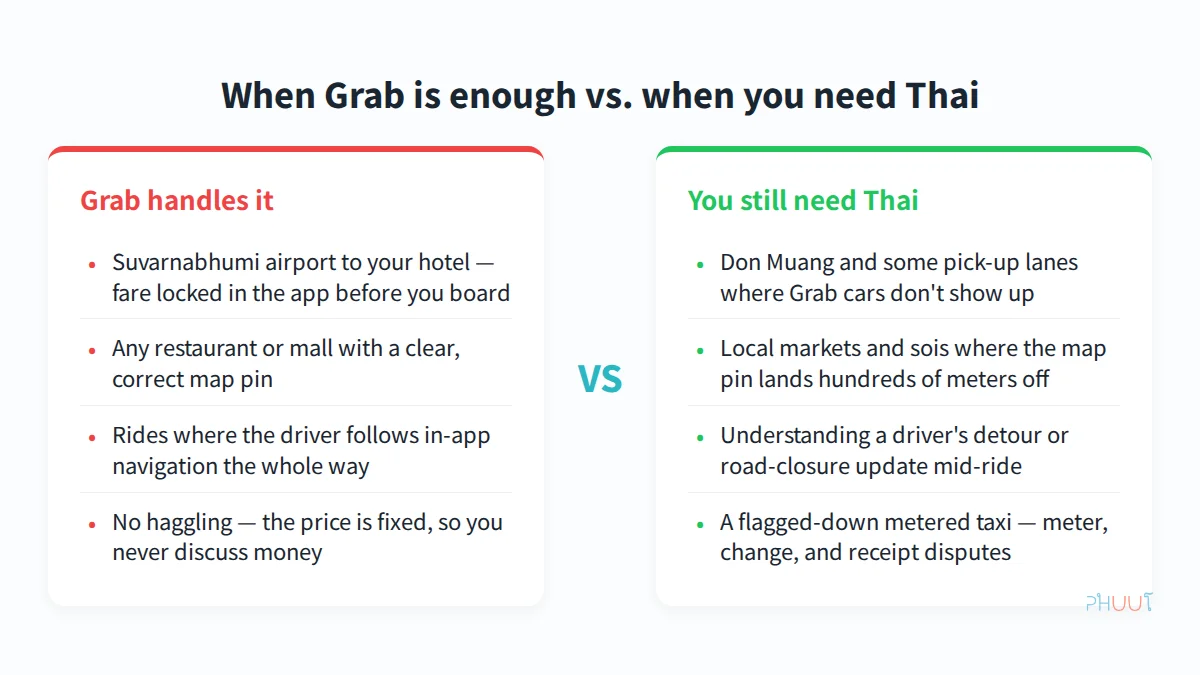
Most English-language taxi-phrase guides were written before Grab took over, so they treat every Bangkok ride as a haggle. The honest 2026 framing is the opposite. Grab handles the large majority of a traveler’s rides cleanly - fare locked in the app, no money talk, the driver following navigation the whole way. This article is about the remaining slice that Grab can’t reach.
There are three of those moments, and naming them is the whole point.
Moment 1 - the Don Muang flag-down. Suvarnabhumi has clean, well-signed Grab pick-up zones. Don Muang doesn’t - some lanes never surface a Grab car at all, and a first-timer can get funneled straight to the regular metered-taxi rank. That’s a metered taxi, and a metered taxi needs Thai.
Moment 2 - the wrong map pin. Inside Chatuchak, at the far gate of a temple, at a hotel’s service entrance - Grab’s pin can land hundreds of meters from where you actually want to be. The app got you close; a spoken correction gets you there.
Moment 3 - the post-cancellation street taxi. A Grab gets cancelled once or twice on most trips. When it does, you’re flagging down a street taxi at the curb, and “use the meter” in Thai is suddenly the line that protects your fare.
So this is your kit, not a course: 12 phrases, one 5-step ride flow, and three dispute lines for when things get tricky. For the wider picture - markets, beaches, day trips - the full summer travel phrase guide covers the rest of your week in Thailand. Here, we stay in the cab.
How to Ride a Metered Taxi in 5 Steps
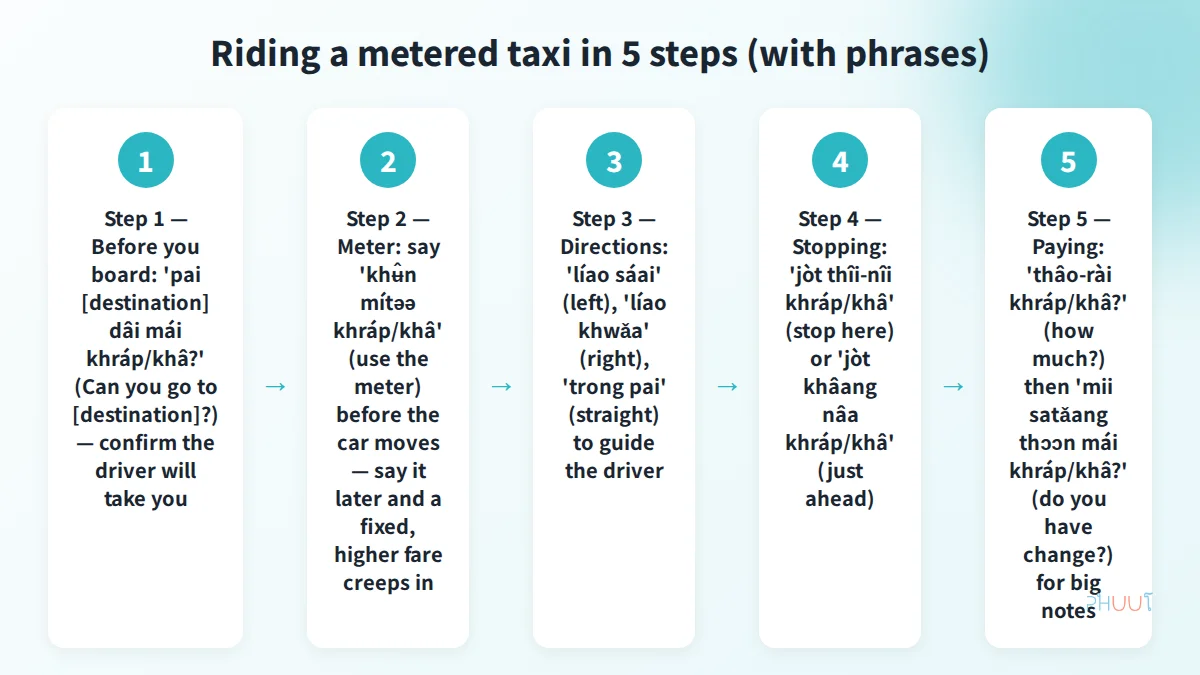
Here’s the differentiator most phrase lists miss: a real ride is a sequence, not a menu. You don’t need 12 phrases at once - you need the right one at each moment. So learn the ride as a flow that runs board → meter → directions → stop → pay, and tie each phrase to the second it fires.
Step 1 - Before you board.
ไป [destination] ได้ไหมครับ/คะ pai [destination] dâi mái khráp/khá (Can you go to [destination]?)
You can say the destination in English - most drivers catch the big landmark names. The Thai frame around it is what does the work: “pai” (go) plus “dâi mái” (can you?). Say it through the window before you open the door, so a driver who doesn’t want your route can wave you on before you’ve committed.
Step 2 - The meter (the critical one).
ขึ้นมิเตอร์ครับ/ค่ะ khʉ̂n mítəə khráp/khâ (Please use the meter.)
This is the single most important line in the article, and timing is everything. Say it before the car moves. Ask after you’ve started rolling and a negotiated, higher fixed fare quietly takes over - at that point you’re arguing, not requesting. Said up front, it’s just the normal way to start a ride.
The pronunciation note that matters here: “khʉ̂n” carries a falling tone - start the pitch high and let it drop. Flatten it and the request loses its shape inside a noisy cab, which is exactly when you need it to land. This is the small, concrete reason Thai tones change the word entirely even for a single beginner phrase.
Step 3 - Directions.
เลี้ยวซ้ายครับ/ค่ะ - líao sáai khráp/khâ - (Turn left) เลี้ยวขวาครับ/ค่ะ - líao khwǎa khráp/khâ - (Turn right) ตรงไปครับ/ค่ะ - trong pai khráp/khâ - (Go straight)
“líao” is turn, “sáai” is left, “khwǎa” is right, “trong pai” is straight on. Learn these one at a time - each has its own tone, so they don’t blur together - and notice they transfer well beyond the cab. You’ll use the same three words asking for walking directions or steering a tuk-tuk.
Step 4 - Stopping.
จอดที่นี่ครับ/ค่ะ - jòt thîi-nîi khráp/khâ - (Stop here) จอดข้างหน้าครับ/ค่ะ - jòt khâang nâa khráp/khâ - (Just ahead)
“jòt” is stop, “thîi-nîi” is here, “khâang nâa” is just ahead. Use the second one when “here” would leave you stranded across a busy road from where you actually want to be.
Step 5 - Paying.
เท่าไหร่ครับ/คะ - thâo-rài khráp/khá - (How much?) มีสตางค์ทอนไหมครับ/คะ - mii satǎang thɔɔn mái khráp/khá - (Got change?)
The meter shows the number, but saying “thâo-rài” while pointing at it is the natural close. One practical habit: if you’re paying with a large note, ask about change before you hand it over, not after. It saves the small standoff that happens when a driver suddenly “has no change.” If a spoken price ever throws you, how to count Thai numbers and baht walks through one to a thousand so you can catch the fare by ear instead of only reading the meter.
All 12 of these sit at the A1 Tourist level - the same beginner band Phuut starts every learner on. You’re not learning Thai; you’re learning a dozen lines for one repeated situation.
If you’d rather hear these out loud than read them off a page, you can rehearse the whole board-to-pay sequence in Phuut’s AI Talk and let the AI respond, so you know whether you were understood before a real driver hears it.
Telling the Driver Where You Mean - When the Map Pin Is Wrong
The map-pin problem deserves its own two-phrase kit, because it’s the most common Grab failure that isn’t really a “taxi problem” at all. It happens in three predictable patterns.
Inside a market. At Chatuchak or the train markets, the pin often lands on the outer ring road while your stall is deep inside. The driver stops where the app says and looks at you.
At a temple’s far gate. Wat Phra Kaew and the big temples have several entrances. The pin may sit at the back gate when you want the main one - a few hundred meters that feel much longer in the heat.
At a hotel’s side entrance. Large hotels sometimes pin to a service or back entrance instead of the lobby. You want the front; the driver only sees the dot.
Two phrases rescue all three:
ใกล้ [landmark] ครับ/ค่ะ - klâi [landmark] khráp/khâ - (It’s near [landmark]) ที่นี่ครับ/ค่ะ - thîi-nîi khráp/khâ - (It’s right here - said while showing the map on your phone)
“klâi” (near) takes a falling tone - let the pitch drop so “near” doesn’t drift into a different word. Pair it with a landmark the driver knows and you’ve converted a wrong pin into a clear destination. For more Thai for places and directions, the everyday-phrases guide goes deeper on near / here / over there.
When the Ride Goes Sideways - Meter, Change, and the Long Way Round
Friendly phrases are easy to find online. The dispute kit is what most English guides skip - and it’s the part you’ll be glad to have memorized when you need it. The golden rule across all three: stay calm. Thai social register rewards politeness, and a level tone gets you further than confrontation every time.
Trouble 1 - the driver skips the meter and pivots to a fixed price.
ขอขึ้นมิเตอร์ครับ/ค่ะ khǎaw khʉ̂n mítəə khráp/khâ (Please use the meter.)
The “khǎaw” up front is a soft “I’d like to ask” - it makes the request polite rather than combative. If the driver still refuses, don’t dig in. Get out and re-book Grab. Combine this with the plate-photo habit below and you’ve handled the two biggest metered-taxi risks before the wheels turn.
Trouble 2 - no change, or “I don’t have change.”
ขอทอนด้วยครับ/ค่ะ khǎaw thɔɔn dûai khráp/khâ (May I have the change, please.)
“thɔɔn” is change; “dûai” softens it to “as well, please.” Asking clearly and politely usually surfaces change that was there all along.
Trouble 3 - you suspect the long way round.
ไปทางลัดได้ไหมครับ/คะ pai thaang lát dâi mái khráp/khá (Can we take the shortcut?)
“thaang lát” is shortcut. Said calmly, this signals you’re watching the route without accusing anyone - which is exactly the tone that keeps a driver cooperative. It’s a nudge, not a fight.

Practice the Three Lines That Matter Before You Fly
Reading a phrase list builds recognition. Saying the right line the instant a driver “forgets” the meter takes production reflex - and those are different skills. You can recognize “khʉ̂n mítəə” on a page all day and still freeze at the curb. The fix is to practice out loud, not just to read.
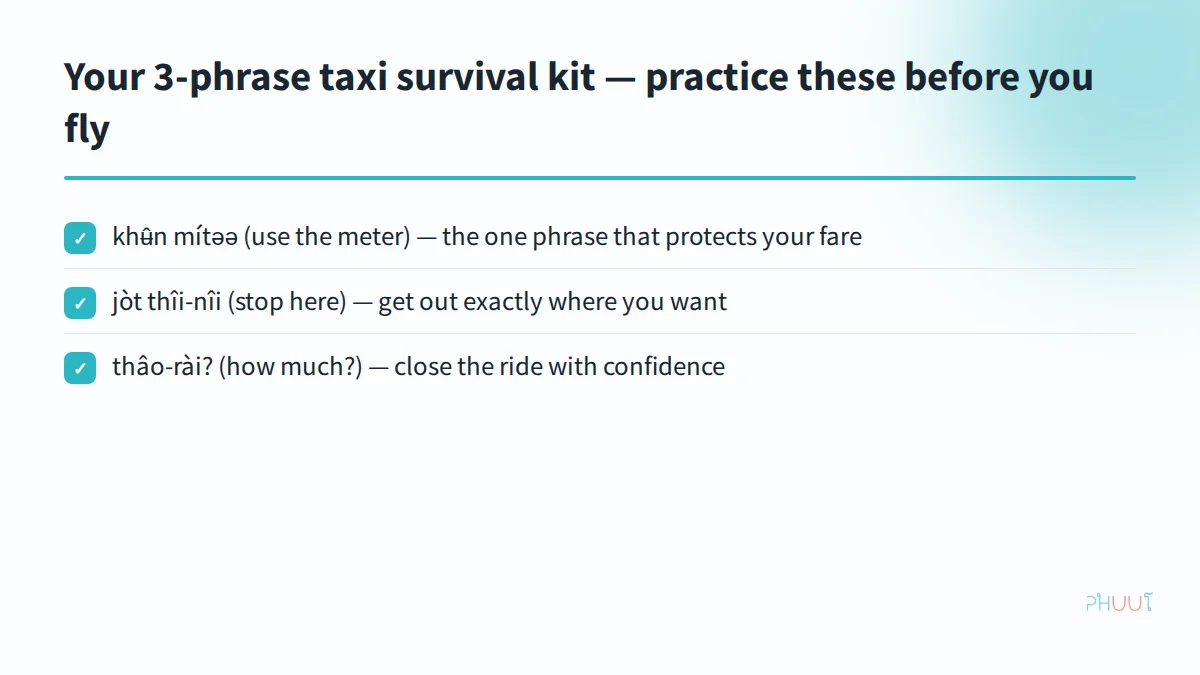
So narrow your job. Of the 12 phrases, three are non-negotiable:
khʉ̂n mítəə - use the meter - the one line that protects your fare jòt thîi-nîi - stop here - get out exactly where you want thâo-rài? - how much? - close the ride with confidence
Everything else is a bonus. Nail these three and you’ve covered the vast majority of metered rides.
A two-pass practice loop:
- Read the three lines aloud, three times each, matching your pitch to the tone marks - especially the falling “khʉ̂n” and the low “thâo.” Your mouth needs the shape before a driver demands it.
- Open Phuut’s AI Talk and run the ride out loud. Use the boarding line, then the meter and payment phrases, and let the AI respond so you hear whether you were understood. Phuut’s tone games are also handy for pre-training the two context-obvious words - “mítəə” and “thâo-rài” - until the pitch is automatic. (Phuut is iOS-only as of June 2026.)
One note on why we use Paiboon throughout instead of plain English spelling: plain spelling drops the tone, and tone is half the word. Learn “khʉ̂n” with its falling mark and the same habit carries straight over to hotels and street stalls - the tone you practice in the cab is the one you reuse everywhere else in Thailand.

Learn Thai that actually leaves your mouth
Free on iOS & Android
Memorizing phrase lists doesn't help when you freeze at a food stall. Phuut runs lessons through real scenes — ordering, taxis, shopping — so the words come out when you need them.
- Scene-based lessons: street food, shopping, taxis, sightseeing
- AI role-play so you stop sounding like a phrasebook
- Native audio + Paiboon transliteration locks pronunciation in
- 5-minute sessions — preview just the scene you need today
Thai Taxi Phrases - FAQ
Your Bangkok Taxi Kit, in One Glance
You don’t need fluency for any of this - you need a dozen lines for one repeated situation, with the tones that make them land.
| # | Phrase | Paiboon | Meaning |
|---|---|---|---|
| 1 | ไป [destination] ได้ไหมครับ/คะ | pai [destination] dâi mái khráp/khá | Can you go to [destination]? |
| 2 | ขึ้นมิเตอร์ครับ/ค่ะ | khʉ̂n mítəə khráp/khâ | Use the meter (the priority line) |
| 3 | เลี้ยวซ้ายครับ/ค่ะ | líao sáai khráp/khâ | Turn left |
| 4 | เลี้ยวขวาครับ/ค่ะ | líao khwǎa khráp/khâ | Turn right |
| 5 | ตรงไปครับ/ค่ะ | trong pai khráp/khâ | Go straight |
| 6 | จอดที่นี่ครับ/ค่ะ | jòt thîi-nîi khráp/khâ | Stop here (priority) |
| 7 | จอดข้างหน้าครับ/ค่ะ | jòt khâang nâa khráp/khâ | Just ahead |
| 8 | เท่าไหร่ครับ/คะ | thâo-rài khráp/khá | How much? (priority) |
| 9 | มีสตางค์ทอนไหมครับ/คะ | mii satǎang thɔɔn mái khráp/khá | Got change? |
| 10 | ใกล้ [landmark] ครับ/ค่ะ | klâi [landmark] khráp/khâ | It’s near [landmark] |
| 11 | ที่นี่ครับ/ค่ะ | thîi-nîi khráp/khâ | It’s right here |
| 12 | ขอขึ้นมิเตอร์ครับ/ค่ะ | khǎaw khʉ̂n mítəə khráp/khâ | Please use the meter |
If you learn only three, make them #2 (meter), #6 (stop here), and #8 (how much?). Got the cab sorted? The same traveler kit continues at check-in - Thai hotel phrases for your check-in is the natural next stop.
Phuut’s AI Talk lets you rehearse the ride out loud - board, meter, stop, pay - with a native-voice AI before you land, and all 12 lines sit in the A1 Tourist level you start on. It’s free on iOS.
Learn Thai that actually leaves your mouth
Free on iOS & Android
Memorizing phrase lists doesn't help when you freeze at a food stall. Phuut runs lessons through real scenes — ordering, taxis, shopping — so the words come out when you need them.
- Scene-based lessons: street food, shopping, taxis, sightseeing
- AI role-play so you stop sounding like a phrasebook
- Native audio + Paiboon transliteration locks pronunciation in
- 5-minute sessions — preview just the scene you need today
Learn Thai that actually leaves your mouth
Free on iOS & Android
Memorizing phrase lists doesn't help when you freeze at a food stall. Phuut runs lessons through real scenes — ordering, taxis, shopping — so the words come out when you need them.
- Scene-based lessons: street food, shopping, taxis, sightseeing
- AI role-play so you stop sounding like a phrasebook
- Native audio + Paiboon transliteration locks pronunciation in
- 5-minute sessions — preview just the scene you need today