
Thai Conversation for Summer Travel: 7-Day Beginner Plan (2026)
Affiliate disclosure: This article contains affiliate links. We may earn a small commission at no extra cost to you. As an Amazon Associate, we earn from qualifying purchases.

About the reviewer

Ramy Hirano
Phuut Founder
Founder of Phuut. Has observed how Japanese and English speakers stumble on Thai and built learning products around those patterns.
Follow Phuut on X →You land at Suvarnabhumi in July and step into a taxi. The driver quotes 800 baht for a 200-baht metered ride. You don’t know the six words that change this. This article is those six words - and 24 more, organized by the five situations every summer traveler faces, with a 7-day plan to take you from zero Thai to confident enough to use them. The approach is deliberate: five scenes, one per day Monday through Friday, AI conversation practice on Saturday, Boss Battle review on Sunday. No grammar theory. No phrase dumps. Just the right phrases for thai conversation for summer travel beginners, in the exact order you’ll need them.
In This Article
- The one thing every beginner needs before the phrases
- The 7-day plan - one scene per day, five capabilities before you fly
- Key scenes and phrases
- How Phuut’s A1 Tourist level covers all 5 scenes
The One Thing Every Beginner Needs Before the Phrases
Before you look at a single phrase table in this article, there are two syllables to learn: ครับ (khrâp) and ค่ะ (khâ). Men say khrâp. Women say khâ. You add either one to the end of almost any phrase - any greeting, any question, any thank-you - and the person you’re speaking to hears that you’re respectful and genuinely trying.
This is not a grammar point. This is a social technology.
Thai is a language where register does an enormous amount of work. The same greeting, the same question, the same request lands completely differently depending on whether a polite particle is attached. สวัสดีครับ (hello + khrâp) and สวัสดี (hello alone) are not the same utterance. At a hotel desk, the first signals a guest who is attempting cultural engagement. The second signals someone who learned a word from a travel list. The difference in response - warmth, patience, the willingness of a taxi driver to actually wait while you figure out your destination - is consistent and immediate.
You cannot overuse ครับ or ค่ะ. There is no point at which a Thai speaker will think you’ve added the particle too many times. Every phrase in every table in this article should end with one of them. That habit, built on Day 1, multiplies the value of every subsequent phrase you learn.
The tone on khrâp is mid - level pitch, not rising, not falling. A rising pitch on khrâp softens into khráp (a different register entirely, used in informal speech). For a beginner, level is the target: stable, unhurried, flat. Say it ten times before you move to any phrase table.
Recovery phrases belong in this first section, not at the end of an article as an afterthought. The reason is practical: your first real-world failure on a summer Thailand trip will almost certainly be a comprehension failure. You’ll say something that lands close but not quite right, or someone will respond to you faster than you expected, and you’ll freeze. The phrases that keep the conversation alive are more valuable than any vocabulary list - and they need to be automatic, which means learning them first.
If you want broader phrase coverage beyond the five travel scenes in this article, 40 conversational Thai phrases for beginners covers the full range of everyday interactions beyond the tourist context. For now, stay narrow: five scenes, one week, and the polite particle on everything.
The 7-Day Plan - One Scene Per Day, Five Capabilities Before You Fly
The problem with most “learn Thai before your trip” advice is that it either gives you a flat list of 80 phrases organized by topic (too much, wrong order) or tells you to “pick up some basics” (no structure at all). The plan below does neither. It gives you one scene per day, a specific phrase target for that day, a named action in Phuut, and a concrete capability you’ll have when the day is done. The daily time investment is 10-15 minutes.
Monday: Greetings. Learn สวัสดีครับ/ค่ะ (sawatdii khrâp/khâ), ขอบคุณครับ/ค่ะ (khàawp-khun, thank you), and ไม่เป็นไร (mâi pen rai, no worries). Learn ครับ/ค่ะ and attach it to everything from this point forward. Learn the three recovery phrases from the info box above. Run the greetings unit in Phuut and say each phrase aloud - not silently. By end of day, you can open any interaction warmly and recover when you’re misunderstood.
Tuesday: Taxi. Learn the destination sentence (ไปที่… khrâp/khâ), the meter phrase (เปิดมิเตอร์ด้วยครับ/ค่ะ), and the fare question (เท่าไหร่ครับ/ค่ะ). Run the Phuut transport lesson unit and say each phrase out loud with the tone contours noted in the H2-4 table. By end of day, you can get into a metered taxi in Bangkok, direct the driver, and avoid the most common flat-rate overcharge.
Wednesday: Food. Learn the เอา ordering pattern (เอา + [item] + ครับ/ค่ะ), the spice phrases, and อร่อยมากครับ/ค่ะ (very delicious). Drill the food unit in Phuut. By end of day, you can order at a Bangkok street food stall, adjust spice level, and compliment the cook - which is the article’s core thesis and Phuut’s own benchmark for completing A1 Tourist.
Thursday: Hotel. Learn the check-in phrase (จองห้องไว้ครับ/ค่ะ ชื่อ…), the generative ขอ request pattern, and the problem signal (มีปัญหาครับ/ค่ะ). Run the accommodation unit in Phuut. By end of day, you can check in, request items at any hour, and report a problem to night staff.
Friday: Shopping. Learn ราคาเท่าไหร่ครับ/ค่ะ (how much?), ลดได้ไหมครับ/ค่ะ (can you lower the price?), and numbers 1-10 (nùeng through sìp). Lock the numbers with Phuut’s game modes - they appear in every scene, and fluency with them is worth the extra 5 minutes. By end of day, you can ask prices, attempt a polite market discount, and confirm change.
Saturday: AI conversation practice. This is the day everything shifts. Days 1-5 built recognition - you’ve seen and heard 29 phrases. Day 6 builds production. Open Phuut AI Talk and run all five scenes as live dialogue, not reading. Start with the scene you’re most anxious about. Repeat exchanges until each opening line comes out without hesitation. The gap between “I know this phrase” and “this phrase comes out when I need it” is crossed on Day 6.
Sunday: Boss Battle review. Run Phuut’s Boss Battle to sweep the whole week in one session. If it’s difficult, that information is useful - it tells you which scene to re-drill on the plane. If you pass, you’re ready to fly. Either outcome is the right outcome.
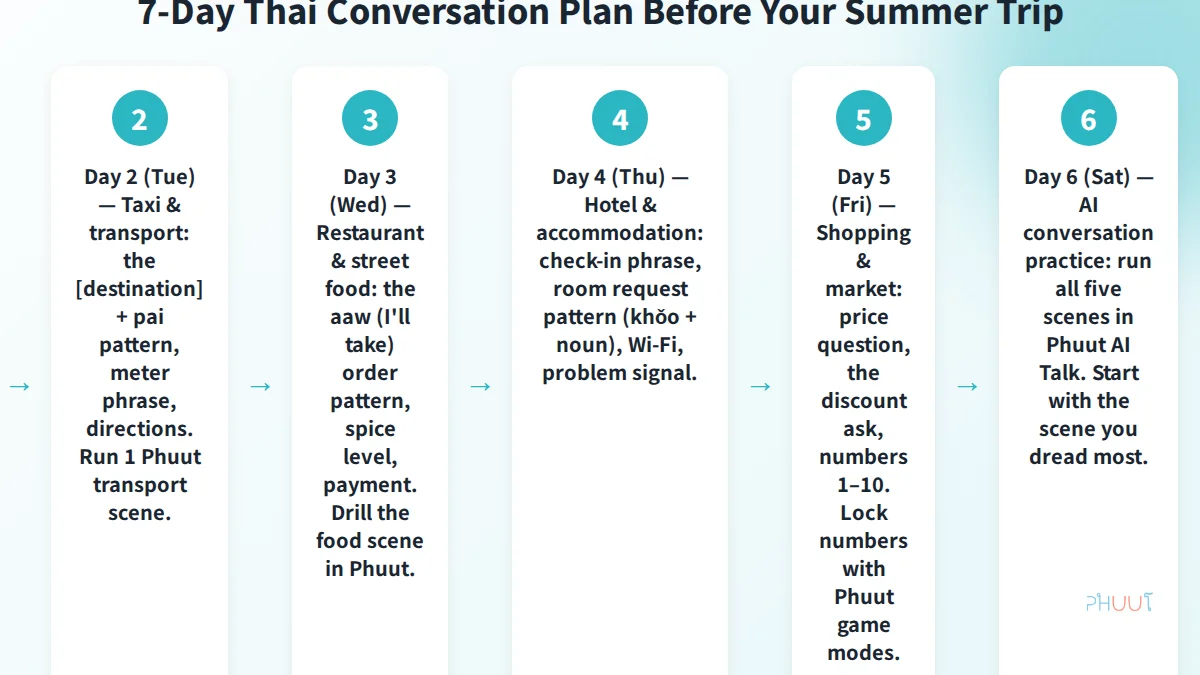
The table below shows what you’re buying with each day’s investment - not vocabulary items but actual capabilities:
Key Scenes and Phrases
Greetings and Polite Basics - Day 1
Three phrases plus the polite particle cover every greeting interaction on a summer Thailand trip. This is the smallest possible vocabulary investment for the highest social return.
The tone consequence you need to know for Day 1: สวัสดี (sawatdii, hello) ends in the syllable dii, which uses a mid tone - level pitch. If that syllable drifts high, it starts to approach a different sound entirely. Keep dii level and unhurried. The flat pitch is what makes the greeting recognizable as a greeting. For a deeper look at how Thai tones change word meaning, how Thai tones change word meaning entirely explains the full system.
The reason ไม่เข้าใจ (mâi khâo-jai, I don’t understand) and พูดช้าๆ (phûut cháa-cháa, speak slowly) appear in the greetings cluster rather than in a separate section is deliberate: your first real comprehension failure will happen during or immediately after a greeting exchange. Having the recovery phrase in the same cluster means it’s available by reflex at exactly the moment you need it.
| Thai | Paiboon | Tone contour | Meaning | When to use |
|---|---|---|---|---|
| สวัสดีครับ/ค่ะ | sà-wàt-dii khrâp/khâ | LOW-DROP-FLAT | Hello / goodbye | Every arrival, departure, and first interaction |
| ขอบคุณครับ/ค่ะ | khàawp-khun khrâp/khâ | DROP-FLAT | Thank you | After any helpful act |
| ไม่เป็นไร | mâi pen rai | DROP-FLAT-FLAT | No worries / you’re welcome | Gracious response to thanks |
| ไม่เข้าใจครับ/ค่ะ | mâi khâo-jai khrâp/khâ | DROP-DROP-FLAT | I don’t understand | When you need to flag a communication gap |
| พูดช้าๆ ได้ไหมครับ/ค่ะ | phûut cháa-cháa dâi mǎi khrâp/khâ | HIGH-FLAT-FLAT-DROP-RISE | Could you speak slowly? | Recovery phrase - use any time |
Note: The tone contour labels (LOW, DROP, FLAT, HIGH, RISE) are orientation markers for beginners, not authoritative phonetic transcription. Use Phuut’s native audio to calibrate your actual pronunciation.
Taxi and Transport - Day 2
The meter phrase alone pays for all 7 days of preparation. เปิดมิเตอร์ด้วยครับ/ค่ะ (pòoet mí-tôoe dûuay khrâp/khâ - turn on the meter, please) is the highest-financial-stakes phrase in this entire article. Street taxi flat-rate quotes from Suvarnabhumi in Bangkok routinely run 600-900 baht for metered rides that would cost 150-250 baht (based on commonly reported tourist fare comparisons). Saying the meter phrase before the car moves - not after - closes that gap immediately. For Bangkok street hails outside the airport, knowing this phrase saves 3-5x the actual metered fare on a typical city ride.
The same principle applies at Phuket International and Ko Samui airport transfers, where flat-rate structures are common. If you’re using Grab for most rides (which is a reasonable strategy for July-August travelers), you still need this phrase for the street hails you’ll inevitably take when Grab surge is high or pickup is inconvenient. Knowing it gives you the choice.
The tone consequence for Day 2: ไป (pai - go / to go) uses a mid tone - level pitch. This word appears in the destination sentence (ไปที่… - I’d like to go to…) and a rising pitch on pai turns it into a question particle. For the taxi destination sentence, keep pai level. The driver is listening for that word as the signal that you’re stating a destination, not asking a question.
| Thai | Paiboon | Tone contour | Meaning | Note |
|---|---|---|---|---|
| ไปที่…ครับ/ค่ะ | pai thîi… khrâp/khâ | FLAT-DROP-[dest] | I’d like to go to [place] | State destination or show map |
| เปิดมิเตอร์ด้วยครับ/ค่ะ | pòoet mí-tôoe dûuay khrâp/khâ | LOW-HIGH-FLAT-DROP | Turn on the meter please | Say before the car moves; saves 3-5x on city rides |
| ตรงไปครับ/ค่ะ | trong pai khrâp/khâ | FLAT-FLAT | Straight ahead | Direction during the ride |
| จอดตรงนี้ครับ/ค่ะ | jòot trong níi khrâp/khâ | LOW-FLAT-HIGH | Stop here please | Clear pull-over signal |
| เท่าไหร่ครับ/ค่ะ | thâo-rài khrâp/khâ | DROP-LOW | How much? | Confirm fare at destination |
| ขอบคุณครับ/ค่ะ | khàawp-khun khrâp/khâ | DROP-FLAT | Thank you | Close the ride positively |
Tone contour labels are orientation markers. Use Phuut’s native audio for accurate calibration.
For travelers who want the full taxi-specific phrase depth - including airport pickup, tuk-tuk negotiation, and songthaew hailing - 12 Thai taxi phrases for Bangkok and beyond covers every scenario.
Food and Street Stalls - Day 3
The เอา (aaw - I’ll take) pattern converts every street food interaction from a pointing exercise into an actual conversation. It is the most generative structure a beginner can learn: เอา + [item] + ครับ/ค่ะ generates every food order. You don’t need to know the Thai name of the dish - อันนี้ครับ/ค่ะ (an níi, this one) paired with a point works equally well. But once you have เอา as a reflex, you can fill in any food word you pick up over the course of the trip.
This is also the section that connects directly to the article’s core thesis. Phuut’s own benchmark for completing A1 Tourist is: “you can order at a street food stall in Bangkok.” After Day 3, you meet that benchmark. The rest of the 7-day plan builds on top of it.
When our team tested เอา อันนี้ครับ at a Chatuchak stall and got the tone wrong, the vendor smiled, shook his head gently, and pointed at the menu board. That was the moment it became clear that “kho duu menu noi” - may I see the menu a moment - actually works better than wrestling with a dish name you just learned. The vendor switched to pointing mode; we ended up with exactly what we wanted plus a small extra portion.
Summer-specific note: June through August brings 35°C heat across most of Thailand. ไม่เผ็ดครับ/ค่ะ (not spicy) is not just a preference phrase - it is a practical health phrase in that climate. The reverse, เผ็ดนิดหน่อย (a little spicy), gives you a middle option. And อร่อยมากครับ/ค่ะ (very delicious) after eating is one of the warmest social gestures available to a tourist. Every street food vendor responds to it.
The tone consequence for Day 3: เอา (aaw - I’ll take) uses a mid tone. If it rises, it approaches a different word. The ordering word must stay level. One flat syllable, repeated until it’s automatic, is Day 3’s actual goal.
| Thai | Paiboon | Tone contour | Meaning | Note |
|---|---|---|---|---|
| เอา…ครับ/ค่ะ | aaw… khrâp/khâ | FLAT | I’ll take [item] | Core ordering pattern - one word generates every food order |
| ไม่เผ็ดครับ/ค่ะ | mâi phèt khrâp/khâ | DROP-LOW | Not spicy | Critical in summer heat - say before ordering |
| เผ็ดนิดหน่อย | phèt nít-nòoi | LOW-DROP-LOW | A little spicy | Mild heat option |
| อันนี้ครับ/ค่ะ | an níi khrâp/khâ | FLAT-HIGH | This one | Point at the item when you don’t know the name |
| เท่าไหร่ครับ/ค่ะ | thâo-rài khrâp/khâ | DROP-LOW | How much? | Ask before or after eating |
| ขอน้ำเปล่าด้วยครับ/ค่ะ | khǒo nám plào dûuay khrâp/khâ | RISE-FLAT-LOW-DROP | Water too, please | Essential in Thai summer heat |
| อร่อยมากครับ/ค่ะ | a-ròoi mâak khrâp/khâ | FLAT-DROP-DROP | Very delicious | The compliment that makes every vendor smile - always use it |
Tone contour labels are orientation markers. Use Phuut’s native audio for accurate calibration.

Want to hear your pronunciation checked by a native Thai speaker before your flight? italki connects you with native tutors for 1-on-1 sessions from around $10-15. A single 30-minute session focused on greetings, food orders, and the taxi meter phrase is enough to arrive sounding like you practiced - not like you read a phrase list.
Hotel Phrases - Day 4
Five phrases cover every hotel arrival. But the structure underneath them is what makes Day 4 efficient: ขอ (khǒo - I’d like / may I have) + noun + ด้วยครับ/ค่ะ generates every in-stay request without memorizing a separate phrase for each one. ขอผ้าเช็ดตัวด้วยครับ (a towel please), ขอสบู่ด้วยครับ (soap please), ขอน้ำแข็งด้วยครับ (ice please) - same pattern, any noun, any hour. Learn the structure once and it scales.
Summer-specific context: June through August is monsoon shoulder season across much of Thailand. Some chain hotels run skeleton night staffs. Budget guesthouses on Ko Tao or Ko Pha Ngan may have a single night watchman who speaks minimal English. The hotel phrases in this section matter most after 10 pm - which is exactly when many travelers arrive after evening flights or long ferry crossings. Having the problem signal (มีปัญหาครับ/ค่ะ) and the request pattern ready for night staff interaction is not an edge case.
The tone consequence for Day 4: ขอ (khǒo - I’d like) uses a RISING tone - pitch starts low and moves up. If it stays flat, the request pattern loses its function. One rising syllable, and you can request anything in any Thai hotel. Say it ten times as a rising slide, not a flat start.
| Thai | Paiboon | Tone contour | Meaning | Note |
|---|---|---|---|---|
| จองห้องไว้ครับ/ค่ะ ชื่อ… | joong hông wái khrâp/khâ - chûue… | FLAT-DROP-HIGH | I have a reservation, name is… | State your name after chûue |
| ขอ…ด้วยครับ/ค่ะ | khǒo…dûuay khrâp/khâ | RISE-[noun]-DROP | May I have [item] please | Generative request pattern - fill in any noun |
| Wi-Fi รหัสอะไรครับ/ค่ะ | wai-fai rá-hàt à-rai khrâp/khâ | FLAT-FLAT / HIGH-LOW-FLAT-FLAT | What is the Wi-Fi password? | Staff will usually point to a card |
| มีปัญหาครับ/ค่ะ | mii pan-hǎa khrâp/khâ | FLAT-LOW-RISE | There is a problem | Add a descriptor: แอร์ (ae, AC), น้ำ (nám, water), ไฟ (fai, lights) |
| ขอบคุณมากครับ/ค่ะ | khàawp-khun mâak khrâp/khâ | DROP-FLAT-DROP | Thank you very much | Close every successful hotel interaction warmly |
| เข้าใจครับ/ค่ะ | khâo-jai khrâp/khâ | DROP-FLAT | I understand | Useful during the passport-copy interaction at check-in |
Tone contour labels are orientation markers. Use Phuut’s native audio for accurate calibration.
For travelers staying at island bungalows or budget guesthouses who want the full depth - check-in scripts, problem-reporting sequences, and checkout - the deep-dive hotel phrase guide with check-in, problem reporting, and checkout covers every scenario.
Market and Shopping Phrases - Day 5
Five phrases plus numbers 1-10 cover every shopping and market interaction. ลดได้ไหมครับ/ค่ะ (lót dâi mái khrâp/khâ - can you lower the price?) is the phrase that goes beyond transaction into cultural participation. A foreigner who smiles and attempts a polite discount request at a Chatuchak stall is not being rude - they are engaging with the market on its own terms. The smile is not optional.
Where bargaining is and is not appropriate: Open-air market stalls - Bangkok’s Chatuchak weekend market, Chiang Mai’s Sunday Walking Street, Ko Samui’s Fisherman’s Village Walking Street (Friday nights), Amphawa Floating Market on weekends - expect polite negotiation. 7-Elevens, department stores, and shopping malls do not. The rule is simple: if there’s a price tag on a fixed shelf, the price is fixed. If a vendor is quoting you a number they made up, the number is negotiable.
Numbers 1-10 are non-negotiable for prices, change, and quantities. They appear in every scene across the week, and the market is where they become essential. nùeng (1), sǒong (2), sǎam (3), sìi (4), hâa (5), hòk (6), jèt (7), bpàet (8), gâo (9), sìp (10). Use Phuut’s matching game and flashcard modes on Friday to lock them. Five minutes of number drilling saves meaningful confusion at every stall.
| Thai | Paiboon | Tone contour | Meaning | Note |
|---|---|---|---|---|
| ราคาเท่าไหร่ครับ/ค่ะ | raa-khaa thâo-rài khrâp/khâ | FLAT-FLAT-DROP-LOW | How much is it? | Clothing, crafts, open-air stalls |
| ลดได้ไหมครับ/ค่ะ | lót dâi mái khrâp/khâ | HIGH-DROP-RISE | Can you lower the price? | Open-air market stalls only; smile mandatory |
| แพงไปครับ/ค่ะ | phaeng pai khrâp/khâ | FLAT-FLAT | That’s too expensive | Polite counter-signal; use gently |
| ขอดูหน่อยได้ไหม | khǒo duu nòoi dâi mái | RISE-FLAT-LOW-DROP-RISE | May I look at it? | Before handling items |
| ขอบคุณครับ/ค่ะ | khàawp-khun khrâp/khâ | DROP-FLAT | Thank you | Whether you buy or not |
Tone contour labels are orientation markers. Use Phuut’s native audio for accurate calibration.
How Phuut’s A1 Tourist Level Covers All 5 Scenes
You’ve now seen 29 phrases across five scene tables: greetings, taxi, food, hotel, and shopping. Every one of them lives inside Phuut’s A1 Tourist level, which holds 594 words and phrases organized around exactly these travel contexts. The selection problem - “what should I actually study for a summer trip?” - is already solved before you open the app.
A1 Tourist is the first of four levels (A1 Tourist → A2 Explorer → B1 Resident → B2 Local). It is also the only level you need for a one-week prep window. Finishing it is Phuut’s own benchmark for being able to order at a street food stall in Bangkok - which is the core claim of the 7-day plan above.
Why 8 game modes matter for a 7-day sprint. Phuut uses 8 game modes: Multiple Choice, Listening, Pronunciation, Script, Typing, Matching, Flashcard, and Boss Battle. For a short prep window, this matters because different modes drill the same phrase from different angles without repetition fatigue. On Day 3, you hear the food-ordering phrase in Listening mode, then have to type it from memory, then match it under a timer in Matching. Recognition first - then production. By Day 6, the phrase comes out under conversational pressure without scanning a table, and Boss Battle tests everything at once under mild time pressure. Over seven days, each phrase gets reinforced through several of these modes - which is why the same 10-15 minutes per day produces meaningfully more durable retention than reading a phrase list the same number of times.
Day 6 explained more precisely. AI conversation practice in Phuut is not vocabulary drill. The difference between reading a phrase and having it come out when you need it is the difference between reading a recipe and actually cooking. Days 1-5 produce recognition - you can identify the phrases when you see or hear them. Day 6 produces reflex - the phrase comes out in response to a live exchange, under the mild social pressure of a simulated real interaction, without time to scan a table. That is the state you need when the taxi driver looks at you and waits. That is what Day 6 is for.
Day 7 as calibration, not just review. Boss Battle sweeps the entire week’s content in one session. If it’s hard, that information tells you which scene to re-drill on the plane - greetings tend to consolidate quickly; taxi and food phrases need more production practice for most beginners. If you pass, the week worked. Either outcome is useful.

Learn Thai that actually leaves your mouth
Free on iOS & Android
Memorizing phrase lists doesn't help when you freeze at a food stall. Phuut runs lessons through real scenes — ordering, taxis, shopping — so the words come out when you need them.
- Scene-based lessons: street food, shopping, taxis, sightseeing
- AI role-play so you stop sounding like a phrasebook
- Native audio + Paiboon transliteration locks pronunciation in
- 5-minute sessions — preview just the scene you need today
Practice these 5 scenes in Phuut’s AI Talk before your flight. Free on iOS.
Download Phuut on the App Store
Get the free Phuut Summer Travel Phrase Card - all 29 phrases from this article as a single mobile-ready card, with Thai script, Paiboon, and tone labels. Useful for offline reference on islands with limited data connectivity.
Keep reading:
- Thai Phrases for Summer Travel: Hotel, Taxi, Market & Beach - scene-by-scene depth on all four summer travel contexts
- Thai Hotel Phrases for Summer Travel: Check-In, Requests & Problems - the complete hotel phrase set for island bungalows and city stays
- Thai Language Tones: What Every Beginner Gets Wrong - pronunciation depth for beginners who want to understand the tone system behind the phrases
Learn Thai that actually leaves your mouth
Free on iOS & Android
Memorizing phrase lists doesn't help when you freeze at a food stall. Phuut runs lessons through real scenes — ordering, taxis, shopping — so the words come out when you need them.
- Scene-based lessons: street food, shopping, taxis, sightseeing
- AI role-play so you stop sounding like a phrasebook
- Native audio + Paiboon transliteration locks pronunciation in
- 5-minute sessions — preview just the scene you need today